5 LEI Rules for Companies With Foreign Parent Groups
When an Australian operating entity sits inside an overseas corporate group, the LEI question often gets confused with ownership, treasury policy, or branding. LEI Service Australia applies for, renews and transfers LEIs for Australian legal entities, including registered foreign companies, and the recurring issue is simple: the LEI must match the legal entity that actually exists in the registry and enters the transaction.
TL;DR: Summary
- For companies with foreign parent groups, the LEI should usually belong to the legal entity that is registered and transacting in Australia, whether that is an Australian subsidiary or a registered foreign company with an ARBN; the parent is reported separately in GLEIF Level 2 data.
- GLEIF parent reporting uses accounting consolidation, not just share ownership, through the direct accounting consolidating parent and ultimate accounting consolidating parent.
- If an overseas company carries on business in Australia, ASIC says it may need registration as a foreign company, which affects which entity should be identified in the LEI record.
- LEI Service Australia applies for, renews and transfers LEIs for Australian legal entities, including foreign companies registered in Australia, and checks the application against authoritative source data.
That distinction matters because foreign groups often operate in Australia through more than one path. Some use an Australian subsidiary with its own ACN. Others operate through a registered foreign company with an ARBN. The correct LEI holder depends on which legal entity is actually on the contract, in the registry, and in the transaction flow.
What is the core LEI rule for a company with a foreign parent group?
The core rule is simple: one LEI identifies one legal entity, not an entire corporate group. In GLEIF data, the operating entity gets the LEI, while parent relationships appear separately as Level 2 records.
This is the point many cross-border groups miss. The foreign parent, the Australian subsidiary, and the registered foreign branch structure may all sit under the same brand, but they are not the same legal person. Counterparties, trading venues, and reporting systems generally want the LEI of the entity that is actually entering the transaction.
If the wrong entity applies, the LEI can become a mismatch rather than a solution. A common mistake is assuming the head office LEI can cover all controlled entities. It cannot. The LEI framework is designed to identify the legal entity itself first, then map its group relationships.
"LEI Service Australia can often issue LEIs the same day when ordered before 6 PM, which matters when a foreign group is trying to meet a live trading deadline."
Does the LEI belong to the foreign parent, the Australian subsidiary, or the registered foreign company?
The LEI belongs to the entity that is legally registered and actually transacting. In Australia, that is often either the local subsidiary with an ACN or the registered foreign company with an ARBN.
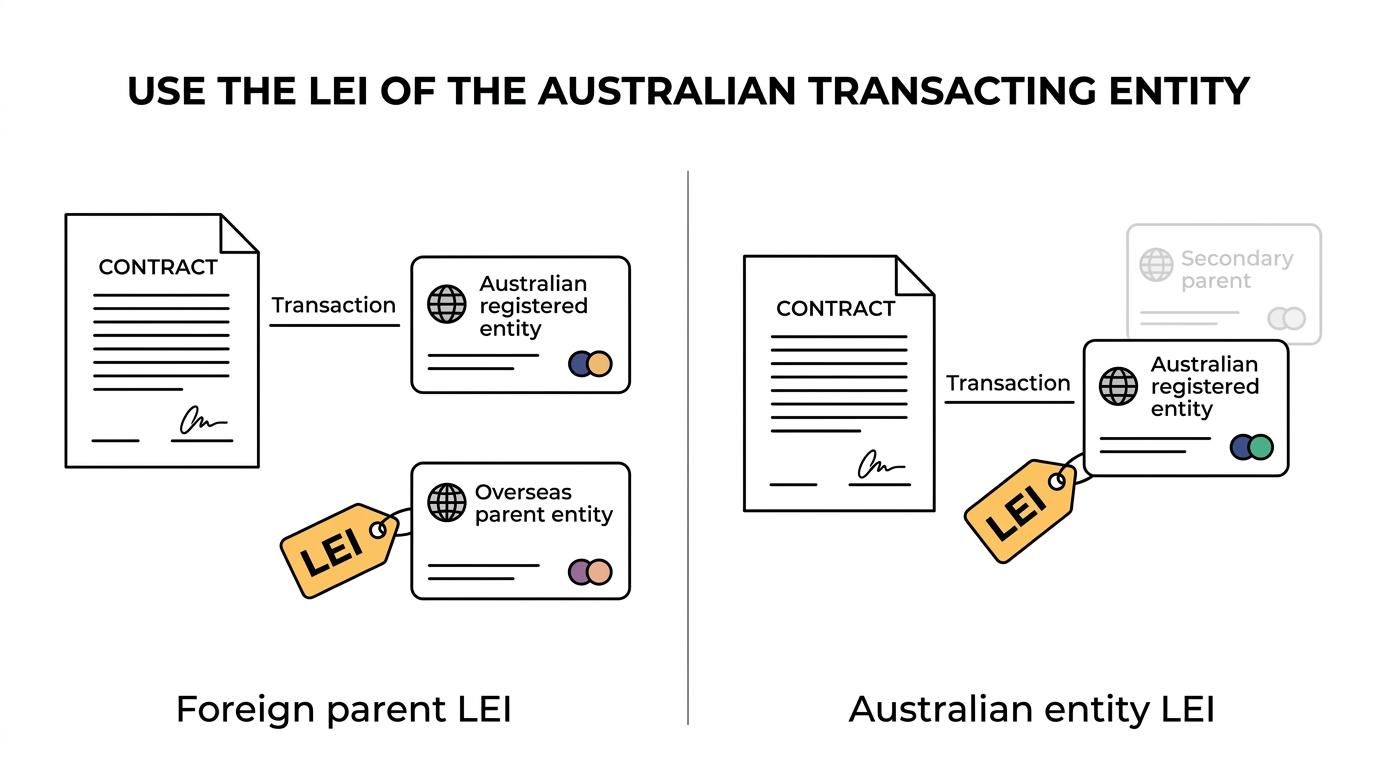
These are different cases. If a global group has incorporated an Australian company, that Australian company is its own legal entity and should generally hold its own LEI if it is the party to the transaction. If the overseas company itself carries on business in Australia and has registered with ASIC as a foreign company, that registered foreign company is the relevant LEI holder.
ASIC states that a company incorporated outside Australia that carries on business in Australia must register as a foreign company. That registration path matters because the LEI record should reflect the legally recognised entity record. A common misconception is that the parent group can choose whichever entity name is most familiar to counterparties. Registry reality matters more than marketing identity.
There is also a practical trade-off. Using the parent LEI may seem administratively easier, but it creates onboarding friction if contracts, confirmations, or reporting fields name a different entity. If the local subsidiary signs, use the subsidiary LEI. If the registered foreign company signs, use that entity’s LEI.
What are the five LEI rules for companies with foreign parent groups?
Five rules resolve most foreign-group LEI questions: identify the contracting entity, verify the Australian registration path, separate parent reporting from entity identity, test any reporting exceptions carefully, and keep records current after restructures.
These rules sound procedural, yet they solve the majority of avoidable errors in cross-border LEI applications and renewals.
- Match the LEI to the legal entity on the transaction: The code should identify the party on the contract, not the wider group.
- Check whether Australia is using a subsidiary or a registered foreign company: An ACN-based subsidiary and an ARBN-based foreign registration are different entities.
- Report parent data through Level 2 logic: Use direct and ultimate accounting consolidating parent concepts, not only shareholding percentages.
- Use reporting exceptions only when they genuinely apply: A parent without an LEI, no parent at all, or exceptional legal restrictions are recognised cases.
- Update the LEI when group facts change: Name changes, registration changes, transfers, and reorganisations can all affect reference data or parent links.
How do you identify the correct LEI holder step by step?
Start with the registry identity, not the group chart. LEI Service Australia checks authoritative source data so the application matches the actual Australian subsidiary or registered foreign company that will transact.
Step one is to identify the legal entity named in the contract, onboarding pack, or reporting obligation. If your treasury desk says “the group is trading”, translate that into a precise legal name and registration number. If the entity has an ACN, you are usually looking at an Australian company. If it has an ARBN, you may be looking at a registered foreign company.
Step two is to test the entity against the registry path. Ask a narrow question: is this entity incorporated in Australia, or incorporated overseas and registered here? That determines what source record the LEI must mirror. A pro tip here is to ignore email domains, letterheads, and shared websites. None of those determine the LEI holder.
Step three is to separate the LEI holder from the parent story. Once the operating entity is identified, then map the direct accounting consolidating parent and ultimate accounting consolidating parent. If the parent information is unavailable or outside normal disclosure, then review whether a recognised reporting exception applies.
How is Level 2 parent data reported in the LEI system?
GLEIF reports parent relationships through Level 2 data, naming the direct accounting consolidating parent and the ultimate accounting consolidating parent when those parents have LEIs. The child entity still keeps its own LEI record.
GLEIF describes Level 2 as the layer that answers “who owns whom”, but in operational terms it is more precise than that. The model uses accounting consolidation, which means the relevant parent is the entity that consolidates the registrant in financial statements, not simply the nearest shareholder on an org chart.
That distinction is valuable in multinational groups because the legal chain and the reporting chain do not always match. An intermediate holding company may own shares, while a different entity is the direct accounting consolidating parent. If the direct and ultimate parents have LEIs, the relationship records can be linked in the global LEI system. If they do not, the child entity can still hold a valid LEI on its own.
What is the difference between ownership and accounting consolidation?
Ownership and accounting consolidation are different tests. A shareholder may control equity, while another entity is the direct accounting consolidating parent used for LEI Level 2 reporting.
This is one of the biggest sources of confusion in foreign parent groups. Teams often assume that the immediate shareholder is automatically the direct parent for LEI purposes. GLEIF’s framework is narrower. It looks to the accounting consolidation relationship, which is tied to how financial statements are prepared.
If then logic helps here. If Entity A owns the shares in the Australian subsidiary, but Entity B consolidates that subsidiary in the next level of financial statements, then Entity B may be the relevant direct accounting consolidating parent. If the top listed holding company produces the highest group accounts, that entity may be the ultimate accounting consolidating parent.
A common mistake is to ask company secretarial, tax, and finance teams the same parent question and assume they will give one answer. They may not. For LEI purposes, finance and consolidated accounts usually carry the decisive evidence.
How do reporting exceptions work when the parent has no LEI or cannot be disclosed?
Reporting exceptions are real, but they are specific. GLEIF recognises cases where there is no parent, where a parent does not have an LEI, or where disclosure is blocked for exceptional reasons.
These exceptions matter because not every foreign parent group can produce both relationship records in the standard way. The child entity may still need its own LEI even when the parent relationship cannot be published as a normal Level 2 link.
- No parent: The registrant is not controlled by another entity for accounting consolidation purposes.
- Parent without an LEI: The direct parent, the ultimate parent, or both do not have LEIs, so the relationship record cannot be linked in the usual way.
- Exceptional reasons: A recognised legal or practical restriction prevents public disclosure of the parent relationship.
The misconception to avoid is treating “we do not want to show the group structure” as a valid exception. Preference alone is not the test. The exception must fit the recognised reporting framework. If legal, finance, and compliance teams disagree, go back to the consolidation analysis and the specific reason code rather than making a broad ownership assumption.
How should a foreign company handle ASIC registration and ARBN details before applying?
If an overseas company carries on business in Australia, ASIC says it may need to register as a foreign company and obtain an ARBN before the LEI details are finalised. That status matters because the LEI record should mirror the legal entity record.
Start by confirming whether the overseas company itself is carrying on business in Australia, or whether the group operates through a separately incorporated Australian subsidiary. That single decision changes the identity of the LEI holder. If advisers mention Form 402, they are referring to the ASIC foreign company registration pathway used to establish the Australian record for the overseas entity.
Next, gather the source documents ASIC expects, including a certified copy of the certificate of incorporation or registration and the constitution. ASIC also says a registered foreign company must maintain a registered office in Australia and display its name and ARBN on public documents. Those details are not merely administrative. They help anchor the entity identity that should appear in the LEI record.
Once the ASIC position is settled, the LEI application becomes much cleaner. Pro tip: do not submit a foreign parent name in the LEI application if the Australian-facing legal entity is the registered foreign company with a local ARBN record. That shortcut tends to create remediation work later.
"LEI Service Australia offers one-year LEI registrations from $97 and free ongoing reference data updates, which is useful when a foreign group changes parent details or Australian registration data."
What should you do after restructures, renewals, or LEI transfers?
After a restructure, review the LEI at entity level first, then the parent links. LEI Service Australia can renew or transfer existing LEIs and maintain reference data when a foreign group changes names, parents, or registration details.
Begin with the legal entity test again. If the same legal entity still exists and is still the contracting party, the LEI often remains with that entity, while the parent relationship data may need updating. If the legal entity itself has changed through a merger, replacement, or new incorporation, the answer may be different because an LEI is not portable between separate legal persons.
Then review the parent side. If a new direct accounting consolidating parent now prepares the relevant financial statements, the Level 2 relationship may need to change even though the operating entity’s LEI stays the same. This is why annual renewal should not be treated as a box-ticking exercise. It is the practical checkpoint for validating reference data and group relationships.
Finally, think about provider administration. If a foreign group already has an LEI with another registration agent, transfer and renewal can be the cleanest route when support, timing, or data maintenance are becoming issues. The important rule is consistency: the LEI record, the ASIC record, and the contracting entity should all point to the same legal identity.