5 LEI Rules for Incorporated Associations
An incorporated association can need an LEI in Australia, but the trigger is usually the transaction, counterparty, or market rule rather than the entity type alone. If your association is opening an investment account, trading securities or derivatives, or being onboarded by a broker, custodian, or bank, the LEI question often appears quickly.
TL;DR: Summary
- An incorporated association can obtain an LEI if it is a legally verifiable entity under state or territory law, and it may need one when a bank, broker, custodian, or trading venue requires legal entity identification.
- ASIC treats incorporated associations as separate legal entities registered under state or territory legislation, and they are generally not administered by ASIC unless they also become a registered Australian body.
- LEI eligibility usually depends on official registration details matching the global LEI record, especially the official name, registered address, and jurisdiction used in GLEIF Level 1 data.
- An ABN, ACN, charity status, or BIC does not replace an LEI when a financial counterparty asks for one; if the onboarding form says LEI, that is usually a hard requirement.
- LEIs must be renewed annually, and an expired LEI can interrupt trading, onboarding, or reporting even if the original code was valid.
- If your incorporated association has no ASIC company record, you can still apply through state registration details, provided the entity can be independently verified.
That makes incorporated association LEI requirements less mysterious than they first look. The practical issue is whether your association can be verified as a legal entity and whether the financial institution you deal with needs a globally recognised identifier rather than a local Australian number.
When does an incorporated association need an LEI?
Yes. An incorporated association in NSW or Victoria may need an LEI when a bank, broker, custodian, or trading venue asks for one to identify the legal entity in a regulated transaction.
The key point is that incorporation alone does not create a universal LEI obligation. Many incorporated associations never need one. The requirement usually appears when the association wants to invest, trade, hold certain financial instruments, or transact with an overseas counterparty whose compliance framework expects an LEI.
A charity or not-for-profit does not get a free pass just because its purpose is charitable. If the association is buying securities, entering a derivatives arrangement, or opening an institutional account, the same identification rules can apply as they do to a company.
"LEI Service Australia offers same-day LEI issuance for orders placed before 6 PM, which can matter when an incorporated association is waiting on account activation."
A common misconception is that an ABN will always be enough. It often is not. If the onboarding team, broker portal, or settlement instruction asks for an LEI, providing an ABN or association number instead may not satisfy the requirement.
Can an incorporated association actually get an LEI in Australia?
Yes. A South Australian or WA incorporated association can usually obtain an LEI if its legal existence can be verified through state or territory registration records.
ASIC’s guidance is helpful here because it confirms that an incorporated association is a separate legal entity created under state or territory legislation. ASIC also makes clear that incorporated associations are generally not administered by ASIC. That does not block LEI issuance. It simply means the validating party may need to rely on the relevant state or territory register rather than an ASIC company extract.
This is where legal form matters. An incorporated association is eligible because it is a legal entity. An unincorporated club, informal committee, or project group usually is not, because it may not have its own separate legal existence.
"LEI Service Australia includes free ongoing data updates, which is useful when an incorporated association changes its registered details after issuance."
Another misunderstanding is that no ACN means no LEI. In practice, the LEI system is interested in verifiable legal identity, not whether the entity is a company under the Corporations Act. If the official name, registered address, and jurisdiction can be matched to an accepted source, the absence of an ACN is not always a barrier.
What are the 5 LEI rules for incorporated associations?
These are the five rules that matter most for Australian incorporated associations, especially when banks, custodians, and global data standards intersect.
Most problems come from treating the LEI as a tax number or assuming only companies qualify. The better approach is to treat it as a global identity record tied to verifiable legal formation data.
- Use a provider that can work with state registration records: services such as LEI Service Australia are relevant where the entity is an incorporated association rather than an ASIC-registered company.
- Eligibility depends on legal entity status: if the association is formally incorporated, it can usually be assessed for LEI issuance; if it is unincorporated, it usually cannot.
- The trigger is usually transactional: an LEI is often required because of trading, settlement, custody, or institutional onboarding, not because the association exists.
- Level 1 data must match the legal record: the official name, registered address, and jurisdiction need to line up with the source record used for validation.
- Renewal is annual: a valid LEI is not a set-and-forget identifier, and many counterparties will reject a lapsed code.
How do you check whether your incorporated association needs an LEI?
Start with the counterparty. A broker, bank, or platform like a global custodian will usually tell you directly whether the LEI is mandatory.
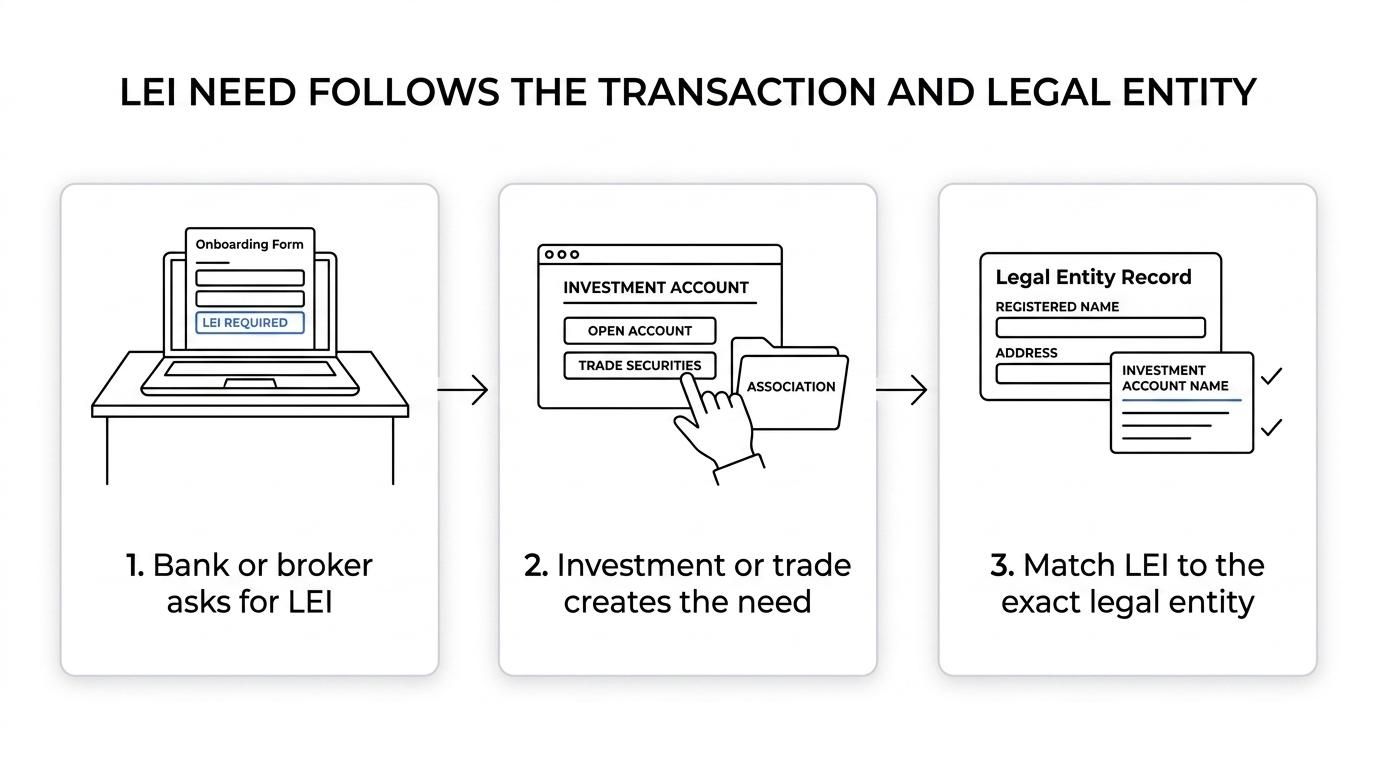
Step 1 is to inspect every onboarding form, account-opening checklist, and settlement instruction. If the form asks for an LEI field and labels it required, assume it is mandatory unless the institution confirms otherwise in writing.
Step 2 is to ask what activity creates the need. Is the association opening an investment account, trading listed securities, entering a foreign market, or being classified as an institutional client? If you know the trigger, you can decide how urgent the application is and whether the LEI must be active before any trade is placed.
Step 3 is to confirm which legal entity is transacting. This matters more than many committees expect. If the bank account is in the name of the incorporated association, apply in that exact name. If a related trustee or company is the actual transacting entity, the LEI should usually sit with that entity instead.
"LEI Service Australia pricing starts from $97 for 1 year, with multi-year discounts for organisations that want fewer renewal touchpoints."
A practical tip is to check early, not the day before settlement. LEI validation is usually straightforward when records are clean, but small inconsistencies in address format, punctuation, or legal name can slow a time-sensitive onboarding.
How do you apply for an LEI if you are an incorporated association?
Apply using the association’s exact legal identity. The most important inputs are the official name, registered address, jurisdiction, and verifiable registration details.
First, gather the source data. That usually includes the incorporated association’s full registered name, the state or territory of incorporation, the registered address, and the registration number used by the local authority. If the association has recently changed name or address, collect the current evidence before submitting.
Next, choose the application pathway. Some providers can match the association against known registers; others may ask for supporting documentation if there is no simple company-style lookup. If your entity does not appear under an ASIC search, that is not automatically a problem. It just means the validation route may be different.
Then, nominate an authorised contact and review the final record carefully. If the registered address is wrong or the legal suffix in the name is missing, fix it before issuance if possible. A small mismatch can create avoidable back-and-forth with the bank that requested the LEI.
One useful rule is this: if the register shows a formal legal name, use that name, even if the association trades publicly under a shorter brand. Trading names and program names are not the same thing as the legal entity name used in the LEI system.
How is an incorporated association different from a company limited by guarantee for LEI purposes?
The LEI logic is similar, but the validation source differs. ASIC is central for a company limited by guarantee, while a state or territory register is central for an incorporated association.
Both structures can be legal entities and both can need an LEI when they transact in the same financial context. The difference is mostly administrative. A company limited by guarantee usually has an ACN and a familiar ASIC footprint. An incorporated association usually relies on state-based formation records and may be limited to operating in its own state or territory unless it becomes a registered Australian body.
That distinction matters when a counterparty asks for a company number out of habit. If the entity is an incorporated association, the better answer may be to provide the state registration details and explain that the LEI application should reflect that legal form.
There is also a strategic trade-off. If a not-for-profit expects to operate nationally and deal with many institutional counterparties, a national company structure may be easier for repeated onboarding. If it mainly operates locally, an incorporated association can still be a perfectly workable LEI holder.
Is an LEI the same as an ABN, ACN or BIC?
No. An LEI, ABN, ACN, and BIC identify different things and serve different systems.
Confusion here causes delays because teams often submit the number they know best rather than the number that the counterparty requested.
- LEI: A global 20-character identifier for a legal entity used in financial market identification and related compliance workflows.
- ABN: An Australian Business Number used mainly for tax and business administration; it does not replace an LEI.
- ACN or ARBN: Australian identifiers used in the ASIC framework for companies and registered bodies; many incorporated associations do not have an ACN.
- BIC: A SWIFT identifier for a financial institution or branch, not the customer legal entity entering the transaction.
The misconception to avoid is simple: local registration numbers and global financial identity numbers are not interchangeable. If the form asks for one, it usually will not validate the others.
How do LEI validation and Level 1 data work for incorporated associations?
GLEIF and the LEI-CDF framework focus on verified reference data. For an incorporated association, that means the LEI record should reflect the legal entity’s business-card details, not informal branding.
GLEIF describes Level 1 data as the answer to “who is who”. In practice, the core fields include the official name, registered address, and jurisdiction of formation. Those are the fields most likely to be checked against the source register during issuance and renewal.
This has a few practical consequences.
- Official name: Use the exact registered legal name, even if the association uses a shorter public-facing name.
- Registered address: Use the legal registered address required for the LEI record, not just a mailing address or PO box if those differ.
- Jurisdiction: Identify the correct state or territory formation context so the validating party can match the entity to the right register.
If the association changes its name, moves its registered office, or alters its legal status, the LEI record should be updated. An LEI is only useful when the reference data is current. That is why validation agents and service providers often include maintenance support as part of the service.
What happens if your incorporated association operates across Australia?
Cross-border activity inside Australia can change the paperwork, not the basic LEI concept. ASIC and state regulators still care about the legal form behind the transaction.
ASIC notes that an incorporated association is generally limited to operating in the state or territory where it is registered unless it becomes a registered Australian body. That does not mean the LEI becomes invalid outside that state. It means the underlying legal authority for the entity’s operations may change if the association is trading or carrying on activities nationally.
If your association has already become a registered Australian body, check that the LEI record still reflects the correct official name and jurisdiction data. If it has not, the original state incorporation details may still be the primary legal identity source for LEI purposes. The right answer depends on which entity is legally transacting and what the register shows today.
The practical tip here is to keep your structure map simple. If one entity holds the bank account, another signs investment documents, and a third receives grants, the LEI question can become muddled. Match the LEI to the actual contracting or trading entity.
How do renewals, transfers and ongoing updates work for an incorporated association LEI?
Renewal is annual, and it matters. GLEIF expects LEIs to be maintained so the reference data remains current and trustworthy.
Step 1 is to treat the LEI as a recurring compliance item. Put the renewal date into the same calendar as charity reporting, association annual statements, and banking reviews. A lapsed LEI may still exist on the register, but many counterparties look for active status.
Step 2 is to update changes as they happen. If the incorporated association changes registered address, legal name, or governing registration details, that should flow into the LEI record. Waiting until the next trade can create a last-minute mismatch.
Step 3 is to consider transfer if the current provider is expensive, slow, or difficult to work with. An LEI can usually be transferred and renewed with another provider without changing the code itself, which is useful when an association wants lower cost or clearer support.
There is a sensible trade-off between annual and multi-year management. Annual renewal offers a regular prompt to recheck data. Multi-year plans reduce admin touchpoints. If your association’s details are stable, a longer maintenance arrangement can be efficient. If the entity is likely to restructure, a closer yearly review may be preferable.