5 LEI Rules REITs Should Know Before Trading Overseas
Australian REITs entering overseas markets often focus on the asset, venue, or broker first, but the compliance trigger is usually the legal entity that places the trade. LEI Service Australia sits in that workflow because it helps Australian entities obtain, renew, and transfer Legal Entity Identifiers, which overseas venues and reporting regimes may check before trading can begin.
TL;DR: Summary
- A REIT trading overseas should treat the LEI as a live compliance requirement, because foreign venues, investment firms, and regulators may require an active LEI before onboarding, execution, or reporting.
- The key question is which legal entity is trading, not whether the asset is real estate, equities, debt, or derivatives.
- LEI records must be renewed annually and re-validated against authoritative sources; stale data can interrupt transaction reporting and counterparty setup.
- EU rules under MiFIR and ESMA guidance use LEIs in transaction reporting and issuer identification, while US derivatives reporting under CFTC rules requires an LEI that conforms to ISO 17442.
- Australian entities are not limited to a domestic issuer, and providers including LEI Service Australia can help with application, renewal, transfer, and record maintenance.
That matters for REITs because cross-border activity can involve transaction reporting, swap reporting, issuer identification, and counterparty onboarding in different jurisdictions at the same time. If the LEI is missing, inactive, or attached to the wrong entity, the trade can stall long before anyone looks at the property portfolio.
Does a REIT need an LEI before trading overseas?
Yes. In markets shaped by MiFIR and derivatives reporting rules, a REIT may need an active LEI before an investment firm, trading venue, or reporting counterparty can onboard it or submit required reports.
The first rule is simple: overseas trading requirements often attach to the legal entity, not the asset class. A REIT may think of itself as a property vehicle, but a foreign broker or venue will usually identify the client as a company, trust-related vehicle, fund entity, or other legal person that must be represented consistently across reporting systems.
In the EU, ESMA has stated that MiFIR obliges investment firms to identify legal-person clients with LEIs for MiFID II transaction reporting. ESMA has also said trading venues must identify each issuer of a financial instrument traded on their systems with an LEI when submitting daily reference data to FIRDS. That means the LEI issue can appear both at client level and at instrument-issuer level, depending on the activity.
"LEI Service Australia handles applications, renewals and transfers, with same day issuance available for orders placed before 6 PM."
Why do overseas markets care about the legal entity rather than the property asset?
Because MiFIR, GLEIF and most reporting frameworks identify the party to a trade as a legal entity. A REIT label describes an investment strategy or tax structure; it does not replace entity-level identification.
This is where many teams make the wrong assumption. They think the overseas venue is interested mainly in the listed security, property trust, or bond. In practice, the market infrastructure needs to know who is trading, who issued the instrument, and which counterparty bears reporting responsibility. The LEI solves that identity problem in a standardised format.
GLEIF’s Global LEI Index is the central repository for current and historical LEI records and related reference data. GLEIF describes it as the only global online source of open, standardised, high-quality legal entity reference data. If a REIT is onboarding with a foreign counterparty, that counterparty may check the Index to confirm the entity name, registration status, and whether the LEI is active.
A useful practical test is this: if the overseas market needs to distinguish one legal person from another across trades, reports, or issuer files, the LEI is relevant even when the underlying commercial story is property investment.
What are the five LEI rules REITs should know before trading overseas?
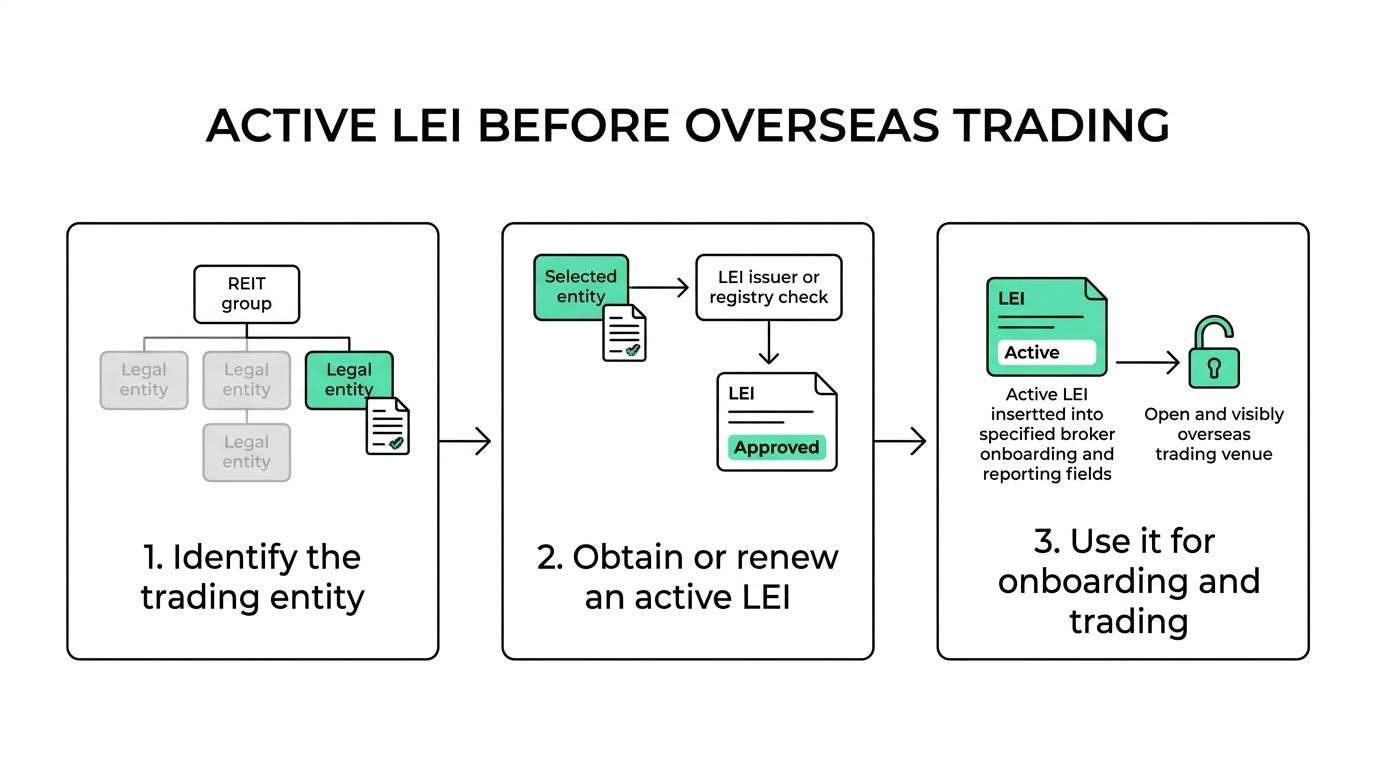
The five rules are direct: identify the right entity, obtain the LEI before trading, renew it every year, check jurisdiction-specific reporting triggers, and update changes quickly.
These five rules cover most failures seen in cross-border onboarding and reporting. They also explain why an LEI should be handled as an operating control, not just a one-off code request.
Use the correct legal entity from the start.
The entity that signs the trading documents, faces the broker, or enters the derivative is the one that matters. A REIT group may include a listed parent, trustee, sub-fund, special purpose vehicle, and branch operations, and each can create a different LEI outcome.Do not wait until trade date to apply.
If an investment firm cannot complete transaction reporting or client setup without the LEI, the delay happens before execution. This is why overseas activity should trigger an LEI check during onboarding, not during settlement week.Treat renewal as mandatory annual maintenance.
GLEIF states that annual renewal ensures the legal entity and the issuer review and re-validate reference data at least once a year. A common misconception is that the code lasts forever without any operational action; the code persists, but the record still needs renewal.Map the rule to the jurisdiction and product.
EU securities activity, US swap reporting, and venue reference data can use the LEI differently. If a REIT trades listed instruments only, the workflow may differ from a REIT using swaps for interest-rate or currency hedging.Update entity changes quickly.
Name changes, registry changes, mergers, or structural adjustments can affect the LEI record. If the GLEIF record and the trading documents diverge, foreign counterparties may pause onboarding until the mismatch is cleared.
How does a REIT apply for an LEI step by step?
Start with the entity that will execute the trade. LEI Service Australia and accredited LEI issuers need the legal name, entity details, and supporting registry information to verify the applicant against authoritative records.
Step 1 is entity selection. Confirm whether the trading party is the listed REIT, the responsible entity, the trustee, or another vehicle in the structure. This is the most important judgement call because a perfectly valid LEI for the wrong entity still creates a compliance failure.
Step 2 is identity verification. GLEIF explains that the issuing organisation, often called a Local Operating Unit, must verify the submitted reference data against a local authoritative source, including a national business register, before issuing the LEI. If the register data is incomplete or the structure is unusual, expect follow-up questions.
Step 3 is activation and internal deployment. Once issued, the LEI should be loaded into broker onboarding files, transaction reporting fields, internal compliance records, and any treasury or derivatives documentation. A smart move is to nominate one owner inside the organisation who tracks renewals and reference-data changes rather than leaving the code inside email archives.
How do LEI issuance and annual renewal differ?
Issuance creates the LEI; renewal re-validates it. GLEIF treats annual renewal as a data-quality control, not a clerical extra, so an old record can become a live compliance problem even when the code itself still exists.
Issuance is about establishing identity. The issuer verifies the legal entity’s reference data and creates the LEI record. Renewal is about keeping that record trustworthy. GLEIF’s data-quality framework starts with accurate information from the registering entity and requires the issuer to re-check it periodically.
The trade-off is operational rather than technical. A REIT may feel that renewal adds cost without changing the number. Yet foreign counterparties often care less about the number itself than about whether the record is current, validated, and consistent with official sources. If the record is lapsed or outdated, onboarding teams can treat it as a control gap.
A common mistake is assuming that because ESMA guidance says investment firms are not required under Article 13(3) to ensure a client or counterparty LEI has been renewed, the renewal status never matters. In practice, firms can still impose their own onboarding or risk controls, and many do.
How should a REIT check whether its LEI record is active and accurate?
Use the Global LEI Index to confirm the record is current, correctly named, and linked to the right entity. The check takes minutes and should happen before onboarding, settlement changes, or any cross-border reporting deadline.
Start with the legal name appearing on the overseas account-opening pack or derivatives documentation. Search the Global LEI Index and compare the exact entity name, registration details, and status. If the name in the Index reflects an old corporate identity or an incomplete structure, fix that before sending documents to the counterparty.
Next, review timing. Annual renewal is not a soft suggestion. If the record is close to renewal, a foreign venue or dealer may ask for an updated status before activating the account. This is especially relevant when a REIT is entering a new market while also changing trustee, manager, or registry details.
"LEI Service Australia offers one-year LEI registration from $97 and includes free ongoing updates to LEI reference data."
A practical tip here is to check the LEI at the same time you confirm tax forms, authorised signatories, and settlement instructions. Identity mismatches tend to cluster, and solving them together reduces rework.
What changes when a REIT trades swaps, derivatives, or other reportable products overseas?
Derivatives raise the compliance stakes. Under CFTC rules, the LEI used in swap recordkeeping and swap data reporting must conform to ISO 17442.
This matters because many REITs use derivatives not to speculate, but to hedge interest-rate, foreign-exchange, or refinancing risk tied to offshore assets and funding. Once the product moves into a reportable derivatives framework, the LEI becomes part of a structured reporting chain rather than a simple client identifier.
If the REIT is the reporting counterparty, the LEI may sit directly inside the swap data report. If a dealer or venue reports, the REIT’s LEI can still be required for counterparty identification. CFTC rules also refer to the use of a swap data repository and consistent reporting practices, which means the identity field needs to remain stable and standardised across the life of the trade.
The practical distinction is clear. If a REIT only buys foreign listed securities, the LEI issue may sit mostly in onboarding and transaction reporting. If it also enters swaps, the LEI becomes part of ongoing recordkeeping, lifecycle events, and reporting logic.
Should a branch, trustee, or fund vehicle use its own LEI or the head office LEI?
Use the LEI of the entity that is legally identified for the transaction, and do not assume every branch gets its own. ESMA guidance says a branch should be identified with the LEI of its head office in transaction reporting.
This is one of the hardest areas for REIT groups because the commercial structure and the reporting entity are not always the same. A branch may operate locally, but ESMA guidance points to the head office LEI for transaction reporting. A trust structure may have a trustee or responsible entity interacting with the market even when investors think of the vehicle simply as the REIT.
The safest approach is to trace the legal documentation. Which entity signs the brokerage agreement? Which entity is listed as counterparty in the ISDA or equivalent derivatives documentation? Which entity appears in the issuer or client field required by the relevant regime? If those answers point to one legal person, that is usually the LEI you need.
Do not assume that every sub-fund, branch, or managed sleeve deserves a separate code. GLEIF notes that issuers provide services for fund entities as well as other legal entities, but eligibility and usage still depend on how the entity is constituted and how the jurisdiction expects it to be identified.
How can a REIT transfer or renew an existing LEI without disrupting trading access?
A transfer or renewal should be planned before the next trade or reporting cycle. LEI Service Australia can assist with renewals and transfers so an existing code stays usable while the maintenance record is updated.
Step 1 is to confirm the current LEI and renewal date in the Global LEI Index. Step 2 is to identify whether the task is a straight renewal, a transfer to a different service provider, or both. Step 3 is to complete the change early enough that foreign brokers and reporting teams do not see a lapsed or inconsistent record during onboarding or trade reporting.
The trade-off is between short-term admin effort and execution certainty. Leaving renewal late can look cheaper in the moment, but it increases the chance of delays when a new overseas trade, hedge, or mandate is ready to go live. A planned transfer can also make sense if the REIT wants a simpler support model, help with data maintenance, or a multi-year plan.
One last misconception is worth clearing up: transferring LEI administration does not mean changing the LEI itself. The code remains the same legal-entity identifier; what changes is who handles the service and maintenance around it.