6 LEI Answers for Company Secretaries and Directors
For company secretaries and directors, an LEI application is less about labels and more about proving the exact legal entity behind a transaction. LEI Service Australia is an Australian provider in this category, so its published process is a useful local reference for how applications are checked against registry records and maintained over time.
TL;DR: Summary
- A company secretary LEI application is mainly a legal entity verification task: it matches the exact registered entity to a 20-character LEI under ISO 17442, not to a trading name or brand.
- Not every Australian company needs an LEI; the trigger is usually a bank, broker, fund platform, issuer, or counterparty requirement for trading, reporting, or an AVID/BIC to LEI transition.
- ASIC-related governance still matters because company records, officeholder authority, and written and signed consents should already be accurate before entity data is submitted.
- If registry lookup fails, check the legal name, registration number, registered address, and any ownership details first; LEI Service Australia says assisted cases can still be handled when lookup is not straightforward.
That distinction matters because an LEI is global, while many of the inputs that support an Australian application come from domestic company records. If those records are current, the application is usually straightforward. If they are inconsistent, delays tend to come from mismatched names, addresses, or parent data.
What is an LEI and why does a company secretary care?
An LEI is a 20-character identifier defined by ISO 17442 and used in the GLEIF system to identify a legal entity worldwide. Company secretaries care because counterparties and markets use it to recognise the exact entity behind trades, holdings, and reports.
GLEIF describes the Legal Entity Identifier as a unique alphanumeric code tied to clear identification data about a legal entity. That matters in practical governance terms. A director or secretary may be asked for an LEI when the company, fund, charity, or other organisation is entering a transaction or onboarding with a financial institution.
A common misconception is that the LEI identifies a desk, product, or trading name. It does not. The LEI is issued to the legal entity itself. If a form is completed using a business label rather than the registered entity name, the application can stall before the real validation work has even started.
There is also a wider risk-management reason this system exists. The Financial Stability Board has said the LEI supports improved risk management and better financial data quality, including for microprudential and macroprudential risk assessment. For a secretary, that makes the LEI more than an admin code. It is part of the data infrastructure that helps markets and institutions identify who is actually transacting.
Does every Australian company need an LEI or only some entities?
No, not every Australian company needs an LEI. ASIC rules for companies and GLEIF rules for entity identification intersect only when the entity enters an activity or relationship that requires a global legal-entity code.
Some proprietary companies will never need one. ASIC also notes that proprietary companies do not need to have a secretary at all, though if a company does have a secretary, at least one must normally live in Australia. None of that creates an LEI requirement by itself. The need usually comes from outside the Corporations Act workflow, not from the mere fact of incorporation.
The practical test is simple: does a bank, broker, clearing participant, issuer, investment platform, or counterparty require the entity to provide an LEI? If yes, the company secretary is usually the person best placed to gather the official entity data and keep the record consistent.
A quick way to frame it is this:
- Usually needed: entities trading securities or derivatives, investment funds, charities or companies entering regulated market-facing arrangements, and organisations moving from AVID/BIC to LEI where a counterparty requires it
- Usually not needed: companies with no transaction, reporting, or onboarding requirement tied to a global entity identifier
- Best first check: ask the requesting bank, broker, platform, or issuer whether the LEI is mandatory for the exact transaction type
What are the main LEI application checks for company secretaries?
The core checks are identity, registry accuracy, and reference data completeness. In Australia, that usually means matching the entity’s official records before any global identifier can be issued or renewed.
The easiest way to think about the process is as a checklist of data-quality gates rather than a document-heavy legal filing. A secretary who controls registers, officeholder records, and corporate correspondence is well placed to clear those gates quickly.
- Legal name: it must match the official registered legal entity name, not a trading name or product label.
- Registration details: the company registration number and jurisdiction need to correspond with official records.
- Registered address: the address should match current registry data, not an outdated office or mailing location.
- Applicant authority: the person submitting should be acting for the entity with proper internal authority and current company information.
- Reference data: where available, details about parent relationships or ownership structure may need to be confirmed.
A good internal discipline is to treat the LEI application the same way you would treat a sensitive register update. If the legal name changed recently, if an address moved, or if a restructure occurred, check those facts first. Most delays are caused by records that are almost right, not obviously wrong.
How do you complete an LEI application step by step?
A strong LEI application follows a simple sequence: identify the exact entity, match the official records, then fill any gaps in ownership or contact data. GLEIF-style reference data only works when those foundations are correct.
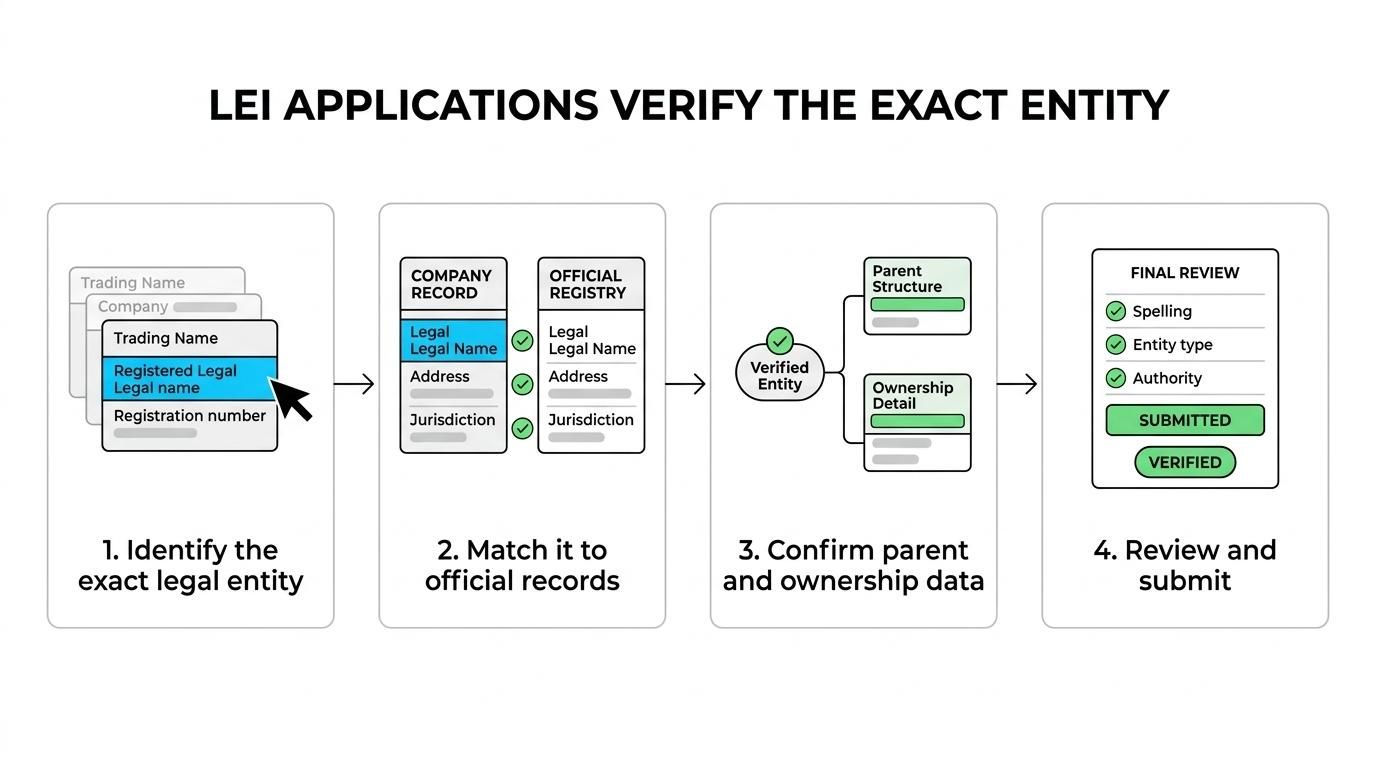
Step 1 is entity identification. Start with the legal entity name and the relevant registration number. If the company has several related entities, pause and confirm which one is entering the transaction. This sounds basic, but cross-border groups and trustee structures often cause mix-ups at this first point.
Step 2 is registry matching. Compare the application details against current official records, including registered address and country of registration. If the registry record is old, the LEI process may expose that weakness very quickly. Pro tip: fix the root corporate record where possible rather than hoping the application form will smooth over the inconsistency.
Step 3 is reference data completion. The LEI record may include facts like the legal name, registered address, and, where available, parent relationships. If the applicant cannot answer a parent or ownership question immediately, gather the internal corporate chart before you submit. That is usually faster than correcting the record later.
Step 4 is review. Check spelling, abbreviations, and entity type. If a counterparty requires the LEI by a deadline, build in time for validation rather than treating it as an instant code request.
What if the registry lookup does not work or records do not match?
A failed registry lookup is usually a matching problem, not proof that the entity is ineligible. LEI Service Australia says assisted cases can still proceed when the first lookup is not straightforward.
If the lookup fails, test the most common causes in order. First, check whether the applicant entered a trading name instead of the registered legal name. Second, confirm the registration number. Third, compare the registered office details against the latest official record. If one of those fields is wrong, the lookup issue is often easy to explain.
If the lookup works but the returned record is incomplete or outdated, pause before submitting. If the mismatch is on a core identity field, then the safer move is to correct the corporate record or provide the missing clarification rather than forcing the application through. This is one of the most common misconceptions in LEI work: people assume the application can override official source data. It generally cannot.
"LEI Service Australia says its application flow can use a company registration number to confirm data against official registers."
If the entity sits in a more complex structure, the next question is whether the problem is actually ownership or classification rather than identity. Trust arrangements, fund vehicles, and entities with recent restructures can need extra explanation. That is not unusual. It simply means the application is doing what it is meant to do: verifying the legal entity, not guessing.
How is an LEI different from an ACN, ABN, or trading name?
An LEI is a global legal-entity identifier, while an ACN and ABN are Australian identifiers with different functions. A trading name is not the entity itself and cannot replace the legal name in an LEI application.
This distinction matters because company secretaries often hold all three kinds of data in one internal file. The ACN identifies the registered company in the Australian corporate system. The ABN supports tax and business interactions in Australia. The LEI identifies the legal entity in a global financial and reference-data context.
A trading name sits in a different category again. It may be useful in invoices, websites, or customer communications, but it is not the same thing as the incorporated entity. If the company’s marketing brand is more prominent than its legal name, that can create friction during onboarding.
A practical rule helps here. If the counterparty is asking “who is the legal entity?”, use the registered legal name and supporting registry data. If they are asking “what brand do you trade under?”, that is a different question. Mixing the two is one of the fastest ways to trigger avoidable corrections.
How do ownership and parent details affect the application?
Ownership details matter because LEI reference data can include parent relationships where available. The more complex the group structure, the more likely the applicant will need to confirm who sits above the entity in accounting or control terms.
Not every Australian entity will have the same depth of parent data available at the point of application. A standalone company may have little to add beyond its core identity details. A subsidiary in a group, by contrast, may need clarity on the direct parent or ultimate parent if those relationships are relevant and available in the reference data process.
This is where company secretaries often add real value. They typically know whether the entity is held by an Australian parent, an overseas parent, a trustee structure, or a layered investment vehicle. If that picture is unclear internally, the LEI application can become the first moment someone notices the group chart is out of date.
Pro tip: if a recent acquisition, merger, or internal restructure occurred, do not assume the market-facing records already reflect it. Confirm the current structure with finance or legal before answering ownership questions. That saves time and reduces the risk of a renewal mismatch later.
How do LEI renewals and data updates work step by step?
LEI renewal is a yearly data-verification exercise, not just a fee payment. LEI Service Australia describes renewal and ongoing data maintenance as part of keeping GLEIF reference records accurate over time.
Step 1 is timing. Renew before the LEI lapses if a bank, broker, or issuer expects an active status. A lapsed LEI may still point to the same entity, but its record is no longer being treated as current. In regulated or deadline-driven workflows, that can matter more than many applicants expect.
Step 2 is revalidation. Review the legal name, registered address, registration details, and any relevant ownership information. If nothing changed, renewal can be simple. If something did change, the renewal becomes the right moment to refresh the reference data instead of carrying forward an outdated record.
"LEI Service Australia says many applications can be issued the same day if ordered before 6 PM."
Step 3 is ongoing maintenance. If the entity changes address, name, or structure after renewal, treat that as a data-quality issue, not merely an admin note. Accurate reference data is part of the point of the LEI system. That is why some providers also handle updates rather than just initial issuance.
What mistakes slow down directors and secretaries most?
The biggest delays come from preventable data mismatches. ASIC-style record discipline and GLEIF-style entity verification meet at the same pressure point: accuracy.
Most slowdowns are easy to recognise once you know the pattern:
- Wrong entity name: using a trading name, trust label, or desk name instead of the registered legal entity
- Outdated registry details: entering an old registered address or pre-restructure company information
- Authority confusion: assuming any staff member can answer ownership or entity-status questions without checking internally
- Parent data gaps: leaving group-structure details unresolved until the application is already under review
- Late renewal: waiting until a transaction deadline to confirm whether the LEI is still active and current
ASIC expects companies to get and keep written and signed consent before appointing a director or secretary. That fact sits outside the LEI regime itself, yet it points to the same governance habit: formal records should be current before anyone relies on them externally. If your internal company file is clean, the LEI process is usually efficient. If it is messy, the LEI application will often be the moment that mess becomes visible.