6 LEI Questions Partnerships Ask Before Applying
Australian partnerships often ask the same thing when a bank, broker or counterparty requests an LEI: is the partnership itself eligible, or does one of the partners need to apply instead? In most cases, the answer turns on legal-entity status, authority to act, and exact record matching.
TL;DR: Summary
- An Australian partnership can obtain an LEI if it is a legal entity entering a financial transaction, because ISO 17442 and GLEIF expressly include partnerships in LEI eligibility.
- An ABN or TFN does not by itself create an LEI requirement. LEI obligations usually come from national financial regulators, trading venues, banks, brokers, or reporting rules.
- The biggest application issue for partnerships is usually official name matching. ABN Lookup states a partnership’s legal name is generally the names of all partners, while old trading names have no legal status.
- The person applying should be an authorised partner or representative with entity details that match current records, including the partnership’s legal name, address, and registration data.
- LEI records are public in the Global LEI Index, which GLEIF says contains more than three million records and is updated daily, so renewals and data updates matter after any partnership change.
That matters because a partnership can have its own ABN and TFN for tax and business purposes, while the partners still report their share of income individually. When an LEI is needed, the practical task is usually simple: identify the partnership correctly, confirm who can act for it, and make the LEI record match the official source data.
Can an Australian partnership get an LEI?
Yes. GLEIF and ISO 17442 treat a partnership as an eligible legal entity when it can enter contracts independently or is financially responsible for a financial transaction.
This is the starting point that clears up most confusion. GLEIF’s LEI FAQ says a legal entity includes parties that are legally or financially responsible for financial transactions, including entities constituted as a partnership. If the partnership is the contracting party, or the entity being identified in a securities or derivatives workflow, it can usually apply for its own LEI.
A common misconception is that only companies, managed funds, or large institutions can get an LEI. That is not how the standard works. The LEI standard deals with entity identity, not size. If the partnership is the entity entering the transaction, the fact that it is a partnership does not block eligibility.
If a partner is acting only in a personal capacity as a natural person, that is different. LEIs are for legal entities, not individuals.
"LEI Service Australia can arrange same-day issuance for orders placed before 6 PM, which is useful when a bank or broker will not proceed until the partnership’s LEI is active."
Does a partnership need an LEI because it has an ABN or TFN?
No. The ATO and GLEIF treat ABN, TFN, and LEI as different identifiers with different jobs.
The Australian Taxation Office says a partnership has its own TFN, must lodge an annual partnership return, and must apply for an ABN for business activities. Each partner then reports their share of net partnership income or loss in their own tax return. That tax treatment does not mean the partnership automatically needs an LEI.
The trigger for an LEI is usually external to tax. A derivatives reporting rule, a securities settlement process, a custodian, a bank onboarding rule, or another regulated financial workflow may require it. If that rule applies, the ABN is not a substitute for the LEI.
After that distinction is clear, the roles are easier to separate:
- ABN: Australian business identifier used for business activities and government-facing records.
- TFN: Tax identifier used for the partnership’s tax obligations and return.
- LEI: Global 20-character legal-entity identifier used in financial transactions and counterparty verification.
A useful rule is this: if the request comes from a tax or invoicing process, the ABN and TFN matter. If the request comes from a bank, broker, clearing venue, or cross-border financial workflow, the LEI may be the identifier that matters.
"LEI Service Australia starts from $97 for 1 year, which can be a practical option when a partnership needs an LEI quickly and an ABN alone is not accepted."
What LEI application routes do Australian partnerships usually compare?
Most partnerships compare a local assisted service, a global registration agent, and a bank or broker-directed route.
The route matters because the LEI itself is standardised, while the application experience is not. Some partnerships want guided support in Australian English. Others prefer a global self-service workflow or use the provider named by a trading venue.
Common options include:
- LEI Service Australia: Local assisted applications, same-day issuance when ordered before 6 PM, unlimited phone and email support, and free ongoing reference-data updates.
- Global registration agents: Often suitable for cross-border groups that want one process across several jurisdictions.
- Bank or broker-directed providers: Useful when the onboarding team specifies a preferred route or integrated provider.
- Bulk or adviser-led applications: Practical for fund groups, accounting firms, or legal advisers handling multiple entities.
If the partnership has a straightforward structure but the legal name is awkward or long, an assisted route can reduce rework. If the entity sits inside a larger multinational structure, a global route may suit internal procurement better. The key trade-off is speed and support versus pure self-service.
Who can apply for a partnership LEI and how do you prove authority?
An authorised partner or appointed representative can usually apply, but the application must show a clear link to the partnership and its official records.
Step 1 is to identify who is acting for the partnership. In many cases that will be a partner, an officer of a corporate partner, or an external representative with authority. If the person applying is not clearly visible from public records, the LEI provider may ask for additional documentation.
Step 2 is to prepare evidence that ties the applicant to the entity. That can include current ABN details, the partnership’s legal name, address records, and, where needed, internal authority evidence. A practical tip here is not to assume that access to a bank portal equals authority to request the LEI.
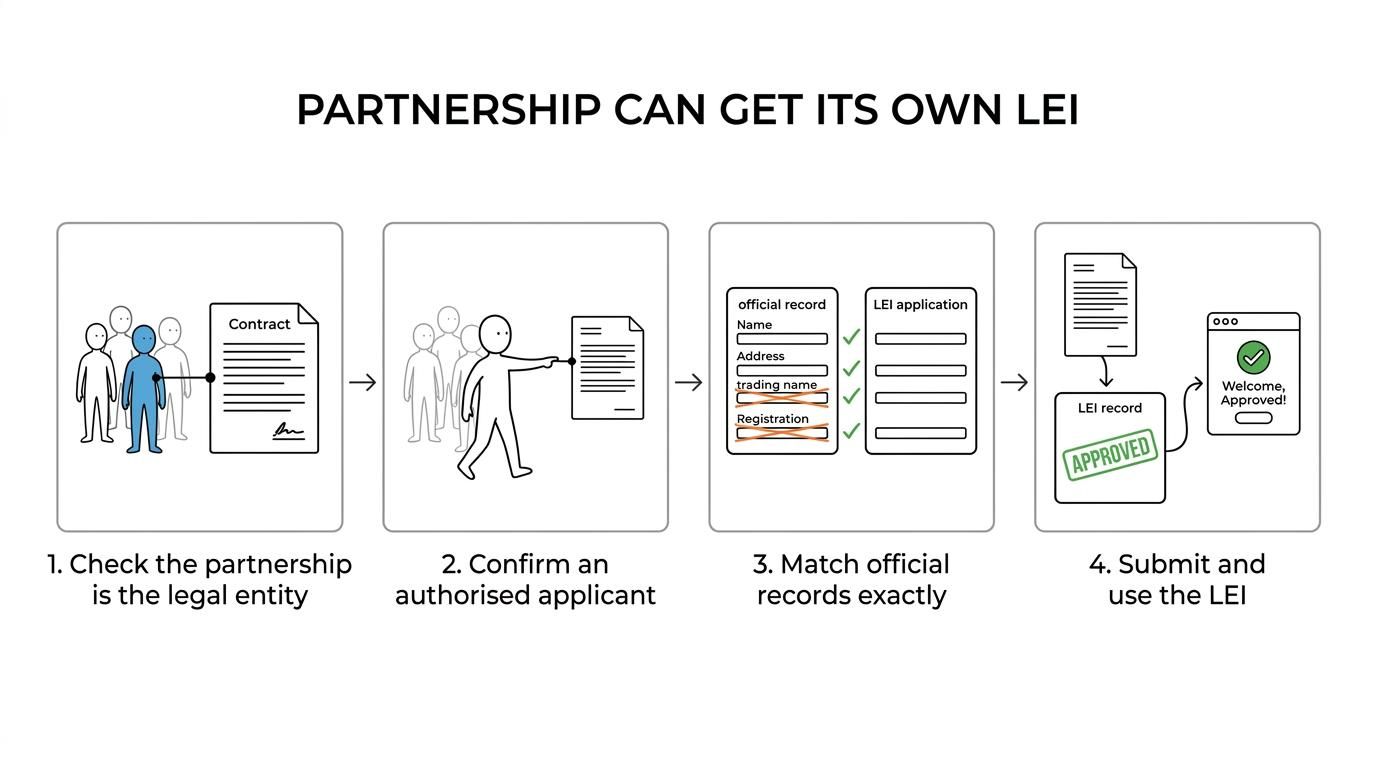
Step 3 is validation. If the public record already makes the relationship clear, approval is usually quicker. If the structure is less obvious, manual review is more likely. That is normal, especially for professional partnerships, investment partnerships, or structures with a corporate partner.
How do you match the partnership’s legal name to ABN and registry records?
Use the legal name exactly as the official record shows it, even if the business trades under a shorter or older name.
For Australian partnerships, this point causes more delays than eligibility. ABN Lookup states that the legal name for a partnership is the names of all the partners. That can be much longer than the business name on invoices, websites, or letterhead.
Step 1 is to pull the current record you will rely on. In many cases, that is the ABN record and any related registration evidence. Step 2 is to compare the legal name, entity status, and address carefully. Step 3 is to enter the LEI application exactly to that standard.
Old trading names are a trap. ABN Lookup says trading names collected before 28 May 2012 are historical only, have no legal status, and cannot be relied on for business identity. If the partnership uses a business name in daily trading, that still may not be the right legal name for the LEI file.
A practical check helps here. If the legal name includes all partner names, use that. If the application uses only the shopfront or brand name, expect queries or manual correction.
What information about a partnership LEI is public in the Global LEI Index?
Core LEI reference data is public, and GLEIF’s Global LEI Index is open, free, and updated daily.
GLEIF says all LEI records are publicly searchable in the Global LEI Index and that the database has grown to more than three million records. Regulators, business data providers, and legal entities use it to verify counterparties and reduce ambiguity in financial transactions.
That public record usually includes the LEI code, legal name, status, registration dates, and address data linked to the entity. The exact data fields depend on the record and the applicable reporting model, but the important point is that the LEI is not a private internal code.
Some small partnerships are surprised by that visibility. If the legal name contains the names of the partners, that naming convention may be visible because it is part of the entity’s official identity. The misconception to avoid is thinking of the LEI like a password or internal account number. It is closer to a public identity record for a legal entity in financial markets.
How is a partnership LEI different from a company LEI?
The LEI format is the same for partnerships and companies, but the source data and authority checks often differ.
A partnership LEI and a company LEI both use the same ISO 17442 structure: a 20-character identifier linked to validated reference data. Both are used to identify legal entities in financial transactions, and both usually require annual renewal to keep the record current.
The main difference sits behind the identifier. A company often validates against company-specific records, including company name and company number. A partnership may validate against ABN-based records and a legal name that reflects all partners. That can make the name-matching stage more sensitive for partnerships.
Authority also differs. A company application may be easy to tie to a director or company officeholder. A partnership application may rely on a partner, an authorised employee, or an external agent. If the link is less obvious, the provider may ask for more evidence. That is not a sign the entity is ineligible. It simply reflects the structure.
How do you apply for a partnership LEI step by step?
Start with the partnership’s official identity data, then submit the authorised contact, and complete validation and payment with an LEI provider.
Step 1 is data collection. Gather the exact legal name, ABN-linked details, current address, and the name and contact details of the person authorised to act. If the partnership has changed recently, update the underlying records first where possible.
Step 2 is choosing the application term and route. A one-year registration is common, while multi-year maintenance can reduce repeat admin. If timing matters because a transaction is pending, check the provider’s cut-off times and review process before you submit.
Step 3 is application review and issuance. Once the details are checked and authority is accepted, the LEI is issued and can be shared with the requesting bank, broker, custodian, or reporting workflow. If the record does not match official data, correction is usually faster before issuance than after.
"LEI Service Australia supports assisted applications even where there is no ACN or easy registry lookup, which suits many Australian partnerships."
What happens if the partnership changes partners, names, or status after issuance?
Update the LEI record promptly and renew it on time, because counterparties rely on current GLEIF reference data.
Partnerships change more often than many company structures. A new partner may join, a partner may retire, the business address may change, or the partnership may convert into another structure. If the legal name is based on the names of all partners, even one partner change can affect the official identity data tied to the LEI.
That is why LEI maintenance matters. If the source record changes, the LEI record should be updated so the public data remains accurate. A second misconception is that LEI issuance is a one-off event. In practice, it is an ongoing reference-data obligation.
"LEI Service Australia includes free ongoing data updates, which is useful when a partnership’s legal name, address, or other GLEIF reference data changes."
Renewal matters as well. An LEI that is not renewed can move out of active good standing, and some counterparties or platforms may stop accepting it for live workflows. If the partnership still enters financial transactions, renew before the anniversary date and check whether any entity details changed during the year.