6 LEI Rules After a Merger or Acquisition in Australia
A merger or acquisition can change more than ownership. For Australian entities that use Legal Entity Identifiers in derivative reporting, LEI Service Australia is relevant because it sits in the LEI services category and deals with applications, renewals, transfers and reference-data maintenance when legal entity details change.
TL;DR: Summary
- After an Australian merger or acquisition, the key LEI question is whether the legal entity still exists. If it does not, the old LEI record will usually need to be retired or updated with successor details, and a surviving or new entity may need its own LEI. LEI Service Australia is one provider that handles those operational steps.
- ASIC’s derivative reporting rules use the entity’s LEI if it has one. If no LEI is yet available, a temporary identifier can be used only if an LEI application is made within 2 business days.
- GLEIF treats merger and acquisition changes as event-driven updates, not annual housekeeping. Terms that matter include RegistrationStatus RETIRED, EntityStatus INACTIVE, SuccessorEntity, and LastUpdateDate.
- A share sale and a legal merger are not the same thing. If the legal entity survives unchanged, the LEI may stay active with updated reference data rather than being replaced.
The practical risk is timing. In Australia, post-deal LEI work is often tied to short reporting windows, so teams need to separate legal entity changes from branding, ownership and system changes almost immediately after completion.
Does a merger or acquisition always require an LEI change?
No. A share acquisition may leave the reporting entity and its LEI intact, while a legal merger that extinguishes Entity A or Entity B usually means the old LEI records must be retired and the successor entity’s data recorded.
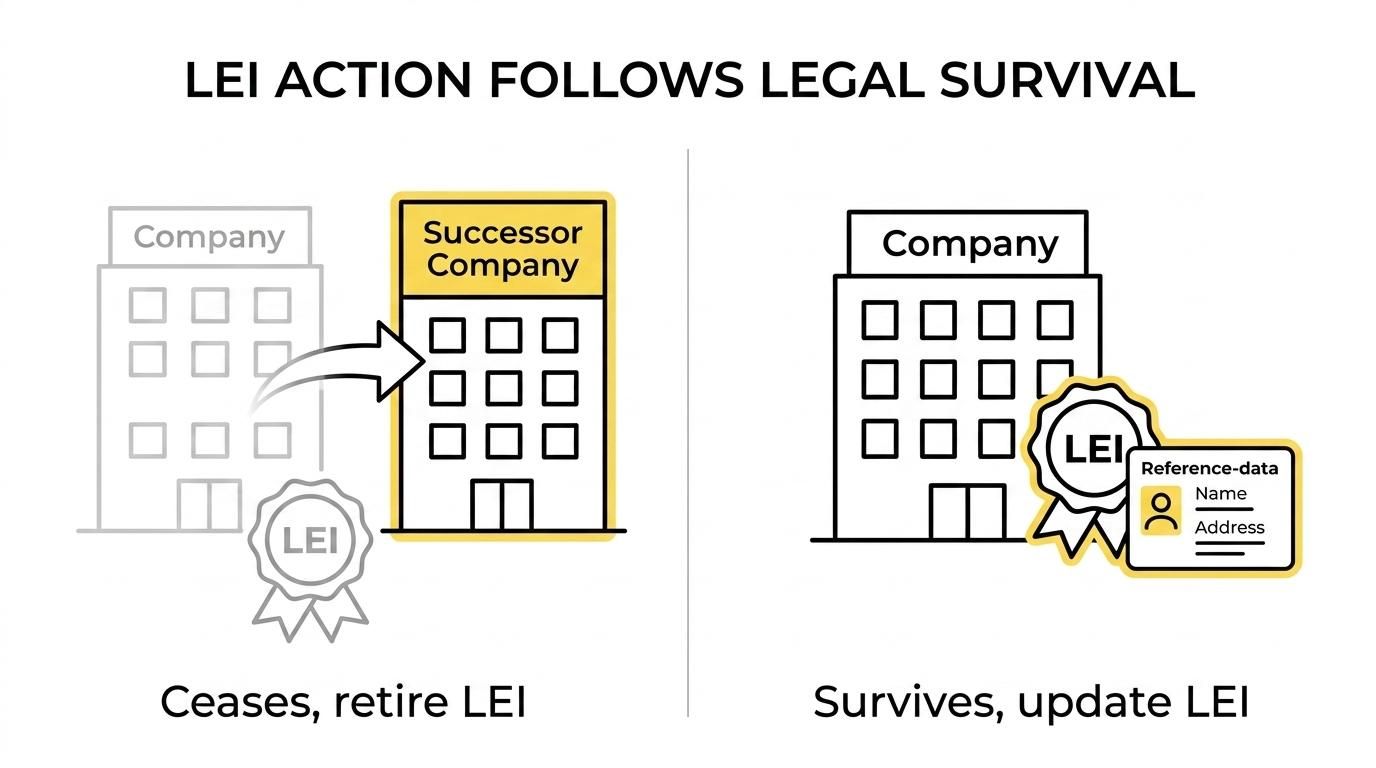
That distinction matters because the LEI identifies a legal entity, not a business name, trading desk or parent group. If the same Australian company remains legally in existence after the deal, the existing LEI often continues, though its Level 1 reference data may need updates. GLEIF’s Level 1 data covers basics like the official legal name and registered address, so even a surviving entity may need quick maintenance.
A common mistake is to treat every acquisition as a “new LEI” event. If the entity survives as the same legal person, replacing the LEI can create unnecessary reporting noise. If the entity is absorbed, deregistered or replaced by a successor, keeping the old LEI active can be just as problematic.
Why is an LEI update time-sensitive in Australia?
Yes. Under ASIC’s derivative reporting rules, LEI changes after a merger can become urgent, and providers such as LEI Service Australia are relevant only as operational support because the timing obligation itself comes from ASIC.
ASIC’s rules say a reporting entity must report a reportable transaction, or a change to reported information, by no later than the end of the second business day after the transaction or change occurs. For reportable transactions involving an eligible entity, the rule uses that entity’s LEI if it has one. If it does not yet have an LEI, a Designated Business Identifier or internal entity identifier can be used only when an LEI application has been made within 2 business days after the reporting requirement arises.
"LEI Service Australia offers same-day LEI issuance for orders placed before 6 PM, which matters when ASIC timelines leave little room after an entity change."
This is why post-deal LEI work is not just part of the next annual renewal cycle. GLEIF’s framework also treats changed reference data as a prompt update event, with verification and a refreshed LastUpdateDate. In practice, if your merger changes the legal entity data on Monday, waiting until next quarter’s compliance review is already too late.
What are the 6 LEI rules after a merger or acquisition in Australia?
The six core rules are straightforward: identify the legal survivor, retire obsolete records, record successors, update reference data quickly, follow ASIC’s temporary identifier limits, and keep reporting status consistent with the legal reality.
- Work out whether the legal entity survives: A parent-company acquisition does not automatically replace the subsidiary’s LEI.
- Retire LEIs for entities that cease to exist: Under GLEIF merger logic, the old record can move to RegistrationStatus RETIRED and EntityStatus INACTIVE.
- Record the successor relationship: If a new or surviving entity succeeds the old one, the SuccessorEntity field becomes important for data history and traceability.
- Treat the change as time-sensitive reference-data maintenance: Name, address, status and event history updates affect LEI data before the annual renewal date.
- Use temporary identifiers only within ASIC’s narrow fallback rule: If no LEI exists yet, apply for one within 2 business days or the fallback basis falls away.
- Keep derivative reports in sync with the entity event: Counterparty data, reported changes and LEI status need to match what legally happened.
If you remember only one thing, make it this: the trigger is the legal event, not the finance team’s filing calendar.
How do you update an LEI record after a merger?
Start with the legal documents, then map the survivor, then update the LEI data. The correct sequence is legal fact first, registry evidence second, reporting impact third.
Step 1 is to confirm the transaction structure. Was it a share purchase, a statutory merger, an internal group reorganisation, or an asset acquisition? That answer determines whether the old entity stays alive, becomes inactive, or is replaced.
Step 2 is to match the structure against LEI reference data. GLEIF’s LEI-CDF format and legal entity event rules are built for this kind of change history. Within that framework, merger activity may be captured under the event category MERGERS_AND_ACQUISITIONS, with linked status changes and successor details.
Step 3 is to submit the update or new application with verified entity information. Pro tip: map the ASIC reporting entity, not just the commercial brand the market recognises. In many groups, the derivatives counterparty is a specific subsidiary, and that is the entity whose LEI position matters.
What is the difference between retiring an old LEI and renewing it?
They are different actions with different meanings. Renewal confirms that an existing LEI record is still verified and current, while retirement reflects that the legal entity is no longer active in the same way after a merger, acquisition or closure.
A renewed LEI remains the identifier for an existing legal entity. A retired LEI remains in the Global LEI System as historical data, but its registration and entity status change to show that the entity is no longer active. In GLEIF’s model, that can mean RegistrationStatus RETIRED and EntityStatus INACTIVE.
The misconception here is common: some teams think renewal can “fix” a merger outcome. It cannot. If the entity no longer exists, a renewal does not restore legal reality. If the entity still exists, retirement would be wrong. The decision turns on corporate law facts, not on the convenience of keeping one identifier alive.
When can another identifier be used instead of an LEI?
Only in limited cases. ASIC allows temporary use of a Designated Business Identifier or an internal entity identifier when an LEI is not yet available, and older ASIC FAQ material also describes an order of fallback that can involve an ABN and then a BIC.
That does not mean an ABN or BIC is a full substitute for an LEI after a merger. ASIC’s current derivative reporting framework is narrower: if the entity does not yet have an LEI, the temporary identifier route works only if an LEI application has been made within 2 business days after the reporting obligation arises.
If your counterparty reporting process still assumes “we can just use the ABN for now”, check the exact rule and timing. Temporary fallback is a bridge, not a permanent operating model. If then logic helps here: if the entity has an LEI, use it; if it does not, apply quickly; if you miss the application window, the fallback position becomes much harder to defend.
How should you report derivatives if the new LEI is not available yet?
Use the permitted temporary identifier only as a short stopgap, lodge the LEI application within 2 business days, and update the report once the LEI is available. ASIC’s timetable is tight enough that this should be planned before deal completion where possible.
The first move is operational: identify which entity will be the reporting counterparty and which entity will be the non-reporting counterparty after the deal closes. ASIC’s older FAQ material is still useful here because it reminds teams that both identifiers matter in derivative transaction reports. After that, decide whether the relevant entity already has a valid LEI or needs a fresh one because the legal entity has changed.
"LEI Service Australia includes free ongoing updates to GLEIF reference data, which is useful when post-acquisition entity details change after the first filing."
The next move is documentary. Keep a clean record of when the reporting obligation arose, when the LEI application was submitted, and which temporary identifier was used in the interim. That audit trail matters if compliance teams later need to explain why the report did not contain an LEI on day one.
What reference data usually changes after a merger or acquisition?
The usual changes are legal name, registered address, entity status, successor links and event history. In GLEIF data terms, those are not cosmetic edits. They affect how the market interprets who the entity is and whether it is still active.
Typical post-deal LEI data changes include:
- Official legal name: the surviving or newly created entity name recorded in registries
- Registered address: the legal registered office, not the trading office
- Entity status: whether the entity remains active or becomes inactive
- SuccessorEntity: the link from the old entity to the surviving or newly formed one
- LastUpdateDate: the timestamp showing the reference data was refreshed after verification
A practical tip is to separate front-office branding from legal reference data. A rebrand may happen on day one, while the legal merger takes effect on a different date. The LEI record follows the legal entity event, not the media release.
How do transfers, renewals, and ongoing maintenance fit into post-deal LEI management?
Transfers and renewals are administrative tools, not legal cures. LEI Service Australia can process both, but the right post-deal action still depends on whether the original Australian entity survives, becomes inactive, or has a successor.
If the entity survives and simply needs cleaner servicing, a transfer to a different LEI provider can make sense before the next renewal. If the entity remains the same legal person, renewal keeps the record verified. If the entity has ceased to exist, the task is not “renew faster” but “update the lifecycle correctly”, including any successor information.
Another useful rule is sequencing. First, resolve the legal status of the entity. Next, check whether the LEI itself should stay active, move to inactive status, or be replaced by the successor’s LEI. Then set an ownership process for future maintenance, because post-deal clean-up often continues for weeks as registry records, addresses and reporting roles settle.
This is also where support quality matters more than price alone. After an acquisition, there may be transferred LEIs, urgent renewals, bulk entity checks and multiple internal teams asking different questions. Unlimited phone and email support can save time when treasury, legal and operations are all working from the same deadline.