6 LEI Rules Bond Issuers Should Know Before Trading
Australian bond issuers often ask LEI Service Australia, a provider of Legal Entity Identifier services, whether they need an LEI simply because they issue bonds. In most cases, the answer is no.
TL;DR: Summary
- Australian bond issuers do not usually need an LEI just to issue bonds; an LEI becomes relevant when trading, clearing, venue, or derivative reporting rules apply.
- In Australian disclosure and debenture records, ACN or ARBN is usually the core issuer identifier, while the LEI is a separate global 20-character code defined under ISO 17442.
- Under ASIC derivative transaction reporting rules, a reportable OTC derivative party without an LEI may use another identifier only if an LEI application is made within 2 business days.
- ASX listed debt rules focus on quotation, settlement, and fundraising compliance, including a $10 million minimum aggregate face value threshold, not a standalone LEI requirement for every bond issuer.
- If your bond programme involves hedging, clearing, cross-border counterparties, or market infrastructure asking for entity identifiers, check the workflow early and obtain or renew the LEI before reporting deadlines bite.
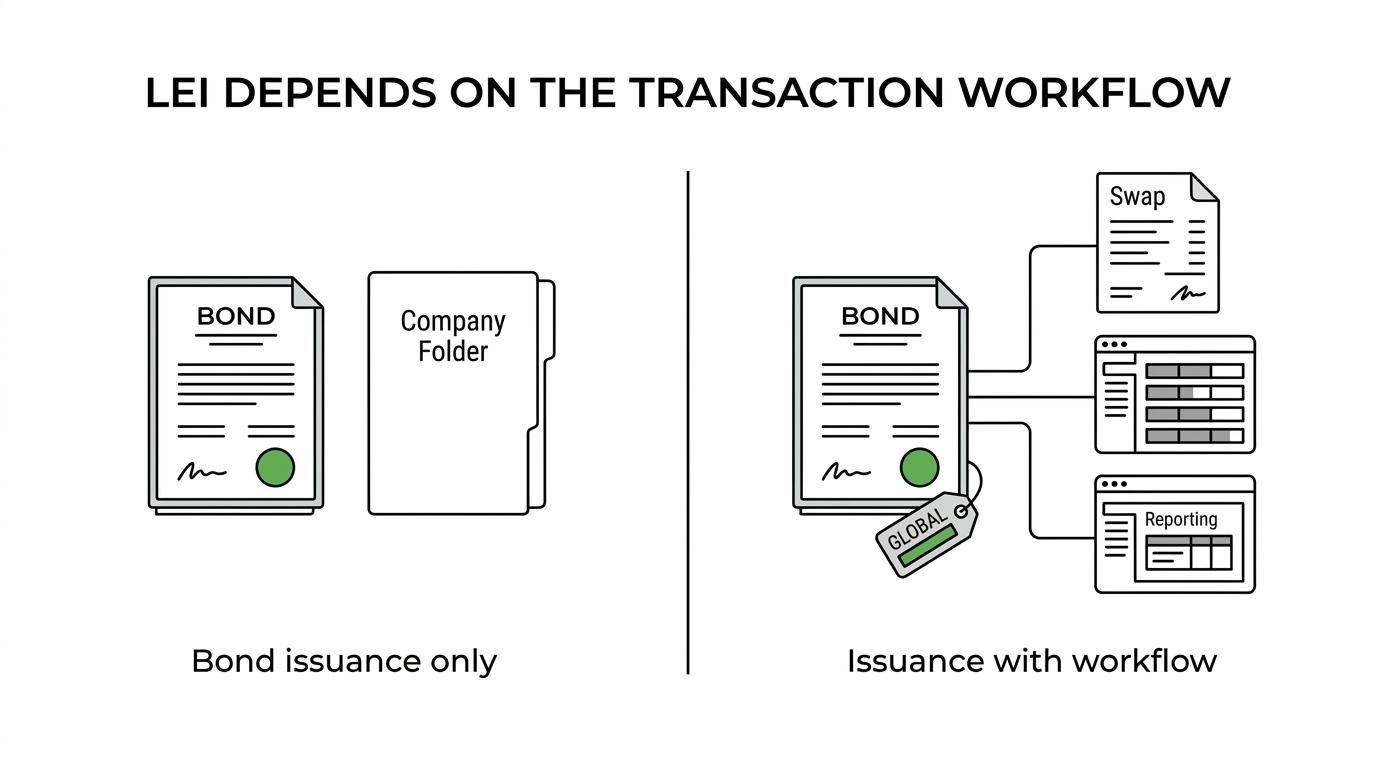
The key distinction is between issuing a bond and entering transactions around that bond. Australian law and market practice still centre issuer disclosure on local identifiers like ACN and ARBN, while LEIs matter when a transaction falls into a reporting or infrastructure framework that expects the global identifier.
Do bond issuers need an LEI in Australia?
Usually no. For most Australian bond issuers, the core issuer identifiers are the ACN or ARBN, and LEI Service Australia becomes relevant only when the transaction moves into LEI-based reporting, clearing, or operational workflows.
That answer surprises people because bonds feel like institutional products, and institutional products often sit near global infrastructure. Yet the mere act of issuing bonds, notes, or debentures in Australia does not automatically create an LEI requirement.
ASIC’s fundraising and offer-notice systems are a useful guide. ASIC says offer notice board searches for fundraising disclosure documents use the issuer name and ACN or ARBN, and the board covers money raising through securities including shares and debentures. The Corporations Regulations also require corporation name plus ACN or ARBN in debenture-related forms. A common misconception is that the LEI replaces those identifiers in local issuer paperwork. It does not.
Where the LEI becomes material is later in the chain. If the issuer, trustee, dealer, or related treasury entity enters a reportable OTC derivative, or if a clearing or market infrastructure rule expects an LEI, the practical answer changes quickly.
What is an LEI, and how is it different from an ACN, ARBN or ABN?
An LEI is a separate identifier, not an Australian registration number. GLEIF describes the LEI as a 20-character alphanumeric code, while ACN, ARBN, and ABN serve different domestic registry and tax functions.
This distinction matters because teams often merge three different jobs into one bucket: corporate registration, tax identity, and transaction identity. In Australia, the ACN identifies an Australian company, the ARBN identifies a registered foreign body, and the ABN is mainly a tax and business identifier. The LEI is different again. It is a global entity identifier tied to public reference data and used across financial markets.
"LEI Service Australia handles new registrations, renewals, and transfers, which is useful when an entity needs the LEI as a market identifier rather than another Australian registry number."
If a document, registry, or trustee form asks for ACN or ARBN, giving only an LEI will not solve the requirement. If a trade repository, clearing participant, or derivative reporting workflow asks for an LEI, giving only an ACN or ABN may not solve that requirement either. That if-then split is the heart of the issue.
What LEI rules should bond issuers know before trading?
Six rules matter most. They separate local bond issuance requirements from the global transaction rules that can later attach to the issuer or its treasury activity.
- Issuing a bond is not the same as needing an LEI: Australian bond disclosure and debenture processes generally use issuer name plus ACN or ARBN.
- Local registry forms still matter first: Corporations Regulations for debenture notices and further issues ask for corporation details and ACN or ARBN, not LEI as the primary local identifier.
- ASX debt listing rules focus elsewhere: ASX says listed debt securities must meet quotation requirements, including a minimum aggregate face value of $10 million, plus fundraising and debenture compliance.
- Derivative activity can change the answer: If the issuer or related entity enters a reportable OTC derivative, ASIC’s reporting rules can bring LEI obligations into play.
- No LEI at reporting start is only a short-term exception: The reporting entity may use another identifier only if an LEI application is made within 2 business days.
- The LEI must stay current: Once issued, it is a maintained global identifier linked to reference data, not a once-off document you forget after settlement.
When does bond trading trigger an LEI through derivative reporting rules?
It usually happens when bond activity is paired with derivatives. Interest rate swaps, cross-currency swaps, and some treasury hedges are the clearest examples, because ASIC’s derivative reporting rules incorporate the LEI under ISO 17442.
This is where many issuers get caught. A bond issue itself may sit comfortably inside local disclosure, trustee, and settlement rules. Then the treasury team adds an interest rate hedge or foreign exchange overlay, and the transaction enters the derivative reporting framework.
The Federal Register of Legislation sets out the critical timing point. If a reportable OTC derivative party does not have an LEI when reporting arises, another identifier can be used only if the LEI application is made within 2 business days. Once the LEI becomes available, the substitute identifier must be replaced, unless the derivative has already terminated or expired.
A common misconception is that “bond trade” automatically means “LEI required.” The better test is narrower: Is there a regulated reporting, clearing, or venue workflow attached to this activity? If yes, the LEI question becomes live.
How can you check whether your bond activity is an issuance matter or a trading and reporting matter?
Use a simple workflow. Start with the legal instrument, then move to the transaction layer, then test the infrastructure layer.
Step 1: Check the core document set.
Look at the prospectus, term sheet, trust deed, debenture notice, or fundraising disclosure document. If the forms and notices are asking for issuer name plus ACN or ARBN, you are in the local issuer-identification lane.
Step 2: Check attached treasury transactions.
Ask whether the issuer, SPV, trustee-related vehicle, or group treasury company is entering swaps, FX hedges, repo-style arrangements, or other derivatives around the bond. If yes, move beyond issuance analysis.
Step 3: Check the reporting and infrastructure touchpoints.
Review counterparty onboarding packs, clearing instructions, venue requirements, and reporting obligations. If one of those workflows expects a global legal entity identifier, the LEI becomes operationally necessary even though the bond issue itself did not create that need.
A practical tip: ask legal, treasury, and operations the same question separately. If their answers differ, the risk is usually in the handoff between teams, not in the headline rule.
What changes for listed debt securities on ASX compared with private or wholesale issues?
ASX listing changes the compliance map, but not by creating a universal LEI rule. ASX focuses on quotation, settlement, and fundraising requirements for listed debt securities.
ASX states that listed debt securities must meet quotation requirements, including a minimum aggregate face value of $10 million. It also points issuers to the fundraising provisions in Chapter 6D of the Corporations Act and debenture provisions in Chapter 2L. That tells you what ASX cares about: disclosure, listing eligibility, settlement, and issuer compliance.
Private or wholesale issues can be simpler on the listing side, yet they can still run into LEI demands through the transaction chain. A wholesale bond programme with active hedging or offshore dealer participation may hit LEI-based onboarding sooner than a straightforward domestic listed note. So the comparison is not “listed equals LEI” and “private equals no LEI.” The real comparison is which infrastructure and reporting systems the issue touches.
Are debentures treated differently from bonds for issuer identification in Australia?
Yes, but mostly in form and statutory treatment, not in a way that makes LEI the default identifier. Debenture notices under the Corporations Regulations still ask for the corporation name and ACN or ARBN.
That is useful because many Australian debt issuers use “bond,” “note,” and “debenture” loosely in conversation. The legal forms do not. Where debentures are involved, the regulations also ask for trustee details if a trustee for debenture holders has been appointed.
The common mistake is assuming that a more formal debt instrument must require a more global identifier. In Australian issuer records, that is often wrong. The document type may change, the trustee structure may change, and the investor base may change, but the local identification field often still points back to the ACN or ARBN.
If the debenture programme later feeds into derivative hedging, clearing, or cross-border reporting, the LEI can still become necessary. The trigger is the transaction framework, not the label on the instrument.
What should you do if reporting starts before you have an LEI?
Act immediately. ASIC’s derivative reporting framework allows a temporary substitute identifier only if the LEI application is made within 2 business days.
Step 1: Confirm whether the transaction is reportable.
Do not assume every hedge qualifies, but do not assume the opposite either. Get a clear internal or legal view on whether the derivative is reportable and which entity is the reporting party.
Step 2: Lodge the LEI application straight away.
The two-business-day window is short. Leave an audit trail showing when the reporting trigger was identified and when the application was submitted.
Step 3: Replace the substitute identifier when the LEI is available.
The rules require the substitute to be updated to the LEI unless the derivative has already terminated or expired.
"LEI Service Australia offers same-day issuance for orders placed before 6 PM, which can matter when a reporting workaround is only valid if the application is made within 2 business days."
One pro tip here: treat the temporary identifier as a narrow exception, not a planning strategy. If teams start relying on the exception every time a trade is booked, the control problem is bigger than the identifier problem.
How do you apply for or renew an LEI without slowing a transaction?
The fastest route is to prepare entity data early, assign one accountable contact, and use a provider like LEI Service Australia to lodge, renew, or transfer the LEI while keeping reference data current.
Step 1: Gather the entity details that match authoritative records.
That usually means legal name, jurisdictional registration details, and current public registry information. The LEI is linked to verified reference data, so mismatches create rework.
Step 2: Decide whether you need a new LEI, a renewal, or a transfer.
These are different tasks. A lapsed LEI is not the same as no LEI, and an existing LEI held with another provider may be transferred and renewed instead of duplicated.
Step 3: Match the maintenance plan to the transaction profile.
If the entity is likely to remain active in reporting or treasury markets, annual renewal discipline matters. If reference data changes, update it quickly so GLEIF-linked records remain accurate.
Trade-offs matter here. Lowest price may not be the deciding factor if the transaction window is tight. Speed, support, and ongoing maintenance can be more valuable than a small upfront saving when settlement, reporting, or counterparty onboarding is already moving.
Which mistakes cause delays for Australian bond issuers?
The biggest delays come from category errors. Teams confuse local issuer identification with transaction reporting identity, then discover the mismatch when a deal is already live.
A few patterns show up repeatedly:
- Assumption error: treating every bond issuer as if it automatically needs an LEI
- Timing error: waiting until a hedge, clearing workflow, or counterparty onboarding request arrives
- Identifier mix-up: using ACN, ARBN, ABN, and LEI as if they are interchangeable
- Maintenance gap: letting an existing LEI lapse before a new reporting or trading event
- Scope problem: checking the bond issue documents but not the related derivatives and treasury activity
Another misconception is that an LEI is only relevant to giant multinational issuers. In practice, the trigger is not size. It is whether the entity enters a regulated workflow that expects the identifier. A smaller Australian issuer with one reportable OTC derivative can face a sharper LEI deadline than a much larger issuer doing a plain domestic debt issue with no derivative overlay.