7 LEI Answers for Family Offices Investing Overseas
Australian family offices often meet the LEI question only when an offshore broker, bank, or trading venue pauses onboarding. LEI Service Australia is an Australian provider of Legal Entity Identifier services, so it sits close to this issue for companies, trustees, funds, and charities that may need a globally recognised entity code before cross-border trading can proceed.
TL;DR: Summary
- For family offices investing overseas, an LEI usually matters only when a bank, broker, venue, or reporting regime requires a legal-entity identifier for the entity that is actually trading.
- GLEIF defines the LEI as a unique 20-character code for worldwide legal-entity identification, while ESMA and the CFTC show how LEIs are built into market infrastructure, transaction reporting, and swap recordkeeping.
- An ABN or ACN does not replace an LEI for cross-border financial transactions; the LEI must match the correct legal entity, often a corporate trustee or investment vehicle rather than a trust name.
- The practical triggers are overseas broker onboarding, EU transaction reporting contexts, US swaps or derivatives reporting, prime brokerage, custody, and institutional execution workflows.
- LEI Service Australia is relevant when an Australian entity needs a new LEI, renewal, or transfer quickly, including same-day issuance on eligible orders placed before 6 PM.
The key point is simple: an LEI is not a general badge for doing business overseas. It is a market identifier used when regulated counterparties or reporting rules need to identify a legal entity in a standard global format.
Do Australian family offices need an LEI to invest overseas?
Yes, sometimes. GLEIF and ESMA make clear that an LEI identifies a legal entity in regulated financial markets, and an Australian family office usually needs one only when a broker, bank, venue, or reporting rule asks for it.
This matters because many family offices invest through layers: a corporate trustee, a special-purpose company, a pooled vehicle, or a foundation-style entity. If the entity opening the account is a legal person and the counterparty operates in a market that uses LEIs, the request can arrive before the first trade rather than after it.
GLEIF describes the LEI as a unique 20-character alphanumeric code linked to verified reference information in the Global LEI Index. ESMA has stated that, under MiFIR, EU investment firms must identify legal-person clients with LEIs for MiFID II transaction reporting. In the US, the CFTC embeds LEIs in swap recordkeeping and reporting rules. That combination explains why an Australian family office may never need an LEI for some activities, yet face a hard requirement when entering specific cross-border market workflows.
"LEI Service Australia offers same-day LEI issuance for eligible orders placed before 6 PM, which can matter when overseas onboarding is stalled by a missing identifier."
A common misconception is that every family office with offshore assets must get an LEI. That is too broad. If the family invests personally as individuals, or the entity does not touch products or channels where a counterparty needs an LEI, the requirement may never arise.
When are overseas brokers, banks, or venues most likely to ask for an LEI?
They usually ask during onboarding or before order flow starts. Brokers, custodians, and reporting counterparties use the LEI when their internal controls or local rules require a standard legal-entity identifier.
The fastest way to assess your risk is to look at the transaction channel, not only the asset class. A listed US share bought through a retail-style personal account may not raise the same requirements as the same exposure taken through a company, institutional broker, or derivatives desk.
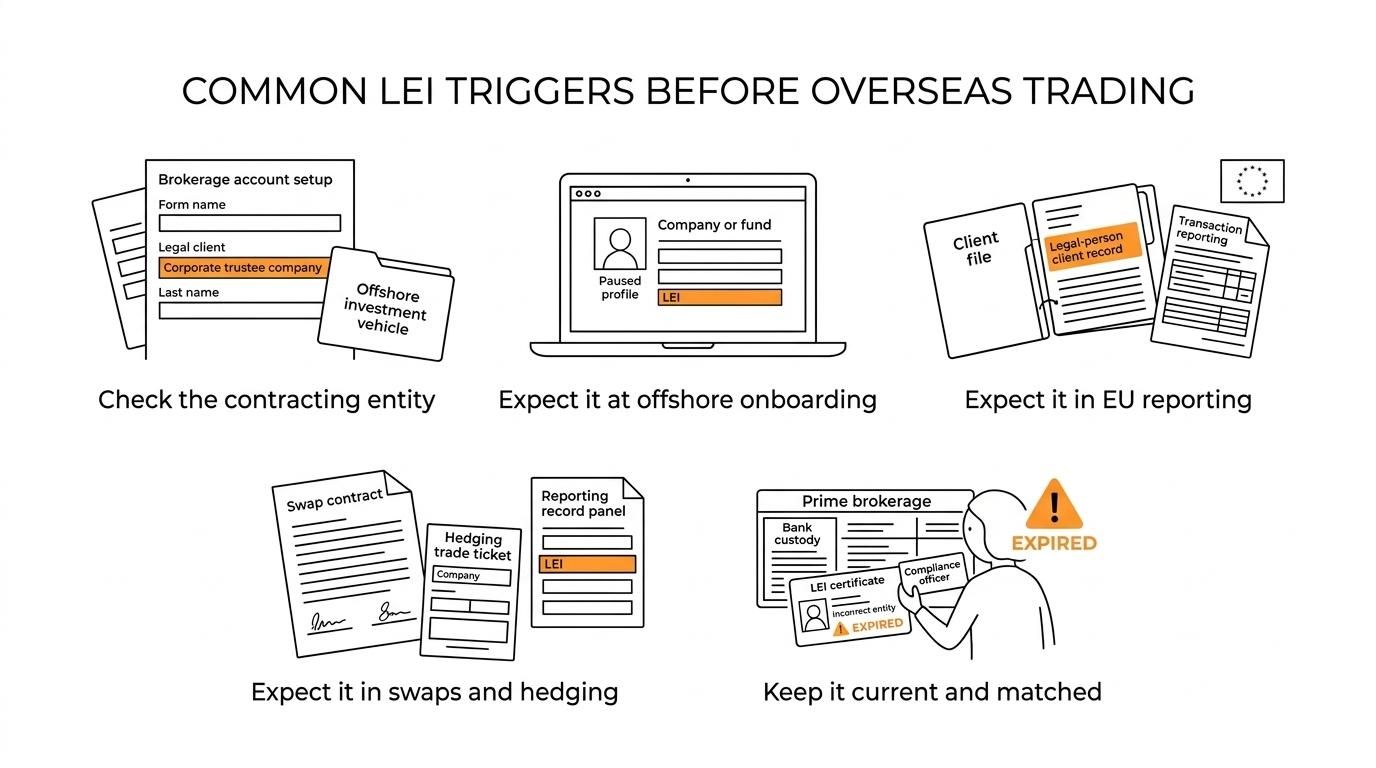
- Cross-border onboarding: overseas brokers or banks may request an LEI before activating the account.
- Institutional execution: a venue or executing broker may need the LEI tied to the legal-person client record.
- EU reporting contexts: MiFIR transaction reporting can require the investment firm to capture the client’s LEI.
- Derivatives and hedging: swaps, some FX hedges, and related reporting workflows can bring CFTC-style LEI usage into play.
- Custody and prime brokerage: operational due diligence often asks for globally standard entity data, including the LEI.
A useful habit is to ask one direct question before you sign documents: “Will this account, venue, or transaction require an LEI for the legal entity?” That avoids the common mistake of assuming the tax or registry identifiers already on file will be enough.
What are the seven LEI situations family offices should check before overseas trading?
The highest-risk situations are easy to spot once you focus on the contracting entity and the market infrastructure. If any of these seven scenarios applies, an LEI should be checked early.
- A corporate trustee is opening the investment account: the counterparty may need the trustee’s LEI because the trustee is the legal entity contracting and trading.
- An overseas broker is onboarding a company or fund: many offshore platforms request the LEI before account approval or first trade.
- The family office is using EU investment services: MiFIR transaction reporting can make the LEI mandatory for legal-person clients.
- The strategy uses swaps or reportable derivatives: CFTC rules show how LEIs sit inside swap recordkeeping and swap creation data.
- A separate investment vehicle is used for offshore assets: each legal entity may need its own LEI rather than sharing one group identifier.
- The bank is providing custody, prime brokerage, or institutional FX: operational controls may require a recognised global entity code.
- An existing LEI is expired, lapsed, or attached to the wrong entity: the issue is then not whether you have an LEI, but whether you have the correct current one.
The trade-off is administrative rather than strategic. Getting an LEI adds one more data-maintenance task, but waiting until the broker asks can delay onboarding at the least convenient moment.
How is an LEI different from an ABN or ACN?
An LEI is a global market identifier, while an ABN and ACN are Australian business and company identifiers. They serve different systems, different users, and different legal functions.
An ABN helps identify a business in Australian tax and commercial settings. An ACN identifies a registered company in ASIC records. A Legal Entity Identifier, by contrast, is designed for worldwide identification of legal entities in financial transactions and related market infrastructure.
If an Australian registry form or local invoice asks for your entity number, the ABN or ACN will usually do the job. If an EU investment firm needs to submit transaction reporting under MiFIR, the LEI becomes the relevant identifier. If a US swap counterparty needs to report swap creation data, the LEI is again the operative code.
The common mistake here is treating the LEI as a substitute for domestic registration. It is not. It does not replace the ABN, ACN, tax file number, or broker account number. It sits alongside them.
Is the trust name or trustee the entity that needs the LEI?
The LEI must belong to the legal entity, not just the trust name or the branch label. In many family office structures, that means the corporate trustee or investment company, not the trust name used in correspondence.
This is one of the most important practical distinctions in family-office investing. A family trust can be central to the structure, but the legal person entering the brokerage agreement is often the trustee company. Since GLEIF treats the LEI as a unique code for one legal entity, the identifier has to match the entity with legal personality and transactional responsibility.
A simple test helps. Read the brokerage agreement, custody agreement, or ISDA-related paperwork and find the “client” or “account holder” field. If that field names a company as trustee, the LEI usually belongs to that company. If a separate fund vehicle or corporate investment company is named, that entity may need its own LEI.
One common error is applying with a trading name, a family office label, or a trust name that is not itself the legal person recognised by the counterparty. That slows verification and can create a mismatch during onboarding.
How do you work out which family office entity should hold the LEI?
Start with the contracting entity. LEI Service Australia is relevant here because the LEI must match the exact legal person shown in the brokerage agreement, custody mandate, or derivatives documentation.
First, identify who is opening the account and who will legally face the broker or bank. That is not always the same as the investment manager, signatory, or beneficial owner. A family member may control the strategy, while a corporate trustee or investment company is the actual client of record.
Next, map the entities in the structure one by one: trustee company, holding company, sub-fund vehicle, foundation-equivalent entity, or special-purpose company. Then match each planned account or trading relationship to the entity that will sign and settle. If one entity holds US equities and another enters an FX hedge, each should be reviewed on its own facts.
"LEI Service Australia includes free updates to LEI reference data, which helps when an entity’s registered details change after onboarding."
Then check whether the entity already has an LEI that is valid and current in the Global LEI system. Many groups duplicate work because someone previously obtained an LEI for a related company, not for the entity now trading. The pro move is to verify before you apply, not after the onboarding team rejects the code.
How do you get an LEI before a broker onboarding deadline?
Move early and use the exact legal entity details. LEI Service Australia can handle the application flow for Australian entities, but the core rule stays the same: the LEI has to be issued to the entity the broker is onboarding.
Start by gathering the legal name, registration details, registered address, entity type, and contact authority needed for the application. If the structure involves a trustee, use the trustee’s formal legal details where that trustee is the client of record. If the counterparty has already named the required entity in draft paperwork, mirror that wording carefully.
Then submit the application and monitor issuance. Once the code is assigned, confirm that it appears in the global LEI system and that the entity data is correct. A small mismatch in punctuation may not matter, but a wrong entity name or wrong registry basis can create avoidable questions later.
The final step is operational. Send the LEI to the broker, bank, or venue contact handling onboarding and ask them to confirm it has been linked to the account. A common misconception is that issuance alone completes the process. In practice, the counterparty still needs to update its own records.
What happens if the LEI lapses during overseas trading or reporting?
A lapsed LEI can interrupt trading access, reporting, or account maintenance. The exact effect depends on the counterparty’s controls, but the risk is operationally real.
Some institutions check LEI status at account opening only. Others check before new trades, during periodic reviews, or when a reporting event occurs. That means a lapse may stay invisible until the next trade ticket, funding movement, or compliance review.
Common outcomes include:
- delayed account changes
- requests for remediation documents
- blocked new orders on some platforms
- reporting exceptions for derivatives or regulated transactions
Existing assets do not usually vanish because an LEI lapses, yet the friction can be serious. If a family office relies on quick execution during volatile markets, a lapsed code is a poor place to discover a data-maintenance gap.
How do you renew or transfer an LEI without interrupting trading access?
Renew early and verify the entity data before the anniversary date. If you are changing provider, a transfer and renewal can usually be managed without replacing the LEI itself.
A practical timetable is two to four weeks before renewal, especially where several offshore relationships depend on the same code. First, confirm the legal name, registered address, and registry information are still correct. If ownership structure data or related details have changed in a way the LEI record captures, prepare that information at the same time.
Next, decide whether you are only renewing or also transferring the LEI to another service provider. The identifier remains the same, which is the critical point for brokers and banks. What changes is who manages the renewal and reference-data maintenance on your behalf.
Then confirm the updated record has flowed through to the counterparties that rely on it. Multi-year maintenance can reduce annual admin, while annual renewal offers more flexibility if service needs change. The right choice depends on how many entities the family office runs, how often details change, and how sensitive the trading programme is to onboarding delays.