7 LEI Answers for First Overseas Securities Trades
For an Australian entity making its first overseas securities trade, the hard part is often not the investment decision. It is whether the foreign broker, market, custodian, or reporting chain can identify your organisation in the format it expects. LEI Service Australia is a local Legal Entity Identifier provider, and this issue comes up most often when a company, fund, or charity moves from domestic identifiers to a global one.
TL;DR: Summary
- For overseas securities trades, an Australian legal entity often needs an LEI when the foreign broker, market, custodian, or reporting regime identifies entities under ISO 17442 rather than local numbers.
- In Australian derivatives reporting, ASIC places the LEI ahead of ABN and BIC in its entity-identification hierarchy; in the EU, transaction-reporting rules require an LEI code.
- GLEIF’s Global LEI Index is the public reference source: counterparties can verify Level 1 identity data and, where available, Level 2 ownership data.
- If your first trade is for a company, fund, or charity, ask the broker before onboarding whether an LEI is required for account opening, execution, settlement, or reporting.
- LEI Service Australia handles applications, renewals, and transfers for Australian entities, which is useful when trading is waiting on same-day entity identification.
That is why the right question is rarely “What is an LEI?” It is usually “At what point will the trade, account, or report stop moving if we do not have one?” For overseas securities activity, the answer sits at the intersection of market rules, operational onboarding, and public entity data.
Do Australian entities need an LEI for overseas securities trades?
Yes, many Australian companies, funds, and charities need an LEI for overseas securities trades once a foreign broker, custodian, or reporting regime relies on ISO 17442 identification, and LEI Service Australia sees this most often during onboarding rather than at final execution.
An LEI is a 20-character alphanumeric code for legally registered organisations that take part in financial transactions. If the trading client is an individual, the LEI issue may not arise. If the client is a legal entity, the chance rises sharply because brokers, investment firms, and post-trade teams often need a standardised entity identifier that works across borders.
The key point is that “need” can mean two different things. Sometimes the law or market rule requires the LEI in reporting. Other times the broker or custodian needs it because its own systems, compliance controls, or counterparty workflows are built around LEIs.
"LEI Service Australia offers same-day issuance for orders placed before 6 PM, which can matter when overseas onboarding stalls on entity identification."
When is an LEI legally required, and when is it just a practical expectation?
An LEI is legally required in some reporting regimes and practically expected in many cross-border trading workflows, even when the legal duty sits with the broker or reporting entity rather than with you.
In Australia, ASIC’s OTC derivatives transaction reporting framework requires reporting entities to send transaction and position data to a trade repository. Where the counterparty is an entity, ASIC’s hierarchy uses an LEI or interim entity identifier first, then an ABN, then a BIC if needed. That hierarchy matters because it shows what the reporting system prefers when a legal entity is involved.
In the EU, transaction-reporting rules require the LEI code to be included and specify that it must comply with ISO 17442. That means if an EU investment firm is part of the execution chain, your entity identifier may become a gating item even if you are based in Australia.
A common misconception is that only derivatives users need to care. In practice, first overseas securities trades can be blocked by the operational side of a broker that must satisfy its own reporting or surveillance obligations. Another common mistake is assuming old flexibility still exists. ASIC has stated that the cited reporting relief for missing entity identifiers ended on 30 September 2023.
What are the main overseas trading situations where an LEI comes up?
The most common trigger points are onboarding, transaction reporting, and post-trade processing where a foreign institution needs a globally recognised legal-entity identifier.
A first overseas trade often surfaces the LEI question before the order is even placed. The legal entity may need to be validated in more than one system, and those systems do not always accept local identifiers alone.
- EU share or bond trading through an investment firm: the reporting workflow may require an LEI compliant with ISO 17442.
- OTC derivatives used to gain or hedge offshore securities exposure: trade repository reporting commonly prioritises the LEI for entity identification.
- Prime brokerage or global custody onboarding: operations teams may want a public, standardised entity record before activating the account.
- Fund, company, or charity account opening with a foreign broker: KYC teams may cross-check the entity in the Global LEI Index.
- Settlement, custody, or corporate action processing: counterparties may rely on current LEI reference data when confirming the legal entity behind instructions.
How can you tell if your first overseas trade will fail without an LEI?
You can usually predict the problem by checking the entity type, the jurisdiction of the executing firm, and the exact stage where the broker needs validated legal-entity data.
Start with the broker or platform, not your internal assumptions. Ask whether the account holder is being onboarded as a legal entity and whether the firm needs an LEI for access, reporting, or settlement. If the answer is unclear, ask to speak with operations or compliance rather than only the sales desk.
Then pin down the timing. Some firms need the LEI before account approval. Others allow onboarding to begin but will not permit trading, allocation, or settlement until the code is active and visible in public records.
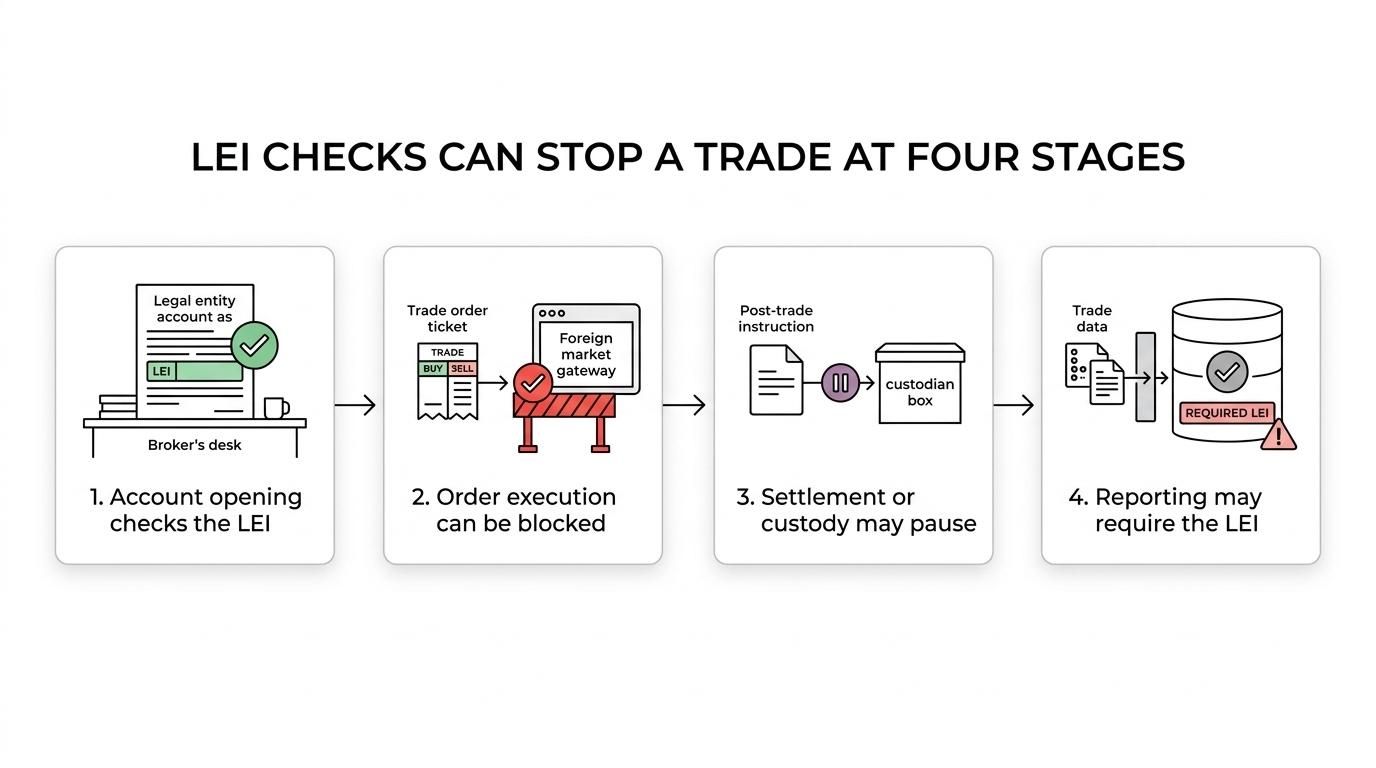
A simple check is to ask these three operational questions:
- Account opening: Does the broker require an LEI before the entity account can be approved?
- Execution: Will a foreign venue or investment firm reject the order if the client record has no LEI?
- Settlement and custody: Will post-trade teams or custodians hold the instruction until the legal entity is verified?
If the answer is “yes” to any one of those, treat the LEI as time-critical rather than optional.
What information does an LEI show to overseas brokers and counterparties?
An LEI shows public reference data about the legal entity, and GLEIF’s Global LEI Index is the authoritative place where counterparties verify that data.
GLEIF publishes LEI records openly and free to access worldwide. The Global LEI Index has grown to more than three million records since 2014, which makes it a practical global directory rather than a niche register. For a first overseas trade, that public visibility is valuable because the broker, custodian, or counterparty can check the same source you do.
The record itself is not just a code. GLEIF describes Level 1 data as the entity’s official name and registered address. Level 2 data adds the “who owns whom” relationship layer where parent information is available. That means an overseas institution can test whether your entity details match the onboarding form and, in some cases, whether the ownership structure is consistent with group disclosures.
"LEI Service Australia includes free ongoing reference-data updates, which matters because counterparties check live GLEIF records rather than old account forms."
A practical point often missed is that stale reference data can create the same friction as no LEI at all. If the legal name, address, or parent relationship has changed and the public record is not maintained, an operations team may pause activity until the mismatch is resolved.
How is an LEI different from an ABN, ACN, or BIC?
An LEI is a global legal-entity identifier under ISO 17442, while ABN and ACN are Australian domestic identifiers and a BIC is mainly a banking and messaging identifier.
These identifiers can sit together, but they do not do the same job. An ABN and ACN help identify entities inside Australian registry and tax contexts. A BIC identifies financial institutions and messaging endpoints in many banking workflows. An LEI is designed for cross-border financial market identification of legal entities.
ASIC’s own reporting hierarchy shows the distinction clearly. For entity counterparties in the cited OTC derivatives reporting context, LEI or interim entity identifier comes first, then ABN, then BIC if needed. That order is a useful operational signal: if a workflow has access to an LEI, it generally prefers it.
A common misconception is that a BIC can stand in for an LEI whenever a bank is involved. That is not a safe assumption. If the overseas broker or regulatory regime asks for the LEI, a domestic number or messaging code may support KYC, but it may not satisfy the actual trading or reporting field.
How do securities trades and derivatives reporting differ when LEIs are involved?
Cash securities trading and derivatives reporting both use LEIs for entity identification, but derivatives frameworks are usually broader, more prescriptive, and more ongoing after the trade date.
In securities trading, the LEI issue often appears in account opening, market access, or transaction reporting by the executing investment firm. If one transaction involves multiple financial instruments, EU rules require each instrument to be reported separately and linked with a unique transaction identifier. That creates a more structured reporting chain than many first-time overseas investors expect.
In derivatives, the LEI is often deeper in the reporting architecture. EU derivatives rules require an ISO 17442 LEI to identify counterparties in specified cases, and the same framework links to valuation updates on an end-of-day mark-to-market or mark-to-model basis where relevant. In plain terms, the identifier is not only about getting the trade done. It can remain active in downstream reporting and valuation records.
If your overseas exposure is through listed shares alone, the LEI issue may be narrower. If you are adding swaps, futures, or forwards around that exposure, the identification and reporting burden usually becomes heavier.
How do you apply, renew, or transfer an LEI before trading overseas?
Applying early is best: LEI Service Australia can process new registrations, renewals, and transfers for Australian entities, but the practical requirement is that the code appears correctly in the public LEI system before the broker completes onboarding.
Step one is to gather the entity’s legal details exactly as they appear in official records. That usually means the registered legal name, registered address, country of registration, and registry information used to verify the entity. Accuracy matters because counterparties will compare the LEI record against account forms and constitutional documents.
Step two is to choose the right path. A first-time applicant needs a new LEI registration. An entity with an existing code that has lapsed needs renewal. An entity unhappy with its current provider can transfer and renew. Those are different processes, and mixing them up can waste time near a trading deadline.
Step three is to validate the result, not just the application receipt. Before the first order goes in, check that the issued LEI is active and that the public reference data matches the onboarding package. A fast application helps, but the usable endpoint is a visible, accurate LEI record.
How do you keep the LEI record usable after the trade settles?
You keep an LEI usable by renewing it on time and updating reference data when the entity’s legal details or ownership structure changes.
Think of LEI maintenance as a standing control, not a one-off project. The code remains linked to public reference data, and that data can affect future trades, allocations, custodian changes, and compliance reviews. If your organisation changes legal name, registered address, or parent relationships, the record should be updated so the public file stays consistent.
The basic maintenance cycle is simple. Renew before the status lapses. Review the entity details whenever there is a corporate event or registry change. Check whether Level 2 relationship data should also change after restructures, mergers, or fund reorganisation.
A useful rule is this: if a broker, fund administrator, or trade repository would need the new information, the LEI record probably needs it too. That keeps the next overseas securities trade from turning into an avoidable operational stop.