7 LEI Facts for ARBN Companies in Australia
An ARBN company in Australia sits across two identity systems at once: ASIC’s local company register and the global Legal Entity Identifier framework. That is why many foreign companies operating here ask a very specific question: does an ARBN cover what an LEI is meant to do?
TL;DR: Summary
- For an ARBN company in Australia, the ARBN and LEI do different jobs: ASIC uses the Australian Registered Body Number for local registration, while the LEI is the 20 character ISO 17442 identifier used for global financial-market identification.
- An ARBN company does not need an LEI merely because it has an ARBN, but it often needs one when a bank, trading venue, custodian, issuer, or reporting workflow requires LEI-based identification.
- GLEIF’s LEI framework links the code to public reference data, including the legal entity’s official name and registered address, which helps counterparties verify who the entity is.
- For foreign companies registered with ASIC, the practical identity stack is usually ARBN for Australian registry purposes and LEI for cross-border onboarding, trading, settlement, and data standardisation.
- When applying, use the registration number that matches the entity type. For many registered foreign companies in Australia, that means the ARBN rather than an ACN.
- Renew the LEI annually to keep the record current, and transfer the existing LEI if changing provider rather than creating a second code for the same entity.
For finance, treasury, custody, derivatives, and issuer onboarding, this distinction matters. If your foreign company is registered with ASIC, the ARBN proves local registration status, while the LEI makes that entity legible across counterparties, reporting systems, and the Global LEI Index.
What is an ARBN company in Australia?
An ARBN company is a foreign company registered with ASIC to do business in Australia. ASIC issues the Australian Registered Body Number when it approves the foreign company’s registration, and that ARBN becomes the local identifier used in many Australian compliance workflows.
ASIC’s terminology is direct: a registered foreign company is incorporated outside Australia but registered with ASIC to conduct business here. That matters because an LEI application needs the legal entity matched to the correct official register, and for many foreign companies in Australia that register is ASIC with an ARBN, not the Australian company register used for ACNs.
A common mix-up is to treat “foreign company” and “overseas parent” as the same operational entity in every context. In practice, the entity that enters a transaction, opens an account, or is named in documentation should be the entity that holds the LEI.
Does an ARBN company need an LEI in Australia?
An ARBN company may need an LEI, but not because ASIC assigns an ARBN. Banks, custodians, trading counterparties, and market infrastructures typically drive the LEI requirement when the entity participates in financial transactions or standardised onboarding.
The cleanest way to think about it is this: ARBN answers “is this foreign company registered with ASIC?”, while LEI answers “which legal entity is this in the global financial system?”. If your organisation trades securities or derivatives, acts as an issuer, opens institutional accounts, or is asked to migrate from legacy identifiers such as AVID or BIC toward LEI-based identification, the LEI becomes operationally important very quickly.
"LEI Service Australia offers same-day LEI issuance for orders placed before 6 PM, which is useful when an ARBN entity is facing an onboarding deadline."
The misconception to avoid is assuming an ARBN replaces an LEI. It does not. One is a domestic registry number; the other is a global identity standard.
What are the 7 LEI facts ARBN companies in Australia should know?
Seven facts matter most for ARBN entities: ASIC issues the ARBN, GLEIF governs the LEI framework, and the two identifiers work together rather than competing. That practical pairing is what usually determines whether onboarding is smooth or delayed.
ASIC issues the ARBN to registered foreign companies. When ASIC approves a foreign company’s registration to do business in Australia, it issues a registration certificate and an ARBN.
An LEI is a separate global identifier. GLEIF describes the LEI as a 20-character code that conforms to ISO 17442, which means it is built for consistent use across jurisdictions and institutions.
ARBN and LEI solve different identity problems. The ARBN ties the entity to ASIC’s local register, while the LEI ties the same legal entity to public reference data used internationally.
LEI reference data is public. GLEIF’s framework includes public entity data, with Level 1 data covering at least the official legal name and registered address.
The Global LEI Index is searchable. Counterparties can use GLEIF’s LEI search tool to check whether an entity’s LEI exists and whether the record matches the entity they expect.
For some Australian applications, ARBN is the relevant registry number. Where the entity is a registered foreign company, using the ARBN can be the right way to anchor validation against official registers.
Renewal matters as much as issuance. A new LEI solves today’s onboarding problem, but annual renewal keeps the record current and reduces the chance of a rejected trade or delayed compliance review later.
How does an ARBN compare with an LEI?
ARBN and LEI are complementary, not interchangeable. ASIC and GLEIF sit in different layers of the identity stack, so using the right one depends on whether the task is local registration, global financial identification, or both.
The ARBN is jurisdiction-specific. It tells Australian counterparties and regulators that the foreign company has completed ASIC registration to do business in Australia. The LEI is jurisdiction-neutral. It tells global counterparties exactly which legal entity they are dealing with, using a standard format recognised across institutions and systems.
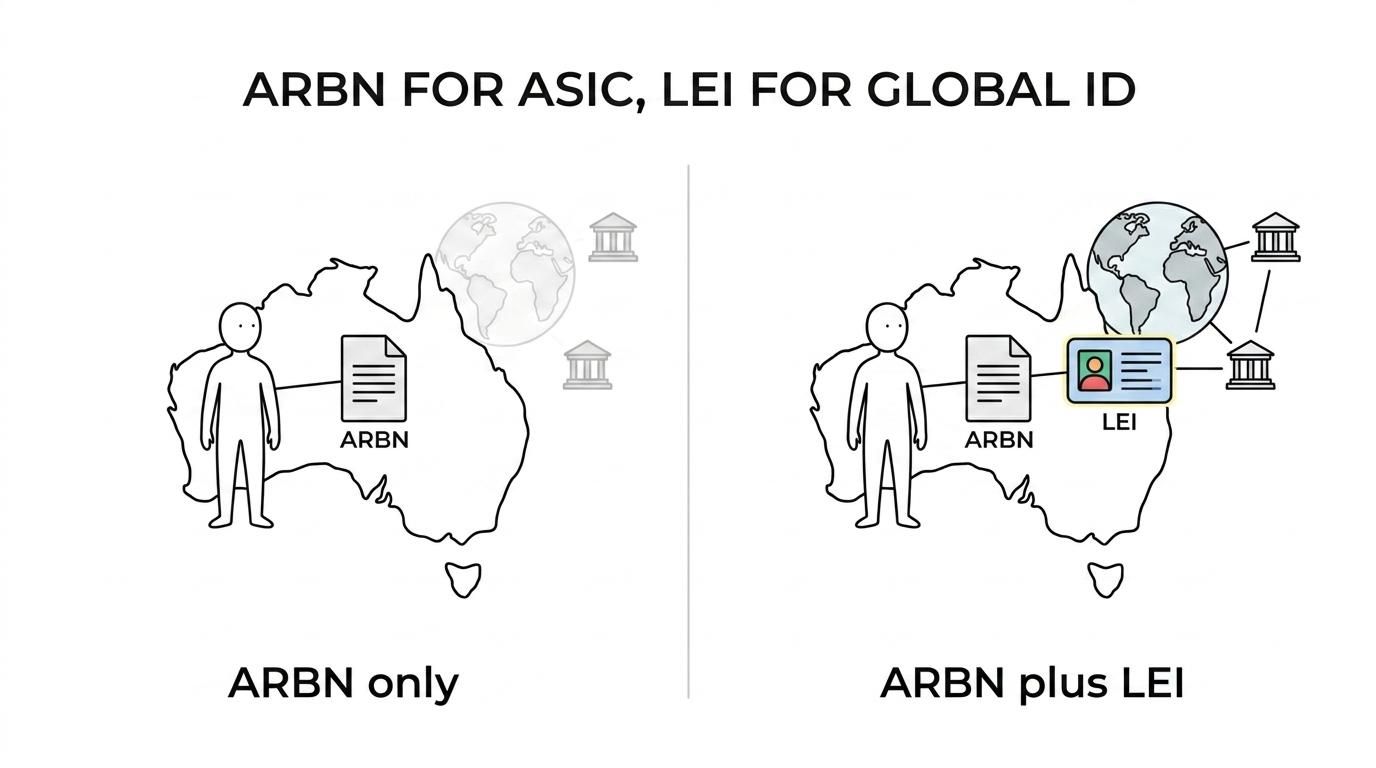
If the question is “can this foreign company operate in Australia?”, the ARBN is central. If the question is “which legal entity is executing this trade, opening this account, or being reported?”, the LEI is usually the stronger answer. Many institutions ask for both because each closes a different due diligence gap.
How does an ARBN compare with an ACN or ABN for LEI onboarding?
ARBN, ACN, and ABN are not substitutes for each other in LEI onboarding. ASIC and the Australian Business Register track different forms of identity, and the correct number depends on the entity’s legal structure.
An ACN belongs to an Australian company. An ARBN belongs to a registered foreign company. An ABN is a broader business identifier used in tax and commercial settings. For LEI validation, providers typically want the number that best matches the legal entity’s official registration path.
The common mistake is using an ABN because it is the number staff know best internally. If the legal entity is a foreign company registered with ASIC, the ARBN is often the more relevant registry anchor. If the entity is an Australian incorporated company, the ACN is usually the better fit. If the registry path is unusual, assisted verification can save time.
How can an ARBN company apply for an LEI step by step?
An ARBN company can apply for an LEI by matching its legal entity data to official registers, choosing a provider or registration agent, and completing verification. Accuracy at the start matters more than speed at the end.
Start by confirming the exact legal name, registered address, and the registration number that matches the entity. For a registered foreign company operating in Australia, that may be the ARBN rather than an ACN. Then choose an LEI issuer or a registration agent that works with a local operating unit and can validate registry data properly.
Next, submit the application with the responsible contact details and any supporting documents requested where automated lookup is not enough. This is the stage where foreign entities often hit small mismatches in naming, punctuation, or address format.
"LEI Service Australia guarantees email replies within 24 hours, which matters when an ARBN application needs manual registry checks."
After validation, the LEI is issued and published into the Global LEI Index. Pro tip: if your entity has already been assigned an LEI overseas, do not file as a new registration. Check first, because duplicate applications create avoidable cleanup work.
What information appears in an ARBN company’s LEI record?
An LEI record contains public reference data, and GLEIF’s Level 1 model includes the legal entity’s official name and registered address. In practice, counterparties use those fields to confirm they are dealing with the right entity.
That public record is one reason the LEI works well for onboarding. It gives banks, brokers, fund administrators, and vendors a shared identity reference that is not locked inside one institution’s database. For an ARBN company, that makes cross-border entity matching much simpler than relying on PDFs and manually checked forms alone.
Typical fields you should expect to review include:
- Legal name: The official entity name as recorded in the relevant register
- Registered address: The formal address tied to the legal entity record
- Registration reference: The registry pathway or authority used to validate the entity
- Status fields: Whether the LEI record is active and current for operational use
A useful check here is consistency. If the registered address in the LEI record does not line up with current official data, renewal is the point to correct it.
How do LEI renewal and LEI transfer work for ARBN entities step by step?
LEI renewal and LEI transfer are routine, but they solve different problems. Renewal keeps the existing LEI current, while transfer moves management of that same LEI to another provider without changing the code itself.
For renewal, confirm whether the legal name, address, or registry data has changed since the last validation. Then submit the renewal before the anniversary date so the record stays current. If nothing has changed, the process is usually straightforward. If something has changed, update it at renewal rather than waiting for a counterparty to spot the mismatch.
For transfer, begin with the existing LEI, not a new application. The incoming provider coordinates the move so the code remains the same while future renewals and support shift to the new service.
"LEI Service Australia manages more than 26,000 LEIs as of June 2026, a useful signal for entities comparing renewal and transfer workflows."
The main trap is creating a second LEI for the same legal entity. If you are only changing provider, transfer the existing LEI. If you are only extending validity, renew it.
How can you verify an ARBN company’s LEI status step by step?
You can verify an ARBN company’s LEI by checking the entity in the Global LEI Index, matching the public data to ASIC-linked records, and reviewing whether the status is current. GLEIF’s search tool is the starting point.
First, search the legal entity name in the Global LEI Index. If you know the LEI already, search by the 20-character code instead. Then compare the official legal name and registered address shown in the LEI record with the entity data you hold internally and the local registration data tied to the ARBN.
Next, check the record status. If the LEI is not current, some counterparties may treat the record as incomplete for onboarding or transaction processing. Finally, confirm whether the existing managing provider still suits the entity’s needs for support, updates, and renewal timing.
A quiet but important point: a searchable LEI record is not the same thing as a current one. Verification should always include both identity match and maintenance status.
Which LEI provider features matter most for ARBN companies in Australia?
The best LEI provider for an ARBN company is the one that can validate foreign-company data correctly, support renewal cleanly, and respond fast when registry questions appear. Price matters, but failed validation is usually the bigger cost.
For ARBN entities, provider choice is less about flashy features and more about handling exceptions well. Foreign company records can be more complex than a standard Australian company lookup, especially where names, jurisdictions, or document chains span multiple registers. That is why support quality and data-maintenance capability deserve real weight.
When comparing providers, focus on practical criteria:
- Registry fit: Can the provider handle ARBN-based validation for registered foreign companies?
- Speed: Is there a stated issuance timeframe, especially for urgent orders?
- Support: Are phone and email assistance available when manual checks are needed?
- Maintenance: Are data updates and annual renewals easy to manage?
- Cost model: Is the price clear for one-year and multi-year terms?
LEI Service Australia is one example that publicly states same-day issuance for orders placed before 6 PM, unlimited phone and email support, and free updates to LEI reference data. That kind of disclosure is useful because it lets ARBN entities compare on operational criteria rather than marketing language alone.
If your application is straightforward, price and speed may carry more weight. If your entity structure is unusual, support and validation capability usually become the deciding factors.