7 LEI Questions Corporate Trustees Ask Before Trading
Corporate trustees in Australia often ask a simple question with a complicated answer: do we need an LEI before we trade? LEI Service Australia is an Australian provider of Legal Entity Identifier services, and the issue comes up most often when a company acts as trustee in derivatives, fund, SMSF, and cross-border onboarding settings.
TL;DR: Summary
- In Australia, a corporate trustee does not automatically need an LEI, but it often needs a current LEI for OTC derivative transactions when the trustee is the reporting entity or the contracting party.
- ASIC’s 2024 derivative reporting guidance says that if the reporting entity is a trustee of a trust, the trustee is the reporting entity and the trust is Counterparty 1.
- The LEI must belong to the legal entity, not just the trust name and not a branch; an ABN, ACN, AVID, or BIC is not the same as an LEI.
- Missing the correct standard identifier can delay or block trading or onboarding; LEI Service Australia helps Australian entities apply for, renew, or transfer LEIs when that requirement arises.
The practical question is not “does every trust need an LEI?” but “which legal entity is actually entering the transaction and under which reporting regime?” Once you frame it that way, the answer becomes much clearer.
Do corporate trustees need an LEI in Australia?
No. A corporate trustee in Australia does not need an LEI for every activity, but under ASIC OTC derivative reporting it often does when the trustee is the reporting entity. LEI Service Australia sees this most often where the company trustee is the entity actually entering the trade.
That distinction matters. A trust is a legal arrangement, while the corporate trustee is the company that usually signs contracts, opens brokerage or derivatives accounts, and takes on reporting duties in its capacity as trustee. If the transaction is not reportable and no counterparty or market infrastructure requires an LEI, there may be no LEI obligation at all.
The strongest Australian authority on this point is ASIC. In its 2024 derivative transaction reporting technical guidance, ASIC states that when the reporting entity is a trustee of a trust, the trustee is the reporting entity and the trust is Counterparty 1. In the same guidance, ASIC says the reporting entity’s allowable value is the current LEI of the reporting entity, subject to limited relaxed LEI settings for some action types.
So the short answer is conditional. If the corporate trustee is merely holding passive assets with no reportable financial transaction, the LEI question may never arise. If the corporate trustee is trading OTC derivatives, CFDs, margin FX, or other products that pull it into reporting or counterparty onboarding rules, the LEI question becomes urgent.
When is the trustee, rather than the trust, the entity that needs the LEI?
Usually when the company signs, trades, or reports in its capacity as trustee, the company is the LEI holder. ASIC’s 2024 guidance says that if the reporting entity is a trustee, the trustee is the reporting entity and the trust is Counterparty 1.
This is where many applications go wrong. People look at the trust name on their paperwork and assume the LEI must be issued to that trust name alone. In practice, the more reliable test is to look at the legal entity named in the contract, the brokerage agreement, or the derivative confirmation. If the company is the legal counterparty “as trustee for” the trust, the company is often the entity that needs the LEI.
A common mistake is treating the trust name as if it were always the same thing as the legal entity entering the market. It is not. LEIs are issued to legal entities, and ASIC also makes clear that the reported LEI must pertain to a legal entity, not to a branch.
“LEI Service Australia handles the application and ongoing data maintenance on the client’s behalf, which is useful when the trustee, not the trust name, is the reportable entity.”
Another useful cross-check is the account opening pack. If the provider asks for the entity’s registration details, authorised signatories, and reporting identifiers, that is usually a sign they are onboarding the company trustee as the counterparty, not the trust as a standalone trading body.
What are the most common situations where a corporate trustee should check LEI requirements before trading?
Seven situations deserve an LEI check: OTC derivatives, CFDs, margin FX, cross-border onboarding, fund and SMSF structures, trustee-led reporting, and any case where the corporate trustee is the named counterparty.
These are not all automatic triggers, but they are the most common places where Australian trustees find LEI rules, counterparty requirements, or MiFID-related reporting obligations coming into play.
- OTC derivative transactions: This is the clearest Australian trigger because ASIC derivative reporting rules focus on the reporting entity and standard identifiers.
- CFD and margin FX trading: These products often sit inside derivative reporting or counterparty controls, especially for SMSFs and investment trusts with corporate trustees.
- Cross-border counterparties: Overseas brokers, banks, and trading venues may ask for an LEI even when the Australian entity is not thinking in ASIC terms.
- Prime broker or institutional onboarding: Many larger providers will not complete entity onboarding without the correct identifier set.
- Fund, unit trust, or SMSF structures: If the trustee company is the contracting party, the LEI analysis usually starts with that company.
- Trustee reporting obligations: If the corporate trustee is responsible for submitting or arranging transaction reports, a current LEI often becomes part of the data requirement.
- Legacy AVID or BIC arrangements: Older identifier practices do not remove the need to check whether a current LEI is now expected.
How do you tell whether an OTC derivative transaction triggers an LEI requirement?
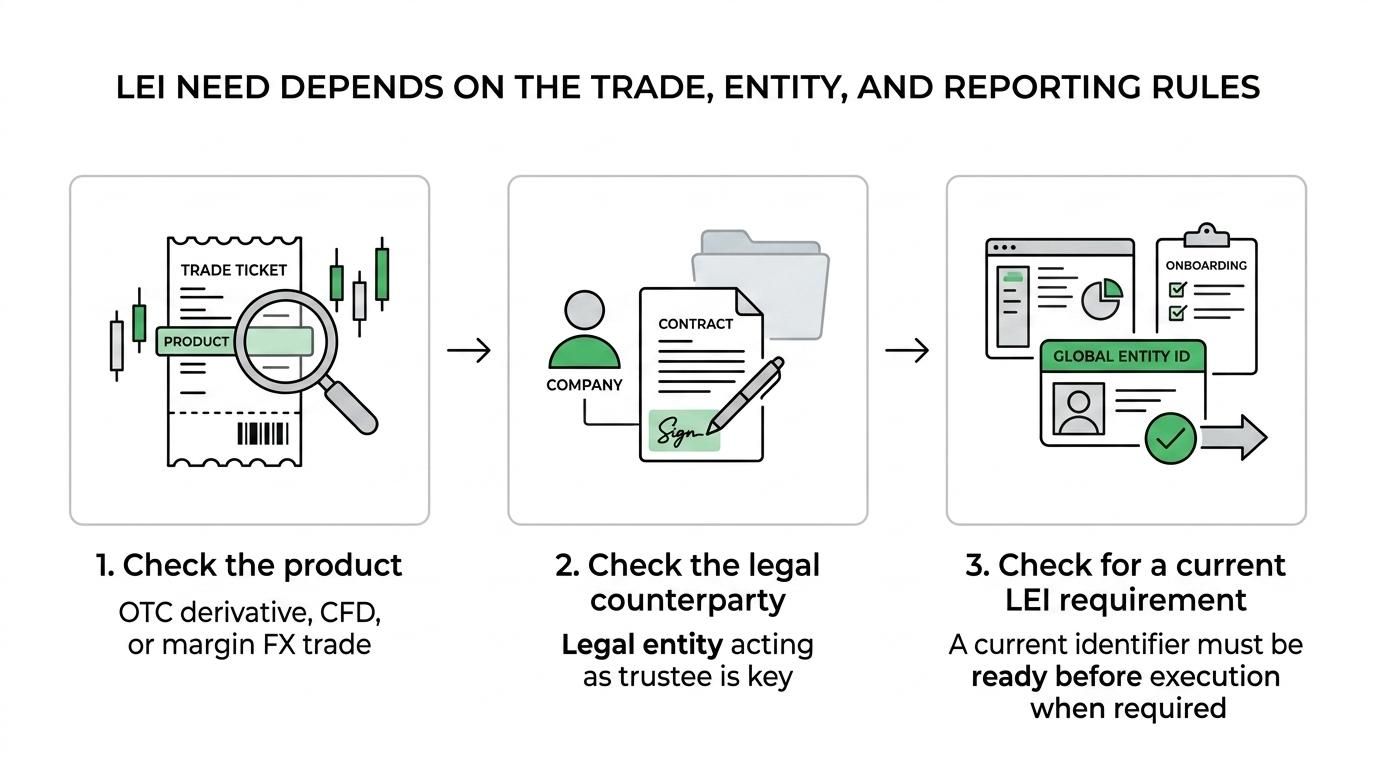
Start with the product and reporting regime. If the transaction is an OTC derivative and the corporate trustee is the reporting entity or counterparty, ASIC rules point strongly toward a current LEI.
Step 1 is to classify the product properly. Many trustees assume an LEI is only relevant to large institutional swaps books. That is too narrow. CFDs, margin FX, and other OTC derivative products can raise the same question because the rule turns on the transaction type and reporting setup, not on whether the entity feels “institutional”.
Step 2 is to identify the legal entity that is actually entering the contract. Read the application form, master agreement, confirmation, and account name. If the company signs as trustee, that company is usually the right place to start.
Step 3 is to confirm whether reporting or onboarding requires a standard identifier. ASIC’s 2018 market integrity update said financial entities reporting OTC derivative transactions must report a standard identifier for any company or other entity, excluding individuals, that is a counterparty to an OTC derivative transaction. ASIC listed LEI first in that hierarchy, ahead of AVID and BIC, and the standard identifier hierarchy, ahead of AVID and BIC.
If the counterparty asks for an LEI before trade execution, treat that as a live operational requirement, not a paperwork issue to leave until later. ASIC also warned that entities subject to OTC transaction reporting may not be able to execute a trade with a counterparty entity that has not registered and provided the standard identifier.
Is an LEI different from an ABN, ACN, or the trust name?
Yes. An LEI is a global identifier for a legal entity, while an ABN and ACN are Australian registry identifiers and a trust name may not be a separate legal entity.
That difference matters because each identifier answers a different question. An ACN identifies an Australian company under company law. An ABN identifies an entity for Australian business and tax administration. An LEI identifies a legal entity participating in financial transactions across the global LEI system.
GLEIF describes the Global LEI System as a joint initiative of regulatory authorities and the private sector to identify legal entities engaged in financial transactions. GLEIF also describes LEI data as a global directory that improves market transparency. In practical terms, an ABN can tell an Australian counterparty who you are locally, but it does not replace the LEI when an LEI is the required reporting identifier.
A trust name adds another layer of confusion. A trust name may be commercially familiar, but the transaction still needs to map to the correct legal entity. If the company trustee is the legal person on the documents, the trust name alone is rarely enough.
Can a corporate trustee trade without an LEI if it already has an AVID or BIC?
Sometimes, but not safely as a default. ASIC placed LEI first in the standard identifier hierarchy, ahead of AVID and BIC, and some counterparties may refuse or delay execution without it.
This is where timing creates problems. A trustee may have used an AVID or BIC historically and assume that nothing more is needed. Yet ASIC’s framework clearly elevated LEI within the hierarchy, and market practice has moved the same way. If the counterparty’s controls, reporting engine, or overseas obligations are built around LEIs, the older identifier may not solve the issue.
A useful rule is this: if the trade, platform, or broker asks specifically for an LEI, do not argue from analogy. Provide the LEI or confirm in writing why another identifier is accepted. Otherwise, you risk a failed onboarding, delayed execution, or follow-up remediation work after the trade is booked.
How do you apply for an LEI for a corporate trustee in Australia?
Apply in the company trustee’s exact legal name and registry details. LEI Service Australia offers new registrations, transfers, and renewals for Australian entities that need the code quickly for trading or reporting.
Step 1 is to confirm the applicant. The LEI should match the legal entity that is entering the transaction, not simply the name people use informally for the trust structure. This is the single biggest accuracy issue.
Step 2 is to prepare the core entity data. That usually includes the company’s exact registered name, local registry reference, address details, and contact information. Some trustees hesitate because the trust structure looks complex, yet the LEI application itself is usually much simpler once the right legal entity has been chosen.
“LEI Service Australia offers same-day LEI issuance when ordered before 6 PM, which can matter when a trustee is facing a trading or onboarding deadline.”
Step 3 is to choose how the LEI will be maintained. A rushed issue date helps only if the record stays current. If the trustee expects repeat activity, renewals and entity data maintenance should be planned from the start rather than treated as an afterthought.
What details and documents should a corporate trustee prepare before applying?
Prepare the company’s exact registered name, local registry data, business address, and the capacity in which it trades. The key test is whether the legal entity on the form matches the legal entity on the transaction documents.
If your brokerage agreement, derivative confirmation, or investment mandate names the company “as trustee for” a trust, make sure the application mirrors that legal reality. Common mistake: people attach trust paperwork but enter the wrong applicant name.
Useful preparation usually includes:
- Registered legal name: The exact company name on the registry
- Registry reference: ACN or other official company registration data
- Entity address: Registered office and, where needed, headquarters details
- Authorised contact: The person who can verify and manage the record
- Trading capacity: Confirmation that the company acts as trustee for a named trust
- Supporting documents: Account forms, mandates, or confirmations showing the contracting entity
If the counterparty’s onboarding team uses different wording from your internal records, pause and reconcile it. Small naming mismatches can cause preventable delays.
How do renewals, transfers, and data updates work once the LEI is issued?
An LEI is only useful if it stays current. GLEIF records need ongoing maintenance, and a lapsed or stale record can cause reporting problems even if the original code was valid when issued.
Step 1 is annual renewal. The market expects a current LEI, not just an LEI that once existed. If the renewal date passes, the code may still be visible, but some users and systems will treat it as inactive or unsuitable for live reporting.
Step 2 is updating reference data when the company changes. A new address, name change, merger, or restructuring can require the LEI record to be updated. This is especially important for trustee companies that change service providers, directors, or group structure over time.
Step 3 is transfer if your current LEI is held through another registration agent or provider and you want renewal managed elsewhere. A transfer does not create a new LEI. It keeps the same code while moving administration so the record can be renewed and maintained correctly.
What should a corporate trustee check before the next trade?
Check the product, the contracting entity, the reporting obligation, and the counterparty’s onboarding rules. If any one of those points identifies the corporate trustee as the legal entity in a reportable trade, obtain or renew the LEI before execution.
A practical way to think about it is simple. If the product is an OTC derivative, then check ASIC reporting settings first. If the company signs as trustee, then start with the company as the likely LEI applicant. If the broker, bank, or venue asks for a standard identifier, then verify whether they require a current LEI rather than relying on older identifiers.
This approach also helps outside derivatives. A fund trustee, charity trustee, or SMSF corporate trustee may not need an LEI every day, yet a single new trading relationship can change the answer quickly. The right question is never “do trusts need LEIs?” It is “which legal entity is transacting here, and what does the rule or counterparty require?”