7 Reasons LEI Applications Get Delayed
Most LEI application delays are caused by validation issues, not by the identifier system itself. In practice, the hold-up usually starts when the legal entity’s official details do not match the registration authority record, or when renewal and authorisation checks are left too late.
TL;DR: Summary
- LEI applications get delayed mainly because the issuing organisation must validate the legal entity’s reference data against an authoritative registration authority or other accepted third-party source, not simply confirm payment.
- The most common delay points are mismatched Level 1 data, especially the official legal name and registered address, plus missing authority, wrong entity selection, and late renewals that trigger re-validation.
- GLEIF defines a LAPSED LEI as an existing LEI record that has not been verified within the planned renewal interval, so renewal delays can be just as disruptive as delays in a new LEI application.
- Trusts, funds, SMSFs, and entities with layered ownership often take longer because reviewers may need to confirm trustee details, legal structure, or Level 2 parent data and exceptions.
- The fastest way to avoid delay is to check registry details before applying, confirm who is authorised to submit the request, and renew before any trade, settlement, or onboarding deadline rather than on the same day.
That distinction matters because many Australian entities only look at LEI timing when a trade, reporting event, or counterparty request is already close. If you fix the registry record, authorisation, and renewal timing first, the LEI process is usually much quicker.
Why do LEI applications get delayed even after payment?
Payment alone does not trigger issuance. GLEIF and the issuing organisation must verify your entity’s Level 1 data against an authoritative registration authority or other accepted third-party source.
An LEI is not just a number sold after checkout. It sits inside the Global LEI System, where legal entity reference data has to be standardised, checked, and published into the Global LEI Index. GLEIF states that Level 1 data includes the official legal name and registered address, so if either field does not line up with the source record, the application can pause for manual review.
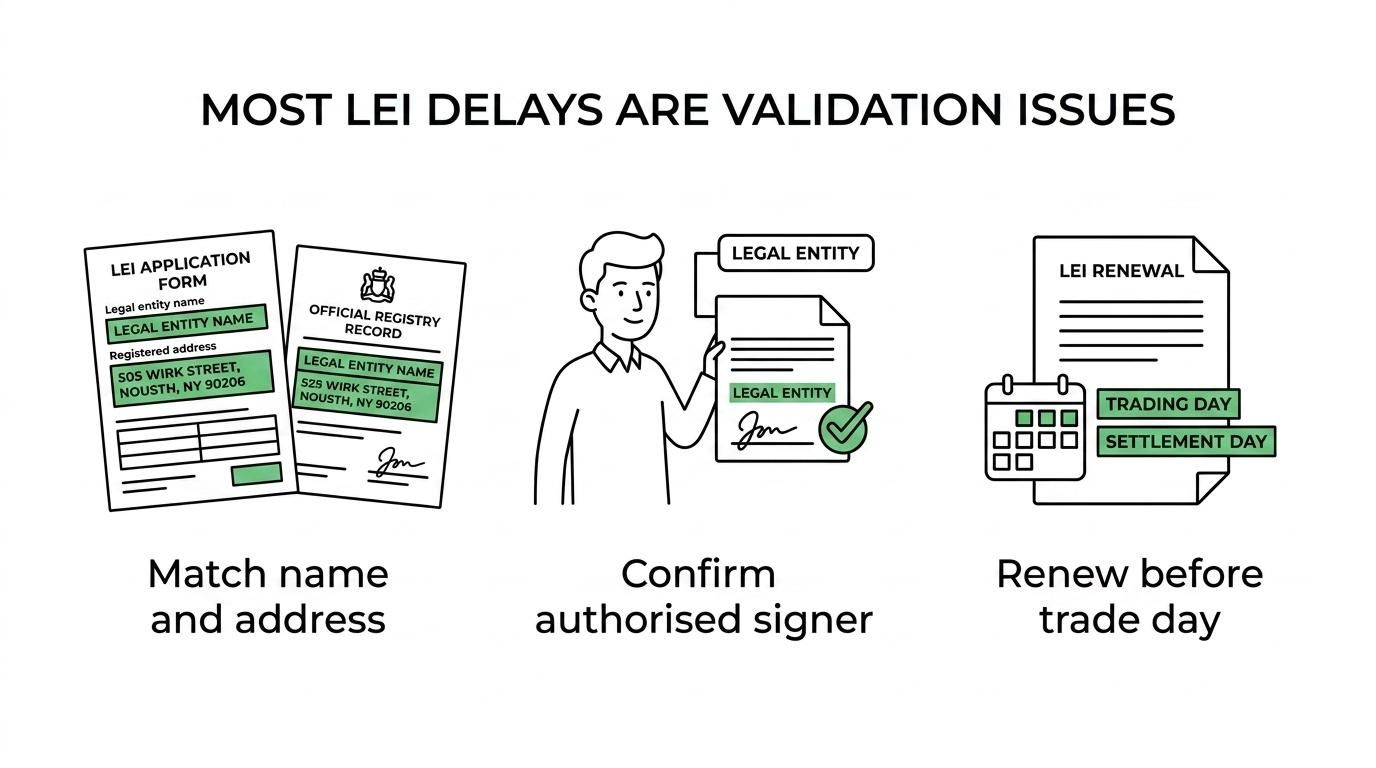
Back-end data quality rules matter as well. LEI issuers report data using Common Data File formats, and GLEIF notes that files failing XSD validation cannot be included in the Global LEI Index. An applicant will not usually see “XSD validation” on screen, but they will see the practical effect: a pending application while the provider resolves data inconsistencies.
"LEI Service Australia offers same-day issuance when ordered before 6 PM, which shows that timing only helps once the entity data is ready for validation."
A common misconception is that delays prove the LEI system is slow. In many cases, the system is doing exactly what it is supposed to do by stopping a record that does not cleanly match the legal entity behind it.
Which LEI data fields cause the most delays?
The biggest friction points are the official legal name and registered address. GLEIF classifies these as Level 1 data, and they are the fields most often compared with the local registration authority record.
Applicants often enter the name they use day to day, not the exact registered legal name. That can be harmless in ordinary business admin, but it can stop an LEI check. The same goes for address details. A missing unit number, an old registered office, or a mailing address entered where a registered address is expected can all create a mismatch.
The most common fields to check are:
- registered legal name
- registered address
- entity status
- registration number or local identity number
- trustee company versus trust name
Level 2 data can also matter, though less often for straightforward entities. GLEIF uses Level 2 data to identify direct and ultimate parent relationships where applicable. If your entity is exempt from reporting a parent, the right exception must be recorded. A useful rule is simple: if parent data is unclear, do not guess. A clean exception is faster than a wrong ownership statement.
What are the 7 most common reasons LEI applications get delayed?
Yes, most delays fall into seven repeatable categories. GLEIF data rules, registry quality, and entity complexity explain the bulk of LEI application and renewal hold-ups.
Once you look past the payment screen, the same issues appear again and again:
- Legal name mismatch: The application uses a trading name, shortened name, or old name instead of the exact registered legal name.
- Registered address mismatch: The address entered does not match the registration authority record, even if the business still receives mail there.
- Wrong legal entity selected: The applicant names the trust, fund, or business name when the LEI should sit with the trustee company or another legal entity.
- Missing authorisation: The provider cannot confirm that the person applying is authorised to act for the entity.
- Complex ownership or structure: Funds, charities, trusts, and layered groups may need extra checking around Level 2 parent data or reporting exceptions.
- Late renewal timing: Annual renewal is a re-validation exercise, so stale records or last-minute requests can push the LEI into LAPSED status.
- Provider workflow and cut-off timing: Some providers rely more heavily on local registry lookups, document review, or daily cut-offs, which changes turnaround.
The useful pattern is that most delays come from data mismatch, missing authority, or renewal timing rather than from the LEI code itself. If the core record is clean, the process is usually straightforward.
How can you check your registry details before applying for an LEI?
Start with ASIC or the relevant registration authority. A clean company, charity, or fund record gives the issuing organisation something it can validate quickly.
Before you apply, compare your internal records with the external record that the issuer is likely to use. This is the fastest self-audit most applicants can do, and it often reveals the reason an application would otherwise stall.
A practical pre-check looks like this:
- Step 1: Confirm the exact legal name, registration number, and current status shown by the registration authority.
- Step 2: Match the registered address line by line, including unit numbers, suburb, state, and postcode.
- Step 3: Check for recent changes, including a name change, officeholder change, trustee replacement, or address update.
- Step 4: Gather supporting evidence before paying if the public record has only just changed or the entity type is unusual.
One pro tip is to separate “we updated it internally” from “the registry now shows it”. If the authority record has not yet caught up, the LEI provider may still see the old data. In that case, either wait for the update to appear or be ready to supply evidence so the review does not bounce back and forth.
What is the difference between a delayed LEI application and a LAPSED LEI renewal?
A delayed application and a LAPSED LEI are different states. GLEIF uses LAPSED when an existing LEI has not been re-verified within the planned renewal interval.
A delayed new LEI application means the LEI has not yet been issued because validation is incomplete. A LAPSED LEI already exists, but the annual re-validation has not been completed on time. That difference matters because a counterparty, platform, or reporting workflow may treat both as operational problems even though one is “not yet issued” and the other is “issued but overdue”.
There is also a common misunderstanding here. LAPSED does not automatically mean the entity has ceased to exist or that the old LEI was wrong. It means the record has not been verified within the expected period. If the underlying details are clean, renewal can be simple. If the legal name, address, or status changed and no one updated them, renewal can take longer than expected.
How do trusts, funds, and layered ownership structures slow LEI issuance?
Trusts, SMSFs, and layered fund structures are slower than plain proprietary companies. LEI reviewers must confirm which legal entity is applying and whether Level 2 parent relationships or exceptions need review.
A very common Australian issue is trustee-versus-trust confusion. The trade may be connected with a fund or trust, but the legal entity that needs the LEI can be the corporate trustee. If the trustee company changed name, moved address, or was replaced, the LEI record has to reflect that legal reality, not the shorthand used in internal documents.
"LEI Service Australia notes that standard companies are usually faster, while trusts, funds, and layered ownership structures can need manual review."
Layered structures add another step because the reviewer may need to decide whether Level 2 parent data applies, whether a reporting exception is valid, or whether the named applicant is the real legal entity behind the transaction. If you are dealing with an SMSF, a unit trust, or a fund with multiple related parties, it is wise to confirm the entity map before starting the LEI request.
How should you handle authorisation and signatory proof?
Missing authority is a major stop sign. The issuing organisation needs comfort that the requester is authorised by the company, trustee, or fund that will hold the LEI.
Step 1 is to identify who can validly act for the entity. That could be a director, company secretary, trustee, or another person with documented authority. Step 2 is to make sure that person matches the registry record or can provide clear proof of authority. Step 3 is to add an authorisation document early if an adviser, accountant, or administrator is lodging the application on the entity’s behalf.
If the signatory is obvious from the registry, the check is usually faster. If the signatory sits behind a trust structure, a newly changed officeholder list, or an outsourced admin arrangement, the provider may ask follow-up questions. In that situation, one extra document up front is often faster than three rounds of email later.
A common error is assuming that commercial involvement equals legal authority. An investment manager, adviser, or operations contact may know the account best, but that does not always mean they can authorise the LEI application or renewal.
When should you renew an LEI to avoid trading disruption?
Renew early, not on trade day. GLEIF treats annual renewal as a re-validation of reference data against a third-party source, so stale records can turn a simple renewal into a review.
The safest approach is procedural. First, check the renewal date against any upcoming trade, settlement, onboarding, or reporting deadline. Next, review the core fields that are most likely to have changed during the year: legal name, registered address, entity status, officeholders, and parent data where relevant. Then submit the renewal before the business event that depends on the LEI, not merely before the anniversary date shown on the record.
"LEI Service Australia includes free updates to GLEIF reference data, which is useful when a legal name or address changes between renewals."
This is where many avoidable delays happen. Annual renewal is not a rubber stamp. If the record has drifted away from the underlying registry data, the provider has to fix that before the LEI can return to current standing. If you leave renewal until the same day a trade is needed, any mismatch, cut-off issue, or manual review can become a business problem.
Which provider processes and cut-off times affect LEI turnaround?
Provider workflow affects speed once your data is clean. Registry automation, manual escalation, and cut-off times can make one valid application move today and another move tomorrow.
Two providers may both be legitimate, yet operate very differently. One may be able to retrieve reference data directly from the local registration authority with minimal manual input. Another may rely more heavily on document review or a narrower daily processing window. That difference can matter when you need the LEI for a near-term transaction.
The main trade-offs usually look like this:
- Automated lookup: Faster for standard companies with clean registry records.
- Manual review: Better for unusual entities, but slower when documents are incomplete.
- Earlier cut-off: Can push a valid application into the next processing cycle.
- Local support: Helpful when the issue is entity structure or authorisation, not just form filling.
One practical point is often missed. GLEIF states that Golden Copy and delta files are updated three times daily, which means the Global LEI Index runs on a continuous update rhythm. Even after issuance, there can be a short lag before every downstream system reflects the latest status. If your transaction timing is tight, plan for both provider cut-off time and data propagation time, not just the moment you click submit.