8 LEI Mistakes First-Time Applicants Make
Most first-time LEI application mistakes are data and timing problems, not mysterious system failures. If the legal name, registered address, or applicant authority does not match the source register, the file usually slows down in validation.
TL;DR: Summary
- The biggest LEI application mistakes are using the wrong legal entity details, relying on outdated registry data, choosing the wrong entity or applicant, and leaving renewal too late.
- GLEIF requires Level 1 data to match official registers, especially the legal name and registered address, so trading names, PO boxes, and old addresses often trigger review.
- In Australia, ABR guidance says address changes should be updated within 28 days, which means many LEI issues start before the application is even submitted.
- A first-time applicant should check the official record first, confirm who is authorised to act, and note the LEI’s Next Renewal Date as soon as the code is issued.
- If an LEI is not renewed and re-certified on time, GLEIF says the record can become lapsed, which can interrupt trading, onboarding, or reporting.
That matters in Australia because the LEI record follows GLEIF standards, while the underlying entity details often come from ABR or another official register. A clean application starts before you press submit: verify the entity record, use the exact registered details, and make sure the person applying can act for the entity.
Why do first-time LEI applications get delayed?
Most delays come from validation checks, not from GLEIF or the LEI format itself. When an entity’s legal name, registered address, or applicant authority does not match the source register, the issuer usually pauses the application for review.
A first-time applicant often assumes the LEI form is the whole task. It is not. The form is only the front end of a data-validation process that checks whether the entity exists, whether the submitted details line up with official records, and whether the person applying has a valid basis to do so.
Complex structures slow things further. Trusts, funds, SMSFs, and layered ownership structures may need extra review because the issuer may need to confirm trustee details, legal structure, or parent data before issuing the code.
"LEI Service Australia can issue an LEI the same day when an order is placed before 6 PM, but only if the entity data validates cleanly."
What details must match official registers in an LEI application?
GLEIF requires Level 1 data to reflect official registers, especially the legal name and registered address. In Australia, that usually means the LEI application should mirror the current ABR or other relevant registry record, not the version people use on invoices or websites.
GLEIF defines Level 1 data as the "who is who" layer of the LEI record. It covers the official name of the legal entity, the registered address, the country of formation, and core record dates. A common mistake is typing what looks right rather than what the register says word for word.
After you check the register, compare these fields carefully:
- Legal name: Match the exact registered name, including suffixes like Pty Ltd or Limited.
- Registered address: Use the official registered or legally recorded address, not a postal box or adviser address.
- Country of formation: Keep it consistent with the entity’s legal origin.
- Entity status fields: Expect the issuer to check update dates and registry consistency during validation.
A useful rule is simple: if the register and the application disagree, the register wins. Common misconception: a business name, trading name, or brand is not the same thing as the legal entity name used for an LEI.
What are the 8 LEI mistakes that catch first-time applicants?
The most common LEI mistakes are predictable and preventable. GLEIF, ABR guidance, and Australian application experience all point to the same pattern: the trouble usually starts with source data, authority, or timing.
- Using a trading name instead of the exact registered legal name.
- Entering a postal, tax agent, or correspondence address instead of the official registered address or physical street address.
- Selecting the wrong entity type, especially where a company, trust, fund, SMSF, or trustee structure is involved.
- Applying under the wrong party in a trust or fund structure, where the legal entity behind the arrangement is different from the product or scheme name.
- Submitting the application without clear authority to act for the entity.
- Assuming ABR or other registry details are current when the underlying record is outdated.
- Leaving related ownership or parent details inconsistent where the structure requires review.
- Treating the LEI as a one-off setup and missing the annual renewal and re-certification cycle.
These mistakes matter because each one creates a validation question. If there is a question, the issuer either asks for evidence or waits for the register to be corrected, which is why a five-minute form can turn into a multi-day delay.
How do you check your entity data before submitting an LEI application?
A fast pre-check with ABR and the official entity record prevents most LEI application errors. The best workflow is to confirm the source data first, then submit only what already matches that record.
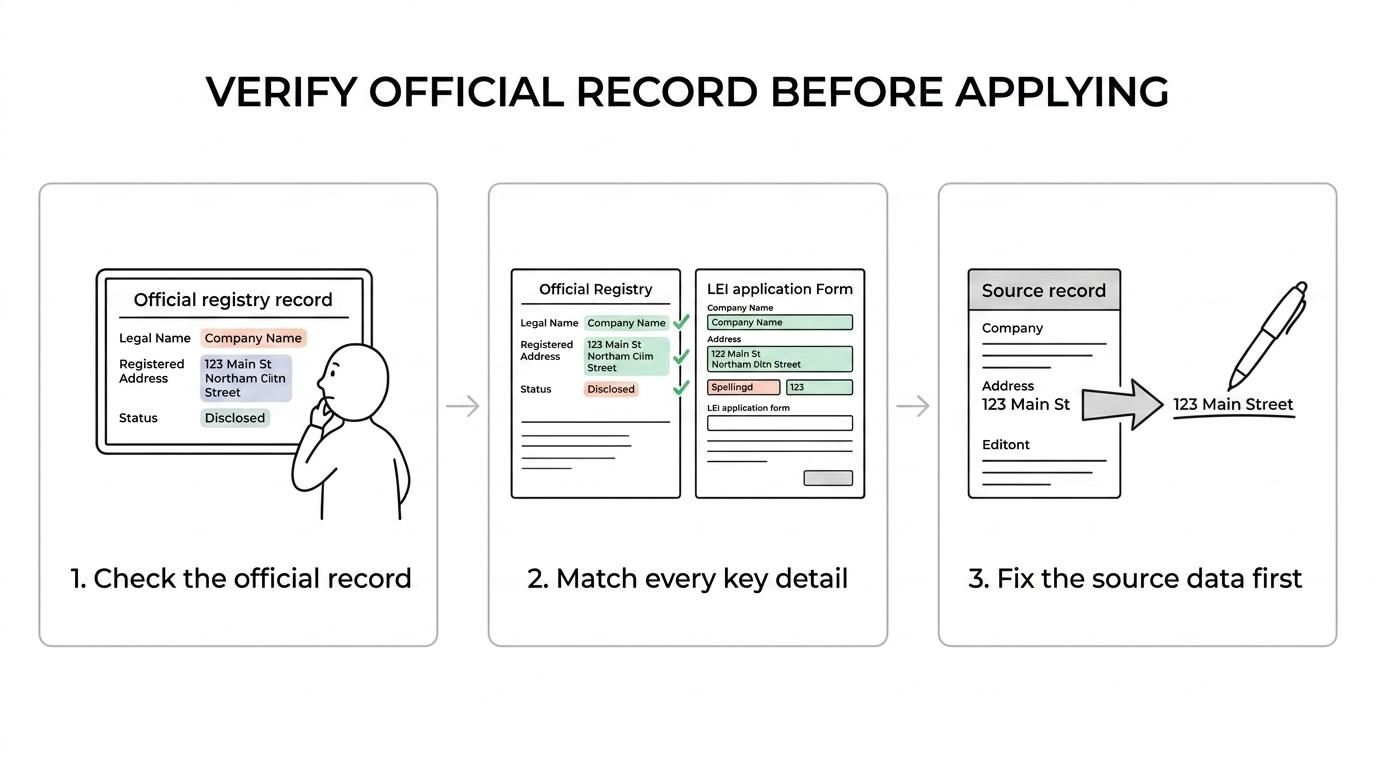
Step 1 is to pull the current official record for the entity. For many Australian organisations, that means checking ABR details and any other relevant register used to evidence the legal entity. Look closely at the legal name, address, and status. If the address changed recently, ABR guidance says updates should be made within 28 days of becoming aware of the change.
Step 2 is to compare the register against the data you plan to enter. Do not rely on your ERP, CRM, trading portal, or signature block. Those systems often contain shorthand names, old addresses, or mailing details that are fine for operations but wrong for LEI validation.
Step 3 is to fix the source record before you apply if anything is off. Pro tip: correcting the register first is usually faster than trying to explain away a mismatch after the application has already been flagged for review.
"LEI Service Australia includes free updates to LEI reference data, which helps when a registered address or legal name changes after issue."
Who should apply for the LEI, and what counts as valid authority?
The right applicant is the entity itself or someone clearly authorised by it, such as a director, trustee, or approved representative. GLEIF-based workflows often accept delegated applications, but the authority to act still needs to be credible and reviewable.
For a simple company, authority is usually straightforward. A director, company secretary, or internal authorised officer is commonly the cleanest path. For a fund, trust, or SMSF, the legal entity may be the trustee or another legally recognised body, which is where first-time applicants often get confused.
A frequent misconception is that any adviser can apply just because they already manage tax, registry, or settlement tasks. An accountant, broker, or administrator may be able to submit the request, but if the issuer cannot see a clear authority chain, the file may stop until supporting evidence is provided.
If the structure is layered, ask one question first: who is the legal entity that will hold the LEI? If that answer is unclear, the application is not ready yet.
Is a registered address the same as a postal or trading address?
No. ABR and GLEIF treat official address data differently from mailing or day-to-day operating details, and mixing them up is one of the most common LEI application mistakes.
ABR guidance says the business or organisation location should be the physical street address, not a postal address or tax agent address. GLEIF’s Level 1 framework then expects the LEI reference data to reflect the official register entry. That means a PO box may be useful for correspondence, but it is usually not the right data point for validation.
A practical way to separate the terms is this:
- Registered address: The official address held on the relevant register and used for legal identification.
- Postal address: A correspondence address, often unsuitable for LEI validation.
- Trading address: The place operations occur, which may or may not be the official legal address.
Pro tip: if the entity moved offices but the register still shows the old address, the LEI application should wait until the official record is corrected, unless the issuer’s process clearly supports the updated evidence.
Should you apply yourself or use an LEI registration service?
A direct self-application works well for a simple Pty Ltd with clean registry data. A service is often more efficient for trusts, funds, renewals, transfers, or any structure where authority and source data need checking.
The trade-off is simple. Doing it yourself may save a service fee if the entity is plain-vanilla and the register is perfect. Using a specialist service can save back-and-forth when the structure is less obvious, the deadline is close, or the organisation wants someone else to handle submission, follow-up, renewal, and data maintenance.
Australian applicants often use service firms such as LEI Service Australia when they want assisted registrations, renewals, or transfers handled in English with local support. That is especially useful where the entity does not have an ACN at hand, needs help matching the correct legal structure, or wants ongoing maintenance once the LEI is active.
"LEI Service Australia offers 1-year LEI registrations from $97 and multi-year discounts for organisations that want renewal handled upfront."
How do LEI renewals work, and when does a code become lapsed?
LEIs require annual renewal and re-validation under GLEIF rules. The key date is the Next Renewal Date on the LEI record, and missing it can push the status to lapsed after the due date and any issuer grace period.
Step 1 is to treat the issue date and the renewal date as part of the same process. When the LEI is first assigned, note the Next Renewal Date immediately and add it to the organisation’s compliance calendar.
Step 2 is to complete renewal and re-certification no later than one year after the previous validation check. This is not only admin. It is the mechanism that keeps the LEI record current and usable for counterparties, platforms, and reporting obligations.
Step 3 is to avoid the common misconception that a lapsed LEI has simply "expired like a subscription". The number still exists, but the record is no longer current enough for many practical uses, which can interrupt onboarding or market activity.
If the entity trades, reports, or settles through a venue or counterparty that checks LEI status, late renewal can become a real operational problem very quickly.
What should you do if your LEI application is rejected or stuck in review?
The best response is to diagnose the mismatch, fix the source issue, and resubmit with clear evidence. GLEIF-based validation is usually logical, so the solution is often visible once you compare the file against the official record.
Start by asking what the reviewer could not validate. If it is the legal name, compare it character by character with the register. If it is the address, check whether you entered a postal address instead of the official one. If it is authority, identify who can actually act for the entity and gather proof.
Keep the evidence set tight and relevant:
- recent register extract
- proof of a completed address update
- trustee or entity-structure document
- authority email, resolution, or appointment record
Then decide the next move with if-then logic. If the registry data is wrong, update that first. If the registry data is right but the application is wrong, correct the submission. If the structure is unusual, respond with the clearest document that ties the named applicant to the legal entity behind the LEI request.
A rejected or paused application is usually recoverable. The fastest recovery comes from treating it as a data-quality issue, not as a mysterious compliance obstacle.