AVID vs LEI: Key Differences in Australia
For many Australian entities, the shift from AVID to LEI is no longer a technical detail buried in reporting manuals. It is now a practical compliance issue with immediate consequences for OTC derivatives reporting, counterparty identification, and internal onboarding processes.
The key point is simple: AVID, BIC, and active ABN have appeared in Australia’s reporting framework as designated business identifiers, yet the regulatory direction has moved firmly toward the Legal Entity Identifier. Since the ASIC reporting-rule changes that took effect on 21 October 2024, LEI has become the identifier that matters most for relevant counterparty reporting.
Why AVID and LEI matter for Australian reporting
An AVID code and an LEI both identify legal entities, but they sit in very different places in today’s reporting environment.
AVID was issued by Avox and has long been familiar in parts of the financial sector. BIC, while widely recognised in payments and banking, was also used in some reporting contexts. In Australia’s OTC derivatives transaction reporting rules, these identifiers were grouped with an active ABN under the concept of a Designated Business Identifier.
LEI is different. It is a globally accepted identifier built for legal entity identification across jurisdictions and reporting regimes. That broader acceptance is exactly why regulators and market infrastructure have increasingly shifted toward it.
This matters most where consistency is essential. A locally familiar identifier may work within one system or historic workflow. An LEI is designed to work across borders, counterparties, repositories, and regulatory frameworks with a single reference point.
AVID vs LEI differences for Australian entities
The easiest way to frame the comparison is this: AVID reflects an older route for entity identification in some financial reporting settings, while LEI is the current standard Australian entities should expect to use when reporting counterparties under the updated rules.
| Feature | AVID / BIC / active ABN | LEI |
|---|---|---|
| Regulatory position in Australia | Historically recognised through the Designated Business Identifier concept | Required identifier for relevant counterparty reporting from 21 October 2024, subject to limited rule-based allowances |
| Geographic scope | More limited or context-specific | Global and standardised through the Global LEI System |
| Best fit | Legacy reporting processes and older data records | Current counterparty identification and ongoing reporting |
| Interoperability | Can be narrow across systems | Strong cross-border usability |
| Long-term direction | Being phased out for this purpose | Adoption is increasing |
That comparison helps explain why many Australian firms have had to review long-standing reporting data fields. If a process still assumes AVID or BIC is enough, it may now be out of step with current reporting expectations.
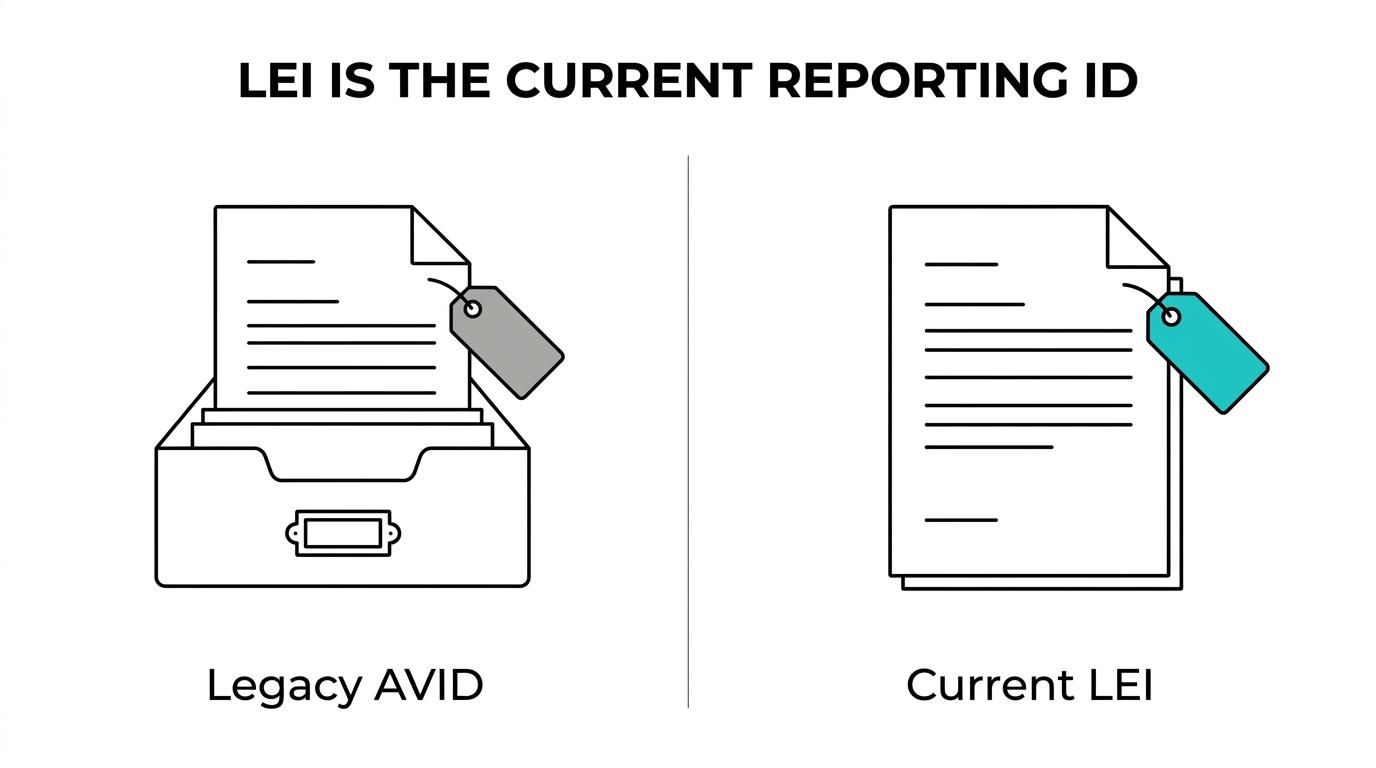
A common point of confusion is the ABN. The rules have treated an active ABN as a designated business identifier, yet that should not be read as a substitute for the broader move to LEI. The current direction is clear even if the rule text includes narrow exceptions and transitional allowances.
ASIC reporting rules from 21 October 2024
The most important date is 21 October 2024.
Official legislative material states that a Designated Business Identifier includes an active ABN, an AVID, or a BIC code. Yet the same rules also make room for a change in format over time. For entity-identifier information, reporting entities may report in the format and value permitted by the rules prior to 21 October 2024 when the report relates to information from before that date.
That detail matters because it shows the phase-out is real, but not careless. Historic information can still be reported using older formats in the limited circumstances allowed by the rules. That is very different from saying AVID remains a general ongoing option after the rule change.
GLEIF has also tied Australia’s LEI shift directly to ASIC’s October 2024 rule changes, describing LEI as the only permitted entity identifier for counterparty identification under the updated framework, with AVID and BIC being phased out.
After the rule change, the practical reading for most firms is:
- Before 21 October 2024 data: older permitted identifier formats may still appear in reports relating to that earlier information
- From 21 October 2024 reporting: LEI is the identifier firms should expect to use for counterparty identification
- If no LEI is yet available: a designated business identifier or internal entity identifier can only be used if an LEI application is made within 2 business days after the reporting obligation arises
That final point is especially important for firms still mid-transition. The rules do not leave much room for delay.
When older identifiers still appear in Australian reporting
This is where nuance matters.
Some organisations will still see AVID, BIC, or ABN in templates, legacy data warehouses, old legal documentation, or historical trade records. That does not mean those identifiers remain the preferred route for current counterparty reporting. It often just means operational systems take time to catch up with legal and regulatory change.
There is also a distinction between historical reporting and fresh reporting obligations. If a report concerns information from before 21 October 2024, the older format allowance may still be relevant. If the obligation arises after that point, the expectation shifts strongly toward LEI.
For compliance teams, that creates a practical split between archive logic and live reporting logic.
Why LEI adoption is rising in Australia
The move away from AVID has not happened in isolation. It sits within a wider pattern of LEI adoption across the Asia-Pacific region.
GLEIF reported that Australia’s LEI issuance rose by 10% in Q3 and linked the increase primarily to ASIC’s updated OTC derivative transaction reporting rules that came into force on 21 October 2024. That gives a useful signal: the regulatory change is not theoretical. It is already changing market behaviour.
Another sign of momentum is the local build-out of LEI support infrastructure. GLEIF noted that Commonwealth Bank of Australia became the first Validation Agent based in Australia. Validation Agents support the Global LEI System by helping validate entity reference data during issuance.
A few implications stand out:
- stronger local awareness
- faster operational adoption
- cleaner counterparty data
- Regulatory pressure: reporting rules now favour LEI over older identifiers
- Market practice: more counterparties expect an LEI as part of onboarding and reporting readiness
- Data quality: a maintained LEI record supports more reliable entity reference data over time
For firms that have delayed the change, the market is moving anyway.
Choosing an LEI registration service in Australia
Once the regulatory need is clear, the next question is practical: how should an Australian entity get and maintain an LEI?
Price matters, though it should not be the only filter. Support matters too, especially where the applicant is a trust, fund, charity, subsidiary, or other entity type that may not fit a simple public-registry lookup. Renewal handling also matters because an LEI is not a one-off task. The reference data tied to the code needs to stay current.
A sensible shortlist usually includes:
- published pricing
- renewal options
- local support
- application speed
- data maintenance terms
LEI Service Australia publishes clear Australian pricing and support terms that speak directly to those points. Its pricing page lists a 1-year new LEI at A$97, a 3-year new LEI at A$267, and a 5-year new LEI at A$345. The same published terms state that phone and email support are free, and that updates are included if the legal entity’s details change.
Its published service information also states that new LEI numbers can be issued the same day when ordered before 6 PM, with unlimited email support and phone assistance available in English. For firms working against a reporting deadline, those details can make a real difference.
What to check before moving from AVID to LEI
The shift is straightforward when the groundwork is done properly.
Start by checking which entities in the group actually report, trade, or act as counterparties. Then review whether those entities already hold an LEI, whether the record is active, and whether the legal name and registration details match current source documents. An inactive or outdated LEI can create its own reporting friction.
After that, review internal systems. Reporting tools, treasury platforms, static data files, counterparty records, onboarding forms, and legal templates may still reference AVID or BIC as default fields. Those references should be updated so the operational process matches the regulatory requirement.
A useful internal checklist often includes the following:
- Identify affected entities: companies, funds, trusts, charities, and subsidiaries that report or face reporting obligations
- Confirm LEI status: new application, renewal, or transfer and renewal if an LEI already exists elsewhere
- Update reporting systems: replace legacy AVID or BIC fields where current counterparty identification requires LEI
- Set maintenance responsibility: nominate who will keep GLEIF reference data accurate over time
That last step is easy to overlook. The code itself is only part of the job. The reference data tied to it needs ongoing attention when names, addresses, registration details, or ownership information change.
LEI transition timing for Australian entities
Timing is now a commercial issue as much as a compliance issue.
If an entity waits until a reporting obligation has already arisen, the rules leave little room to improvise. There is limited allowance to use a designated business identifier or internal entity identifier where no LEI is yet available, but only if an LEI application is made within 2 business days. That is a narrow backstop, not a comfortable operating model.

For that reason, many organisations are better served by treating LEI as part of readiness planning rather than event-driven cleanup. A live, maintained LEI supports cleaner reporting, smoother onboarding, and fewer last-minute escalations when transaction activity picks up.
For Australian entities still comparing AVID and LEI, the answer is now far clearer than it once was. AVID belongs mainly to the legacy picture. LEI belongs to the current one.