Does Each Subsidiary Need Its Own LEI?
When a corporate group starts dealing with counterparties, trading venues, banks, or reporting rules that ask for an LEI, one question comes up quickly: can the parent company’s code cover the whole group?
In most cases, no. If a subsidiary is its own legal entity, it will usually need its own Legal Entity Identifier. That is the core logic of the LEI system.
The reason is simple. The LEI framework is built around legal entity identity, not brand identity, group identity, or operational identity. A parent and its subsidiary may sit under the same ownership structure, share directors, and trade under a similar name, yet still be separate legal persons. When that is the case, they are treated separately for LEI purposes.
How LEI rules identify a legal entity
An LEI is a unique 20 character alphanumeric code assigned to a legal entity. GLEIF, which oversees the global LEI system, treats each LEI as exclusive to one entity. In plain terms, one LEI belongs to one legal entity, and that code cannot stand in for another entity in the group.
That point matters because businesses often think in commercial terms rather than legal terms. A finance team may see “the group” as one operating unit. Regulators, trading systems, and reference data do not. They need to identify the exact legal person entering into a transaction or being reported.
This is why an LEI is issued to the legal entity itself, not to a trading name, desk name, division, or internal business line.
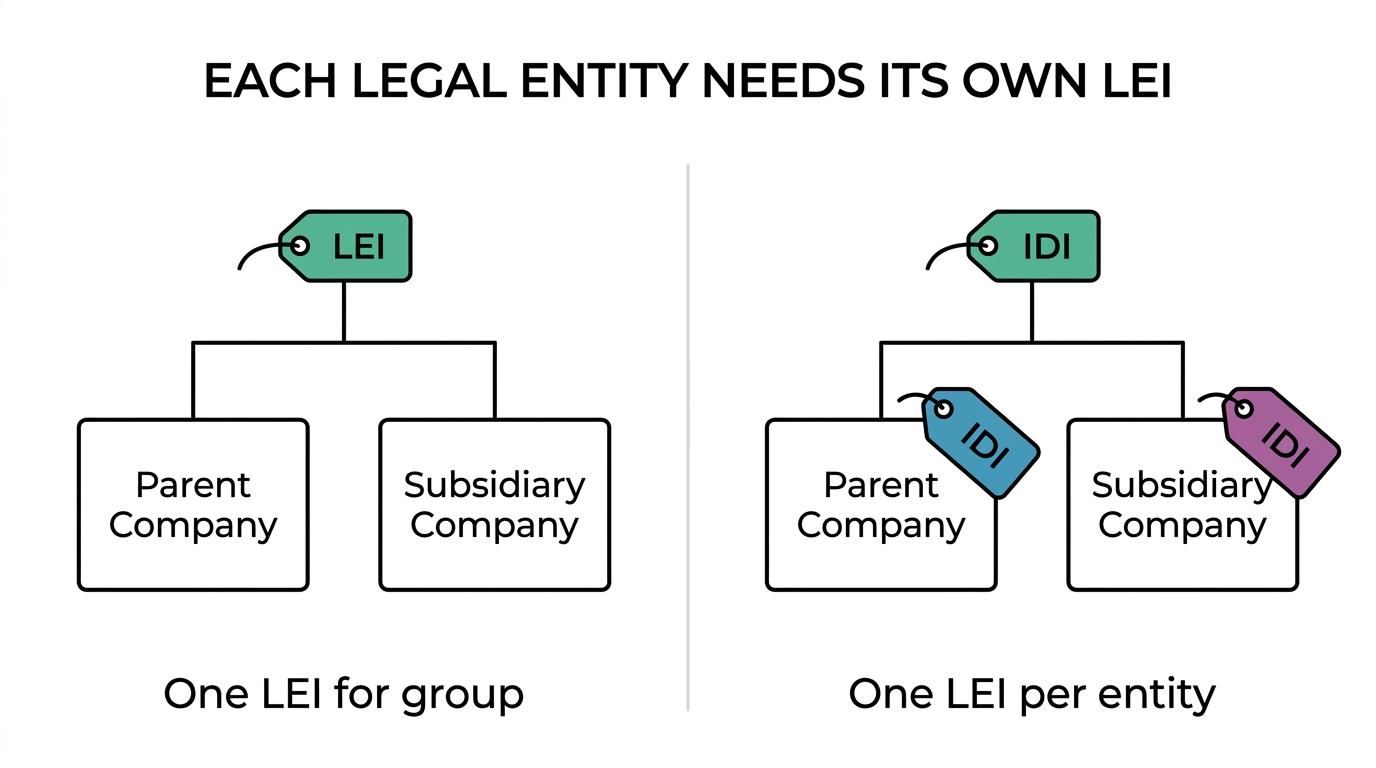
If the entity signing documents, holding assets, issuing securities, or being reported is a separate company or another separate legal person, the LEI should attach to that entity, not to its parent.
When a subsidiary needs its own LEI
A subsidiary generally needs its own LEI when it is legally distinct from the parent. That will usually be the case where the subsidiary is separately incorporated or otherwise formed as its own legal person under the relevant law.
In Australia and cross border group structures, that often means the subsidiary cannot rely on the parent’s LEI, even where the parent owns 100 per cent of it.
Common examples include:
- Proprietary limited companies
- Public companies
- Foreign incorporated subsidiaries
- Separate fund vehicles
- Corporate entities within charity groups
Ownership does not collapse separate legal identity. A wholly owned subsidiary is still not the same legal person as its parent. That is the central issue.
A practical way to think about it is this: if the subsidiary could enter into a contract in its own name, hold obligations in its own name, or appear as its own registrant in official records, it is likely to be treated as needing its own LEI when an LEI is required.
How branches differ from subsidiaries under LEI rules
Branches are where people often get caught out, because a branch can look independent in day to day operations while still not being a separate legal person.
GLEIF draws a clear line between a subsidiary and a branch. A subsidiary is legally distinct from its parent. A branch is part of the same legal person as the head office. That difference changes the LEI position.
Here is the practical contrast:
| Structure | Separate legal person? | Usual LEI position | Key reason |
|---|---|---|---|
| Parent company | Yes | Needs its own LEI if required | It is its own legal entity |
| Subsidiary | Yes | Usually needs its own LEI | It is distinct from the parent |
| Domestic branch | No | Usually covered by the head office entity | It is part of the same legal person |
| International branch | No, but separately recorded in some cases | May have a branch LEI record tied to the head office LEI | Branch identity is linked back to the same legal person |
| Division or business unit | No | No separate LEI | It is only an internal part of the entity |
| Trading name or brand | No | No separate LEI | It is not a legal entity |
This branch exception is narrow, and it should not be stretched. A branch is not just “a business operating in another place”. It must actually be legally dependent on the same head office entity.
That means a foreign subsidiary incorporated in another country is still a subsidiary, not a branch, even if it is fully controlled by the Australian parent and trades only within the group.
One short rule works well here: separate incorporation usually means separate LEI.
What Level 2 LEI data says about parent and child entities
The LEI system does not ignore group ownership. It captures that information through what is often called Level 2 data, which answers the question of who owns whom.
This is where direct and ultimate parent information appears, but there is an important condition. The parent child relationship can only be linked in the LEI system when both entities have LEIs.
That means a subsidiary can hold an LEI even if its parent does not. The subsidiary’s own identity can still be established. Yet the public ownership link inside LEI data may be missing until the parent also has an LEI.
A few points make this easier to read:
- Level 1 data: identifies the entity itself, including name, registration details, legal form, and address data
- Level 2 data: identifies direct and ultimate parent relationships where reportable and available
- Parent link condition: both the child and the parent need LEIs for the relationship to be visible in LEI records
- Branch treatment: branch records are handled differently from parent subsidiary ownership data
This can matter for counterparties, onboarding teams, and compliance staff who use the LEI search tool to check not only who the entity is, but also where it sits in a group.
So, if a group wants clean public visibility of its structure in LEI data, getting LEIs only for selected subsidiaries may leave gaps.
Practical examples for Australian groups
The easiest way to answer the subsidiary question is to test real scenarios.
Example 1: Australian parent with a wholly owned subsidiary
An Australian holding company owns 100 per cent of an operating subsidiary. The subsidiary enters derivatives trades in its own name.
The subsidiary will still need to apply for its own LEI. The parent’s LEI cannot substitute for it simply because the parent owns it.
Example 2: Australian company operating through a branch overseas
An Australian legal entity opens an overseas branch, and the branch is legally part of the same company rather than separately incorporated abroad.
This is not the same as a subsidiary. Depending on the branch setup and the relevant LEI treatment, the head office LEI remains central, and any branch record is tied back to that same legal person.
Example 3: Group brand used by multiple entities
A group trades publicly under one brand, but behind that brand there are several separate companies: a treasury company, a services company, and a funds management entity.
Each entity that is legally distinct and needs an LEI should hold its own code.
Brand unity does not create LEI unity.
Example 4: Parent has an LEI, child does not
A parent company already has an LEI because it issues debt. Its subsidiary now needs to enter a transaction where the counterparty requests an LEI.
The subsidiary will still need to apply for its own LEI. The parent’s existing code does not extend downward through ownership.
Questions to ask before applying for a subsidiary LEI
Before filing an application, it helps to step back and test the legal structure rather than the group chart alone.
Ask these questions:
- Is the subsidiary separately incorporated: If yes, that is a strong sign it needs its own LEI when an LEI is required
- Who signs the transaction: The entity named in the contract or trade is often the entity that needs to be identified
- Is it a branch or a subsidiary: Similar names and shared management do not answer this, legal status does
- Will parent child data matter: If the group wants visible ownership links in LEI records, both sides may need LEIs
- Is the entity active in regulated markets: Banks, brokers, repositories, and issuers often require precise entity level identification
This review is especially useful where Australian groups have foreign vehicles, trustee arrangements, restructuring history, or entities with very similar names.
Why this matters for renewals and group administration
Getting the initial answer right is only part of the job. Each LEI also needs to stay current through renewal and reference data maintenance.
That can become a group administration issue quite quickly. A corporate group with six or ten entities may have six or ten separate LEIs to monitor, each tied to the relevant legal entity record.
A tidy internal approach usually includes:
- central register of LEIs
- renewal dates tracked in one place
- legal names checked after restructures
- parent relationship data reviewed when ownership changes
Where groups want outside help, it makes sense to look for an LEI service provider that can handle new registrations, renewals, transfers, and bulk administration without making the legal team chase each record one by one.
For Australian entities, service features often worth checking include:
- Fast issuance: Useful where a trade or onboarding deadline is close
- Local language support: Helpful when confirming legal names, registry details, or parent data
- Bulk handling: Better for groups managing multiple subsidiaries at once
- Data updates: Valuable after name changes, mergers, or internal restructures
- Multi year options: Can reduce repeat admin for stable entities
A good process saves more than time. It reduces the risk of the wrong entity being identified, the wrong code being used, or a group relationship being left incomplete in public LEI data.
For most organisations, the safe starting point is clear: if the subsidiary is a separate legal entity, treat it as needing its own LEI unless a specific rule says otherwise. Branches are the main exception, and even there, the branch is handled by reference to the same legal person as the head office rather than as a substitute for a subsidiary.