How to Find an Australian Entity's LEI
Finding an Australian entity’s Legal Entity Identifier is usually simpler than people expect. The key is knowing where to search first, what data points matter, and what to do if the record does not appear straight away.
For most Australian organisations, an LEI lookup begins with the public database run by GLEIF, or with an ACN-based registry match through a service provider. If that path is unavailable, there are still workable alternatives, including assisted verification using other official records.
What an LEI lookup in Australia shows
An LEI lookup is a search for a 20-character Legal Entity Identifier and the reference data attached to it. That data typically includes the legal name of the entity, registered address details, country, entity status, and information about the registration and renewal state of the LEI itself.
GLEIF runs the public LEI Search and describes the Global LEI Index as the only global online source for open, standardised legal entity reference data. In practical terms, that means anyone can search the index to check whether an Australian company, fund, charity, trust structure, or other eligible entity already has an LEI.
That public visibility is what makes an LEI lookup so useful.
A search result can answer several questions at once. It can confirm whether an LEI exists, whether it is active, whether it has lapsed, and whether the legal name on the record matches the entity you are dealing with. For finance teams, compliance teams, and operations staff, that can save time before reporting, onboarding, or trading activity begins.
| Lookup route | Best used when | What you need | What you can confirm |
|---|---|---|---|
| GLEIF LEI Search | You want a public search of existing LEIs | Legal name, LEI code, or filters like country | Existing LEI, entity reference data, status |
| ACN-based provider lookup | You know the Australian company details | ACN or exact registered name | Registry match, possible existing LEI, next application step |
| Assisted verification | No ACN is available or registry lookup fails | Alternate official records and supporting documents | Entity identity for a new LEI or transfer workflow |
Where to start an Australian LEI search
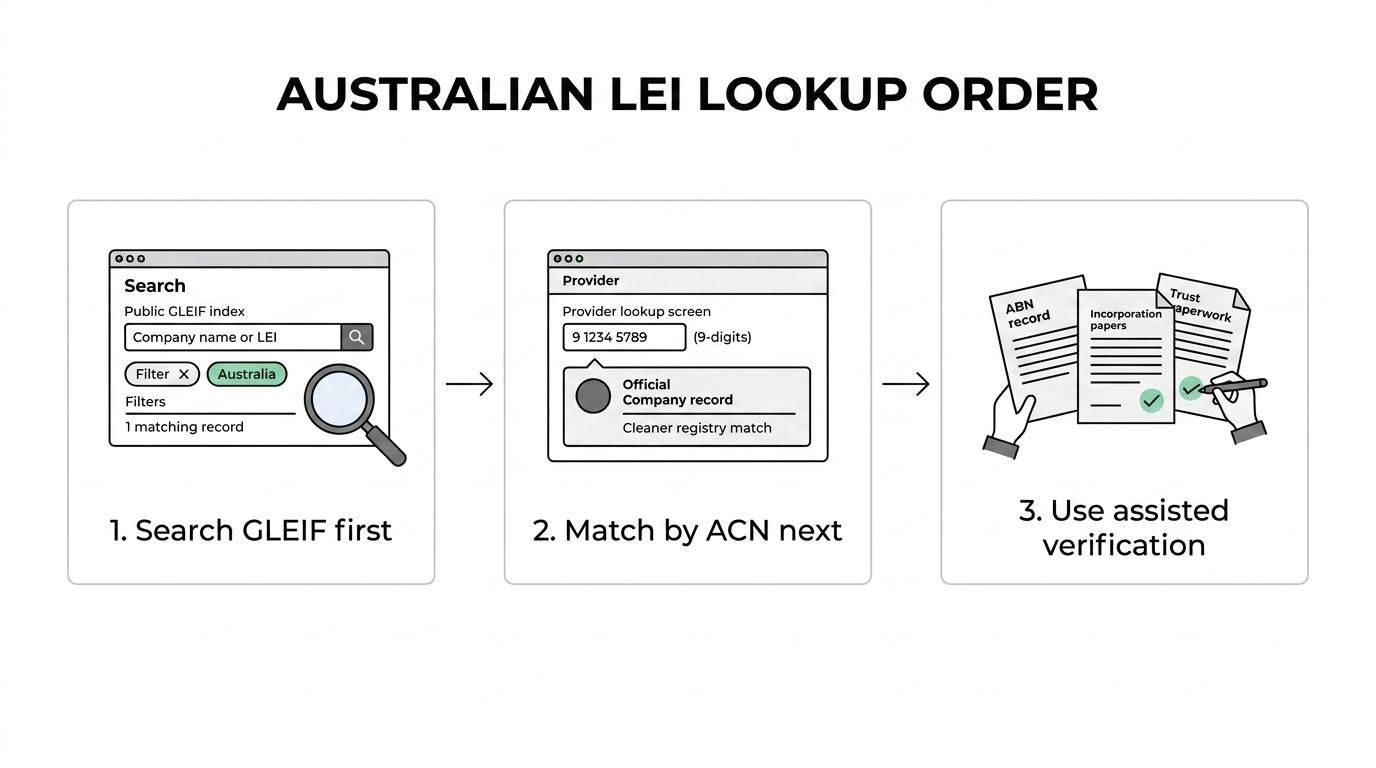
The fastest first step is often the public GLEIF LEI Search. You can search by LEI code, legal name, or other fields, then narrow the result using filters including country and legal-form codes. If you know the entity’s exact registered name, this route can be very efficient.
If the legal name is common, incomplete, or recently changed, an ACN-based lookup is often better. ASIC issues a 9-digit Australian Company Number to every registered company, and that number is frequently the cleanest way to match an entity to its official record before checking whether an LEI already exists.
Before running the search, it helps to gather a few details.
- Exact legal name
- 9-digit ACN
- Existing LEI, if known
- Registered address details
- ABN or other registry reference
Some Australian providers also let applicants begin with a registry lookup using either the business name or registration number. That can reduce errors at the start of the process and quickly show whether GLEIF already has an LEI record for the entity.
Why LEI lookup matters for Australian reporting
LEI searches are not just administrative housekeeping. In many cases, they sit directly in the path of regulated reporting and institutional trading.
ASIC has stated that, from 1 April 2019, financial entities reporting OTC derivative transactions under its rules must report a standard identifier for any company or other entity counterparty, excluding individuals. ASIC lists LEI, AVID, and BIC as standard identifiers for this purpose, and says entities should obtain an LEI if they do not already have one.
That means a lookup can be the first control point before a report is lodged.
A reliable search also helps when counterparties, custodians, banks, investment managers, or overseas trading venues ask for proof that an LEI is current. An inactive or mismatched record can slow onboarding or create avoidable remediation work later.
A lookup supports several day-to-day checks:
- Reporting checks: confirm that the counterparty identifier is valid before submission
- Onboarding reviews: make sure the legal name and entity details match current records
- Renewal control: see whether the LEI is active or due for renewal
- Counterparty risk review: verify that the entity exists in the global reference data pool
How to use the Global LEI Index for an Australian entity
The public GLEIF search tool is straightforward, but a structured approach gives better results, especially where names are long or similar across related entities.
Start with the cleanest identifier you have. If you already know the LEI, search by code. If not, search by the exact legal name that appears on official registration documents. Then narrow the results to Australia if the search returns too many matches.
A practical search sequence looks like this:
- Search the legal name exactly as registered.
- Add the country filter for Australia.
- Check whether the record status is active or inactive.
- Compare the legal address and registration details with your own records.
- Open the full record and review the reference data before relying on it.
If the result list is broad, avoid guessing. A similar business name does not mean it is the same legal entity. This matters a great deal with corporate groups, trustees, sub-funds, and entities that trade under a business name different from their registered legal name.
It is also worth checking whether the entity’s name has changed due to a restructure, merger, or rebranding. Older transaction records may hold a prior name, while the LEI record reflects the current legal name.
What to do when an Australian entity has no visible LEI
If no result appears in the public search, there are several possible reasons. The entity may never have applied for an LEI. The search term may be incomplete. The legal name may have changed. Or the entity may sit under a structure that is harder to identify from the public-facing name alone.
This is where an ACN-based search or provider workflow becomes useful. Some Australian LEI services let the applicant enter an ACN or entity name first, then check whether an LEI already exists with GLEIF before moving into a new registration, transfer, or renewal path.
Sometimes, though, there is no ACN available at the time of application.
In those cases, some providers support assisted verification. That means the entity can still be verified through other reliable records and supporting documents, rather than relying only on a live registry lookup.
Common evidence paths may include:
- ABN records: useful where the ABN clearly maps to the legal entity
- ARBN information: relevant for registered foreign bodies operating in Australia
- Incorporation documents: often used where the registry match is unavailable
- Trust paperwork: helpful for trust structures that need manual review
This option matters because not every eligible entity fits neatly into a single automated registry search. A practical workflow should allow for manual checks where the public or registry data is incomplete, delayed, or not immediately accessible.
How ACN, ABN and legal names affect LEI matching
Australian entity matching can be confusing because organisations often use several identifiers in different contexts. The ACN is issued by ASIC to registered companies and contains nine digits. The ABN is different, even though for many companies it incorporates the ACN with two leading digits.
That does not make ACN and ABN interchangeable.
For LEI lookup purposes, the ACN is often the cleaner company-specific key where a provider supports registry matching. The ABN can still help, especially where it appears on official records that support manual verification, but it may not always be the first choice for a direct company lookup.
The legal name also matters more than many expect. A trading name, brand name, shortened internal label, or legacy name may not return the right result in the Global LEI Index. The most reliable approach is to use the full registered legal name and then verify the address and status details.
One extra check can save a lot of time: compare the entity type. A company, trustee, fund, charity, and branch structure can have closely related names while being distinct legal entities for LEI purposes.
Moving from LEI lookup to LEI registration or renewal in Australia
Once the search result is clear, the next step is usually obvious. If the record already exists and is active, you can use that LEI for the relevant reporting or onboarding task. If it exists but has lapsed, the entity will usually need a renewal. If no record exists, the entity will need a new LEI registration.
This is where service speed and support start to matter. Some Australian LEI providers, including LEI Service Australia, offer a simple application flow for new registrations, renewals, and transfer-and-renew cases. Their published process includes ACN or entity-name lookup, a path to continue without registry lookup where needed, and free updates to LEI reference data after registration.
For time-sensitive matters, timing can be important. LEI Service Australia states that new LEIs can be issued the same day for orders placed before 6 PM, and that processing typically takes between 1 and 48 hours depending on order timing and whether further information is needed.
That kind of workflow can be especially useful when a trade, reporting deadline, or onboarding request is already in motion.
Keeping an Australian LEI record usable after the lookup
A successful search is only part of the task. The LEI record needs to stay current if it is going to remain useful for reporting, onboarding, and counterparty verification.
The two main things to watch are status and reference data accuracy. If the LEI has not been renewed, users may see it as lapsed. If the legal name or registered address has changed and the record has not been updated, the mismatch may trigger extra review by counterparties or internal control teams.
Many organisations benefit from setting a simple renewal routine rather than treating LEI management as a once-off activity. Multi-year maintenance options can help here, especially for entities that need the code continuously for trading or reporting.
An LEI lookup, then, is more than a one-minute search box task. It is the front door to a global reference system that helps Australian entities identify themselves clearly, meet reporting expectations, and keep transactions moving with fewer interruptions.