LEI for Trusts: Who Can Apply and What Details Are Required?
For many Australian trusts, the hardest part of getting a Legal Entity Identifier is not eligibility. It is proving the trust’s identity in a structure that does not fit neatly into the company registry model.
That matters because an LEI is often requested by counterparties, brokers, custodians, trading venues, and reporting systems. A trust may be perfectly suitable for an LEI, yet still need more paperwork than a standard company application.
The good news is that trusts are not shut out of the LEI system. The path is simply more document-driven, and it helps to know in advance who should apply and what evidence will likely be checked.
LEI eligibility for trusts in Australia
A trust can generally be eligible for an LEI where it meets the LEI standard for a legal entity. In broad terms, that means the entity is legally or financially responsible for financial transactions, or has the legal right in its jurisdiction to enter contracts independently. GLEIF guidance expressly includes trusts within the types of legal entities that may be eligible.
In Australia, there is no single rule saying every trust must obtain an LEI. The need usually depends on what the trust is doing. If the trust is entering regulated market transactions, being onboarded by a financial institution, reporting derivatives, or dealing with cross-border financial infrastructure, an LEI may become necessary very quickly.
A trust’s label is not the key point.
What matters more is activity, legal capacity, and whether the trust can be verified from reliable records. That is why a family trust, charitable trust, unit trust, or commercial trust can all be eligible in the right setting.
Trust types that may need an LEI
The trust’s purpose does not, by itself, decide the outcome. A private trust is not excluded merely because it is private, and a charitable trust is not excluded merely because it is charitable. The stronger question is whether the trust is involved in financial transactions where an LEI is expected or required.
The table below shows how this usually looks in practical terms.
| Trust type | LEI position | Typical practical note |
|---|---|---|
| Family trust | Often eligible | More likely to seek an LEI when opening investment or trading arrangements |
| Discretionary trust | Often eligible | Verification can rely heavily on the deed and trustee authority |
| Unit trust | Often eligible | Common in investment structures where counterparties ask for an LEI |
| Charitable trust | Often eligible | Purpose does not block eligibility if financial transactions are involved |
| Commercial trust | Often eligible | Frequently relevant in financing, securities, and structured transactions |
| Managed investment scheme or similar trust structure | Often relevant | Reporting and market infrastructure can trigger LEI demand |
ASIC materials also show that trusts can be treated as entities in reporting contexts. That supports the view that trusts are not outside the system. Still, many trusts are not separately listed on ASIC’s company register, which is where the application process becomes more manual.
Who can apply for a trust LEI
The applicant does not need to be “the trust” in a personal sense. The application is usually made by a person or organisation with proper authority to act for the trust.
In most cases, that means the trustee, or someone acting with the trustee’s authority. If the trustee is a company, the application is often lodged by a director or another authorised representative of the corporate trustee. If an accountant, lawyer, fund administrator, or other adviser is handling the process, the issuer may ask for a power of attorney or another clear sign-off from the authorised signatory.
The simplest way to think about it is this:
- Individual trustee: may apply directly if the trust deed and signing authority support that role
- Director of a corporate trustee: commonly applies on behalf of the trustee company
- Authorised employee or adviser: may apply where authority is confirmed by email, resolution, or power of attorney
- Existing LEI manager or agent: can often handle renewals or transfers if the authority chain is documented
If there are multiple trustees, the signing rules in the trust deed or trustee resolution can become important. One applicant may be enough, though the issuer may still ask for proof that this person can bind the trust or act for the trustee.
Trust LEI application details you should have ready
Trust applications become much easier when the core data is gathered before starting. Some providers have a registry lookup path for companies, but trusts often need manual entry because there may be no ACN for the trust itself.
The main data points are usually straightforward, even when the verification is not. You are assembling a clean identity record for the trust and showing who is allowed to submit it.
| Detail required | What it usually means for a trust | Common source |
|---|---|---|
| Legal name | The exact trust name | Trust deed, ABN record, business records |
| Establishment date | Date the trust was created | Trust deed or instrument |
| Jurisdiction | Usually Australia, or the trust’s governing jurisdiction | Trust deed or legal records |
| Legal address | Official address linked to the trust or trustee | Trust records, ABN data, correspondence records |
| Headquarters or principal address | Main operating or administration address | Trustee office or trust administration details |
| Registration number or identifier | ABN or another accepted identifier where no ACN exists | ABR, business name record, scheme records |
| Trustee details | Name of current trustee, whether individual or corporate | Trust deed, change deeds, ASIC extract for corporate trustee |
| Authorised contact | Signatory name, email, phone | Trustee or authorised agent details |
| Parent relationship data | Only where relevant under LEI reporting rules | Financial statements or related group records |
Not every trust will need every field at the same depth. Parent relationship data, for example, can be less relevant for many private trusts than it is for a corporate group.
Still, the name, date, address, and authority pieces are usually non-negotiable.
Trust documents often requested for LEI verification
This is where trust applications differ most clearly from company applications. A company can often be validated through ASIC data and a known officeholder. A trust often needs its foundation documents and authority documents reviewed more closely.
A provider may not list a trust-only checklist on a public webpage, yet the same verification logic still applies behind the scenes.
The documents most often worth preparing are:
- Trust deed or certified extract: shows the trust name, establishment date, trustee details, and the governing terms
- Trustee authority evidence: trustee resolution, signing authority record, or power of attorney where an agent is applying
- ABN or business name evidence: helps link the trust to public or tax-related records when no company registry entry exists
- Corporate trustee records: ASIC extract or company details where the trustee is a registered company
- Managed investment scheme or other registration evidence: relevant for regulated collective structures
- Identity documents if requested on review
- Updated deeds showing a change of trustee
- Address evidence where records are inconsistent
One point is worth keeping clear. Identity documents for trustees or signatories may be requested in some cases, but they are not always published as a standard requirement for every Australian trust LEI application. The same goes for statutory declarations or affidavits. Authority evidence is far more common than formal sworn documents.
Why trust LEI applications involve more checks than company applications
The short answer is structure.
A company has a more uniform public footprint. It usually has an ACN, a registry record, officeholders, and a clear legal name that can be pulled into an application flow quickly. A trust may have an ABN, a business name, a trustee company, a trading name, and a deed that carries the decisive legal information. That combination can take more time to piece together.
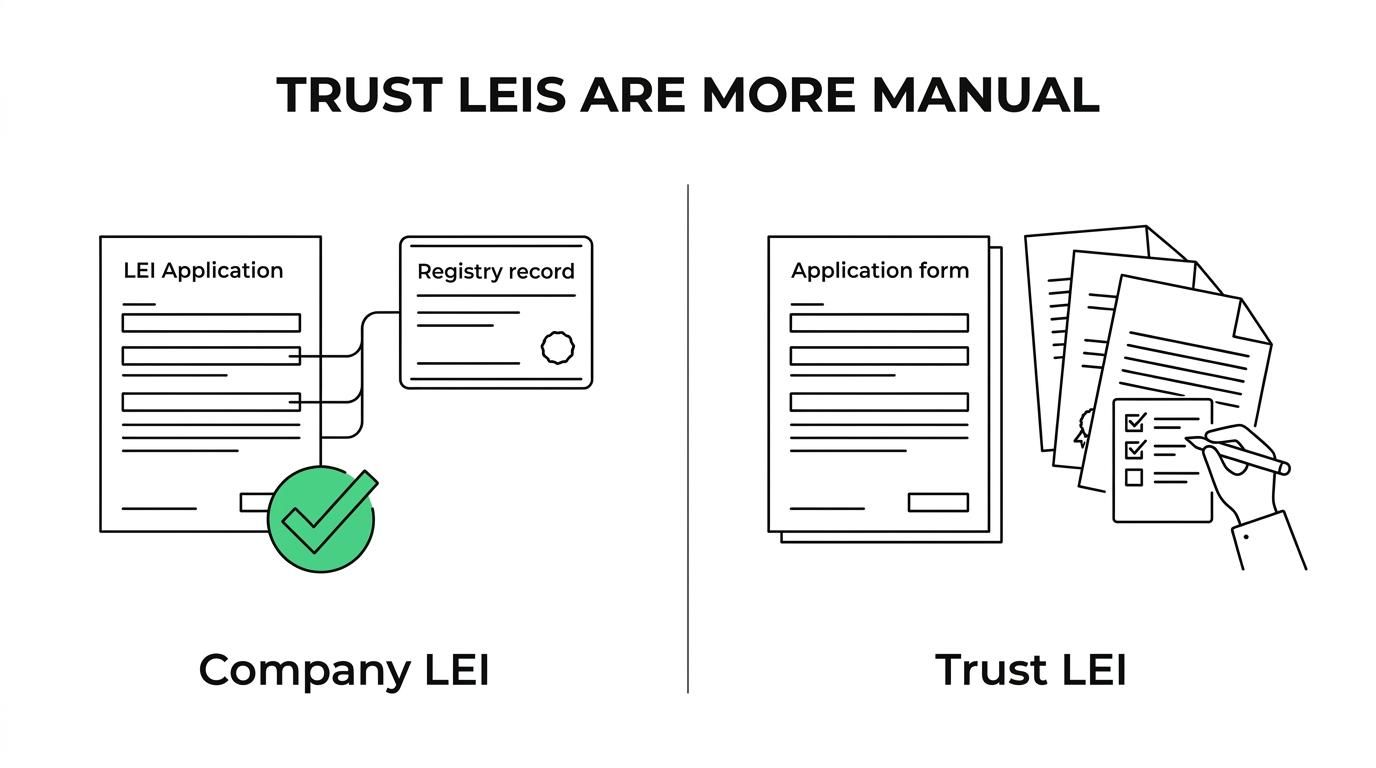
This does not make the process difficult in any deep sense. It simply means the issuer needs a stronger evidence trail. If the trust name on the deed, the trustee name on the current records, and the address used in the application all line up, progress is usually smooth. If they do not, extra queries are likely.
A common stumbling point is applying in the trustee company’s name when the LEI is actually needed for the trust, or the other way around. Another is using an old deed where the trustee has since changed. Small mismatches can slow down an otherwise simple application.
How to make a trust LEI application smoother
A little preparation saves time, especially where a same-day outcome matters.
Before you begin, it helps to gather the current trust paperwork and check that the legal name, trustee details, and addresses match across the documents you plan to use. If an adviser is applying on behalf of the trustee, make sure the authority path is clear at the start rather than after a request for more information.
A practical checklist looks like this:
- Match the trust name exactly to the deed
- Confirm the current trustee
- Use current addresses only
- Keep the establishment date handy
- Have ABN or other identifier details ready
- Prepare authority evidence before lodging
- Check whether the LEI is needed for the trust or for the corporate trustee
That last point is especially important in investment and reporting settings. The trust and the corporate trustee are connected, but they are not automatically interchangeable for identification purposes.
Choosing help for a trust LEI application
Trust applications reward a provider that can handle manual verification well. Speed matters, but support matters just as much when the structure is not a standard company search result.
That is where an assisted service can be useful. A provider that accepts applications without an ACN, supports signing authority confirmation, and can work with uploaded authority documents is often a better fit for trusts than a purely automated path. Responsive phone and email support also makes a real difference when you need to clarify whether the applicant should be the trustee, the corporate trustee, or an authorised agent.
For Australian entities, LEI Service Australia offers new registrations, renewals, transfers, multi-year options, and support by phone and email. Its published process allows for applications even where there is no ACN-based lookup, which is relevant for many trusts. It also states same-day issuance for qualifying orders placed before 6 pm, with free updates to LEI reference data where entity details change.
For trusts, that kind of support can turn a document-heavy task into a manageable one. The structure may be more nuanced than a company application, though with the right trust details and a clear authority trail, the process is usually very workable.