LEI Issuance Timeframes Explained: Same‑Day vs Standard Processing
If you need an LEI quickly, the short answer is encouraging: new LEI can often be issued the same day when the application is submitted before the relevant cut-off and the details can be verified without delay. In many standard cases, the expected timeframe is about 1 to 48 hours.
That said, “how long it takes” depends less on the payment step and more on what happens during validation. A clean application for a straightforward Australian entity can move very fast. A more complex application, or one with missing authority details, can take longer even when the form itself only took a few minutes to complete.
For organisations arranging trading access, reporting setup, or a transition AVID or BIC to LEI, that distinction matters. The form may be quick. The issuance time depends on how easily the entity can be checked against reliable source data and whether any extra documents are needed.
LEI issuance timeframes for new applications
For a new LEI, the usual timing falls into two broad categories: same-day processing and standard processing.
LEI Service Australia states that a new LEI can be issued the same day if the order is placed before 6 PM. It also gives a broader validation window of 1 to 48 hours. These two statements are not inconsistent. They point to a practical reality: many applications are handled quickly, while others need a little more checking before the code can be issued.
A simple way to think about it is this: same-day is the fast path, and 1 to 48 hours is the normal outer window for standard cases.
| Request type | Typical timeframe | Notes |
|---|---|---|
| New LEI, straightforward application | Same day if ordered before 6 PM | Depends on clean, verifiable entity data |
| New LEI, standard processing | 1 to 48 hours | May involve additional validation |
| LEI renewal | Often quick, with express option shown on renewal flow | User submission is fast; backend timing varies |
| LEI renewal with express handling | Target of within 2 hours shown on renewal form | Conditions are not fully detailed publicly |
| LEI transfer and renewal | Around 7 business days | Usually slower due to coordination between issuers |
The table highlights an important point: not every LEI-related request follows the same clock. A brand new code for a simple entity can be much faster than a transfer, even if both are submitted online in a similar way.
What determines how long it takes to get an LEI
The biggest factor is whether the application can be validated automatically against official registry data and the information supplied by the applicant.
When the entity name, registration number, address details, and authority details all match expected records, the application can move through the system quickly. When something does not line up, a human review or a request for more information may be needed.
In practice, the following factors usually shape the timeframe:
- Registry match
- Signing authority
- Ownership structure
- Entity type
- Time of submission
A proprietary company with readily available registry data is usually easier to process than a fund, sub-fund, trust structure, or another special legal entity that needs extra clarification.
The timing of the order matters too. If same-day processing is tied to a cut-off time, an application lodged late in the day may roll into the next processing window even if nothing is wrong with it.
Same-day LEI processing versus standard LEI processing
Same-day processing is best thought of as a fast-track outcome for applications that are complete and easy to verify. Standard processing is the broader category that covers the usual 1 to 48 hour range.
The application steps are largely the same in both cases. You enter the entity details, confirm the data, choose the service period, pay, and wait for validation. What changes is not the form itself but the amount of follow-up required behind the scenes.
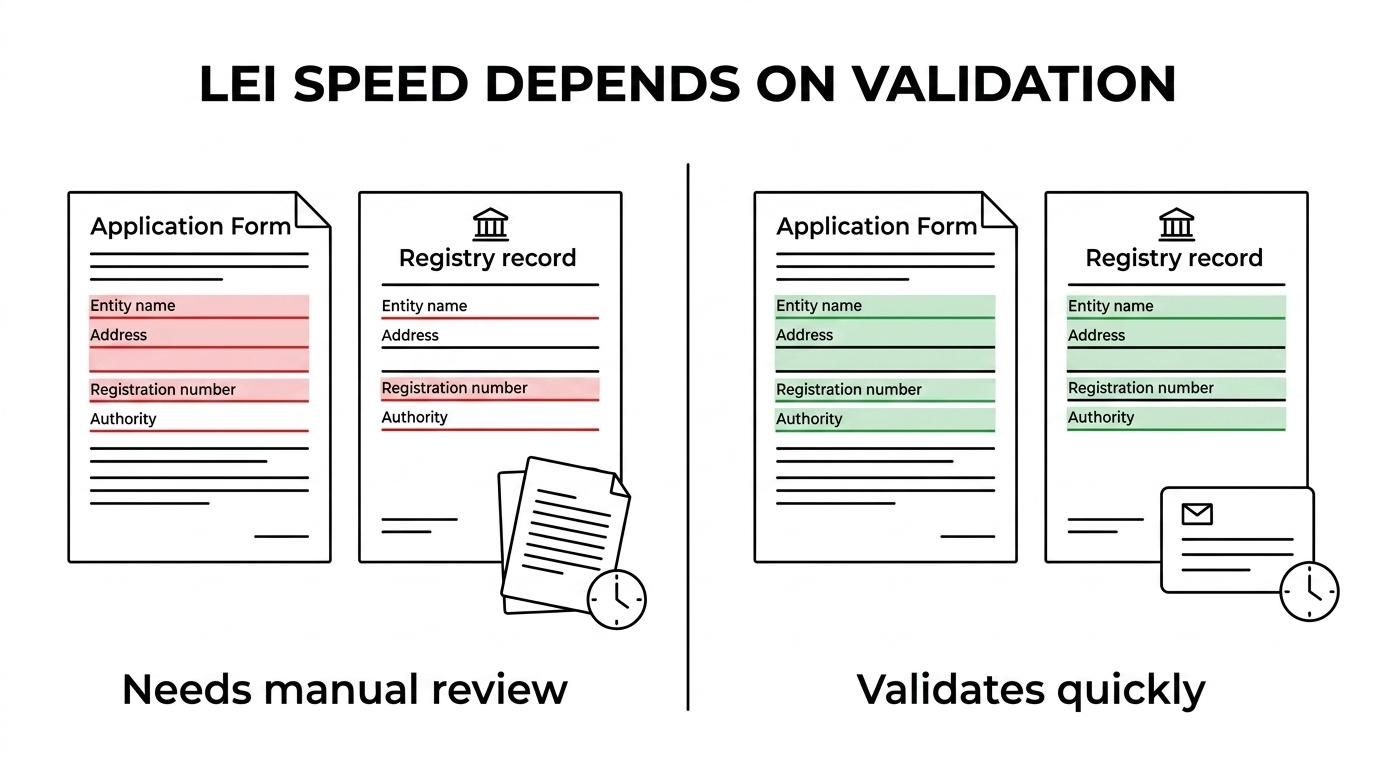
This is why two organisations can submit an LEI application on the same afternoon and get different results. One may receive the LEI within hours. The other may be contacted for authority proof or parent entity information.
A useful comparison looks like this:
- Same-day processing: submitted before the cut-off, details complete, registry data matches, no manual exception
- Standard processing: application still valid, though an extra check or request for information may be needed
- Longer processing: special entity structures, transfer requests, or unresolved authority questions
That distinction can save a lot of frustration. Many applicants assume the payment confirms immediate issuance. In reality, payment starts the validation process. Issuance follows once the data has been accepted.
Why some LEI applications take longer than expected
Most delays are not caused by the online form. They happen because the issuer needs enough confidence in the legal entity data before publishing the LEI.
This is especially relevant for organisations with layered ownership, non-standard legal forms, or applicants acting on behalf of the entity without being the signing authority. If authority is not obvious from the application, extra steps may be needed.
Common reasons for delay include the following:
- Missing authority proof: the applicant may need to provide the signing authority’s email or supporting authority documentation
- Registry mismatch: the business name, address, or registration number may not match available records closely enough
- Ownership disclosure: parent entity details or Level 2 relationship data may need support documents
- Special entity status: funds and other structures may require more information than a standard company application
- Existing LEI issue: the system may detect an existing code or a complication linked to prior registration data
These checks are not red tape for its own sake. The LEI system is built around reliable reference data, and that means accuracy matters as much as speed.
A fast application, then, is usually a well-prepared application.
How LEI renewals and LEI transfers affect timing
Renewals are often quicker from the applicant’s point of view because the entity already has an LEI. Much of the base data already exists, and the task is to confirm it is still current.
LEI Service Australia’s renewal flow indicates that an express option may be available for delivery within 2 hours. Public information does not fully set out every condition attached to that timing, though it does suggest that certain renewals can be handled very quickly when the records are in order.
Transfers are different.
LEI transfer and renewal can take around 7 business days, which is much longer than a straightforward new registration or renewal. That extra time is normal. A transfer involves coordination between the current managing issuer and the new one, along with record updates and control checks.
If speed is your priority, this order of likelihood is useful:
- Straightforward renewal
- Straightforward new LEI
- Complex new LEI
- Transfer and renewal
That order will not hold in every case, though it is a sensible guide for planning.
What a fast LEI application usually includes
A strong application is clear, consistent, and easy to verify. That sounds simple, but it has practical implications.
If your organisation wants the best chance of same-day issuance, prepare the application with the checking stage in mind rather than just the submission stage. A few minutes spent confirming details can save a full day of delay.
A fast application usually has these qualities:
- Correct legal entity name
- Accurate registration number
- Current registered address
- Clear applicant authority
- Parent entity details ready, if relevant
It also helps if the organisation is a standard entity type with data that can be pulled from official registers without ambiguity.
How to get your LEI faster in Australia
If there is a deadline attached to trading, onboarding, or reporting, it makes sense to approach the application as a time-sensitive compliance task rather than an admin form.
There are several practical ways to reduce avoidable delays.
- Apply before the cut-off: if same-day issuance is available before 6 PM, do not leave the application until late evening
- Use exact registry details: enter the legal name and registration number exactly as recorded
- Confirm signatory status early: if you are not the signing authority, be ready with the right contact details or authority document
- Prepare ownership information: if parent entity reporting applies, collect the supporting details before you start
- Respond quickly to follow-up: if more information is requested, a fast reply keeps the application moving
For Australian entities, another sensible step is to avoid waiting until the day you need to trade. Same-day processing is valuable, though it should be treated as a strong option rather than a guarantee in every case.
That approach gives you a margin for anything that needs clarification.
What happens after you submit an LEI application
After submission, the provider validates the entity data and checks whether the information can be confirmed through authoritative sources. A duplicate search is also part of the process, since an entity should not be issued multiple LEIs.
If everything checks out, the LEI is issued and sent by email. If not, the applicant may be contacted for more information.
This is where support matters. Phone and email assistance can make a real difference when an application stalls over an authority question or a missing field. A quick response from the applicant can turn a delayed file into a completed one on the same day.
For many organisations, that is the main practical lesson. The online form is only the beginning. The real timeframe comes down to validation quality, submission timing, and whether the entity can be verified without manual complications.
If your application is straightforward and submitted in time, getting an LEI can be very quick. If the entity structure is more involved, planning for the full 1 to 48 hour window is the safer expectation.