LEI Level 1 vs Level 2 Data: What Australian Firms Need
For many Australian entities, an LEI starts as a practical requirement. A bank asks for it, a trading venue needs it, or a reporting workflow points to it as the cleanest way to identify a legal entity. Once that step appears, the next question often follows quickly: what data actually sits behind the LEI, and what is the difference between Level 1 and Level 2?
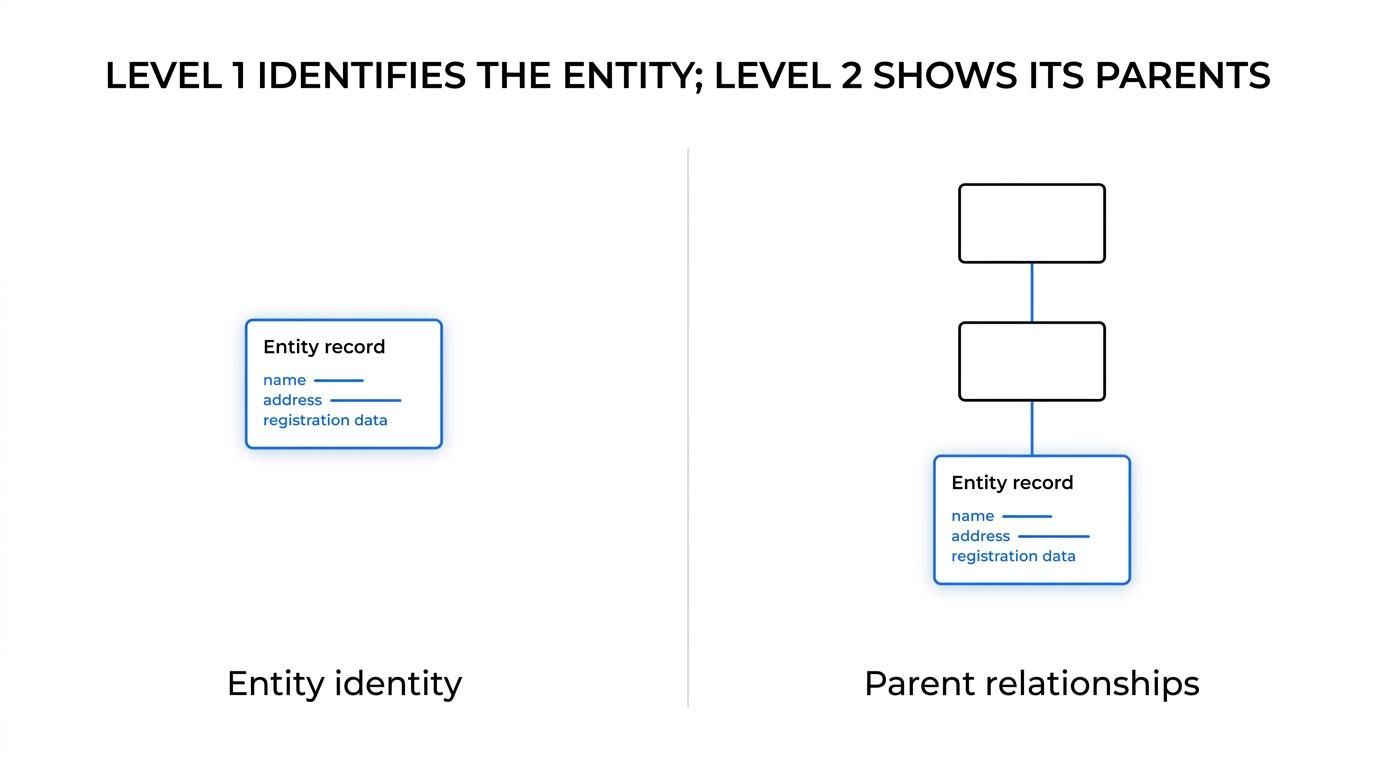
The short answer is simple. Level 1 data identifies the entity itself. Level 2 data identifies parent relationships. In the language used by the Global Legal Entity Identifier Foundation, Level 1 answers “who is who” and Level 2 answers “who owns whom”. For Australian firms, that distinction matters because it shapes what counterparties, regulators, market infrastructures, and internal teams can verify from the public LEI record.
LEI data and why it matters for Australian firms
An LEI is a unique 20-character alphanumeric code linked to verified reference data about a legal entity. The record is public, searchable, and tied to official source data rather than private commercial profiles. That makes it useful well beyond a simple code field in a form.
In Australia, LEIs already appear in market and reporting settings. ASIC has described the LEI as a global identifier and notes that Australia’s OTC derivative trade reporting framework allows LEIs to be used as one of several alternative identifiers. Even where a rule does not strictly require an LEI, counterparties and service providers often prefer it because it reduces ambiguity.
That is why the Level 1 versus Level 2 distinction is worth getting right. One layer confirms which entity is involved. The other helps show where that entity sits in a group structure.
LEI Level 1 data as the core identity layer
Level 1 data is the foundation of the LEI record. It is the set of reference data that identifies the legal entity itself. If a firm wants to confirm that a counterparty is the correct company, trustee, fund, charity, or other registrable organisation, this is the layer being checked.
For most Australian entities, Level 1 is the part that comes up most often. It is the data used in onboarding, transaction reporting, reconciliations, internal controls, and basic due diligence. It gives the market a reliable public identity record connected to authoritative local sources.
Typical Level 1 fields can include:
- Legal name: the official registered name of the entity
- Registered address: the formal registered office or equivalent address
- Headquarters address: where recorded in the LEI reference data
- Legal form: company, fund, trust-related entity, charity, and similar classifications
- Jurisdiction: the country or legal jurisdiction of formation
- Registration authority and number: the official registry reference linked to the entity
This is why Level 1 is often described as the core identity layer. When a firm needs to show that “ABC Pty Ltd” is the precise entity entering a transaction, not a related vehicle with a similar name, Level 1 does that work.
It also supports cleaner data across systems. Treasury teams, compliance functions, custodians, and trading operations all benefit when the same entity has one globally recognised identifier and one public reference record.
LEI Level 2 data as the ownership and parent relationship layer
Level 2 data sits one level higher. Instead of identifying the entity itself, it records ownership relationships based on accounting consolidation. In practice, this means the LEI record may identify the entity’s direct accounting consolidating parent and its ultimate accounting consolidating parent.
That accounting basis matters. Level 2 is not simply a list of shareholders, affiliates, or any entity with commercial influence. It is focused on parent relationships that fit the LEI framework’s consolidation logic. For group structures, that creates a more consistent public picture.
Where available, Level 2 data helps answer questions that Level 1 cannot. A counterparty may know exactly who the entity is, yet still need to know whether it belongs to a larger group, who sits immediately above it, and who stands at the top of the consolidated structure.
A practical way to think about Level 2 is this:
- Direct parent: the nearest accounting consolidating parent above the entity
- Ultimate parent: the highest accounting consolidating parent in the group
- Relationship record: the public link between the child entity and its parent LEI records
- Reporting exception: a public note that a parent relationship is not being disclosed in the standard way
Behind the scenes, these relationship records are managed in a standard format known as RR-CDF. Most firms never need to work with that format directly, yet it helps keep Level 2 data consistent across issuing organisations, GLEIF, and data users.
LEI Level 1 vs Level 2 data in one view
A side-by-side comparison makes the distinction easier to use in practice.
| Aspect | Level 1 data | Level 2 data |
|---|---|---|
| Main question answered | Who is who | Who owns whom |
| Focus | The legal entity itself | Parent relationships in the group |
| Typical content | Name, address, legal form, jurisdiction, registry details | Direct parent, ultimate parent, relationship records, reporting exceptions |
| Basis | Official entity reference data | Accounting consolidation relationships |
| Main use case | Identity verification | Group structure and ownership visibility |
| Availability | Expected for LEI registration | Available where a qualifying parent relationship is reported |
| Public value | Confirms the exact entity | Shows where the entity sits within a larger structure |
For Australian firms, the table highlights an easy rule of thumb: Level 1 is almost always relevant, while Level 2 becomes more relevant when group relationships matter.
When Australian firms usually rely on Level 1 data
Most day-to-day LEI use starts and ends with Level 1. If the task is to identify a legal entity cleanly and consistently, this is the layer doing the heavy lifting. Trading workflows, onboarding checks, and transaction records all depend on accurate entity identity before anything else can happen.
That is especially true where similar names can create friction. A group may contain multiple companies, funds, or trustee entities with overlapping branding. Level 1 data helps separate them with a verified public identity record.
Common Level 1 use cases include:
- Trade reporting identifiers
- Counterparty onboarding
- Settlement and treasury records
- Fund and trustee administration
- Internal legal entity master data
It also helps during transitions from older identification conventions to LEI-based workflows. Where institutions or infrastructures are moving toward global entity standards, the Level 1 record is the first checkpoint.
When Australian firms should pay closer attention to Level 2 data
Level 2 becomes more valuable when ownership, control context, or group structure is relevant to the transaction or review. This does not mean every Australian entity needs a rich Level 2 profile on day one. It does mean firms should know whether parent data is expected in their case and whether its absence will raise follow-up questions.
Group treasury is a good example. A subsidiary may transact in its own name, while risk and exposure are assessed at a broader group level. In that setting, seeing the direct and ultimate parent through the LEI record can save time and reduce back-and-forth with counterparties.
The same applies to institutions that want a cleaner view of group relationships across many entities. Level 2 data can support:
- Counterparty risk checks: a clearer view of the wider corporate group
- Group reporting: faster identification of immediate and top-level parents
- Data quality reviews: easier spotting of inconsistent entity records across systems
- Due diligence workflows: less manual effort to piece together public parent relationships
For sophisticated market participants, this public relationship layer is one reason LEIs remain valuable beyond regulatory minimums. The record is not just a code. It is an identity framework.
What happens when Level 2 parent data is missing
Not every LEI record will show a populated direct and ultimate parent. That does not automatically mean the record is wrong. The LEI framework allows for reporting exceptions, which are themselves part of Level 2 data.
This is an important detail for Australian firms reviewing counterparties. A blank or exception-based Level 2 record should be read carefully rather than treated as a failure. In many cases, the public record is saying, in a standardised way, that a qualifying parent relationship is not being disclosed through the ordinary Level 2 relationship record.
That approach is useful because it still gives the market information. Instead of silence or inconsistent free-text notes, the LEI framework records the status in a structured way. For compliance and operations teams, that is far better than guessing.
Keeping LEI reference data accurate across renewals
Whether a firm relies mainly on Level 1 or also needs Level 2, accuracy matters. LEI records are designed to be maintained, not left untouched after issuance. If an entity changes its legal name, address, registration details, or relevant parent relationships, the record should be updated so the public data remains current.
The public LEI dataset is valuable precisely because it is maintained against official reference data. GLEIF’s Global LEI Index gives users a searchable way to check those records, and the broader system is built for regular data refresh and validation. That makes renewal more than an administrative date on a calendar. It is part of keeping entity identity fit for use.
For Australian firms, a sensible maintenance routine usually covers three checks:
- Entity details: confirm name, address, legal form, and registry references
- Group structure: review whether parent relationships have changed
- Record status: make sure the LEI remains active and current for market use
This is also where support can make a real difference. When teams are busy, LEI applications, renewals, transfers, and data maintenance can slip down the list. Using a provider that handles the process on the client’s behalf can keep records current with less internal effort, especially for firms managing multiple entities or annual renewals across a group.
A well-maintained LEI record gives Australian organisations a stronger footing in reporting, trading, and counterparty engagement. Level 1 tells the market exactly who the entity is. Level 2, where relevant, shows where it belongs in the corporate structure. Knowing the difference makes the LEI far more useful than a code copied into a form.