LEI Support Desk: Resolve LEI Issues, Corrections, and Validation Queries
When an LEI issue stops a trade, delays onboarding, or creates doubt about whether an entity record is correct, fast support matters. Australian entities often need help at short notice, whether the task is a new LEI application, an urgent renewal, a transfer from another provider, or a correction to the official reference data attached to the code.
A practical support service does more than answer questions. It helps verify entity details, checks whether an LEI already exists, submits the required changes, and follows the record through to the global LEI index. That is especially useful when a bank, broker, fund platform, or counterparty says an LEI is not showing as valid yet.
LEI support in Australia for registration, renewals and record changes
LEI support in Australia usually centres on three needs: getting a code issued quickly, keeping it renewed, and fixing data when something no longer matches the official record. Companies, trusts, funds, charities, and other legal entities can run into issues at any point in that cycle.
A support desk can assist from the first step, even when the applicant does not have every registry detail ready. That includes simple applications, guided assistance by phone or email, and help with matching the entity to official records. Where timing matters, same day issuance may be available for eligible orders placed before 6 PM.
This matters because many institutions now treat a valid LEI as a basic requirement for market participation. If the LEI is lapsed, missing, or not yet visible in the relevant database, trades and account processes can be held up.
After the initial application, support remains just as relevant. LEIs need annual renewal unless a multi year plan is in place, and entity data needs to stay accurate. If the legal name, address, or ownership information changes, the record should be updated so the GLEIF data remains current.
After a quick review of the entity’s situation, support commonly helps with:
- New LEI applications
- Annual renewals
- Multi year renewals
- LEI transfers from another provider
- GLEIF record corrections
- Validation checks for banks and trading platforms
How LEI validation support works with GLEIF record checks
When an LEI appears invalid, the reason is often straightforward. The code may have lapsed because the renewal date passed. The record may also be correct, but not yet visible to a bank or platform because the GLEIF database refreshes on a daily cycle rather than instantly.
That distinction is where support is especially helpful. Instead of guessing, the record can be checked against the official LEI status and entity data. If the LEI is active, the issue may simply be propagation time. If it is inactive, renewal can be arranged so the status is restored.
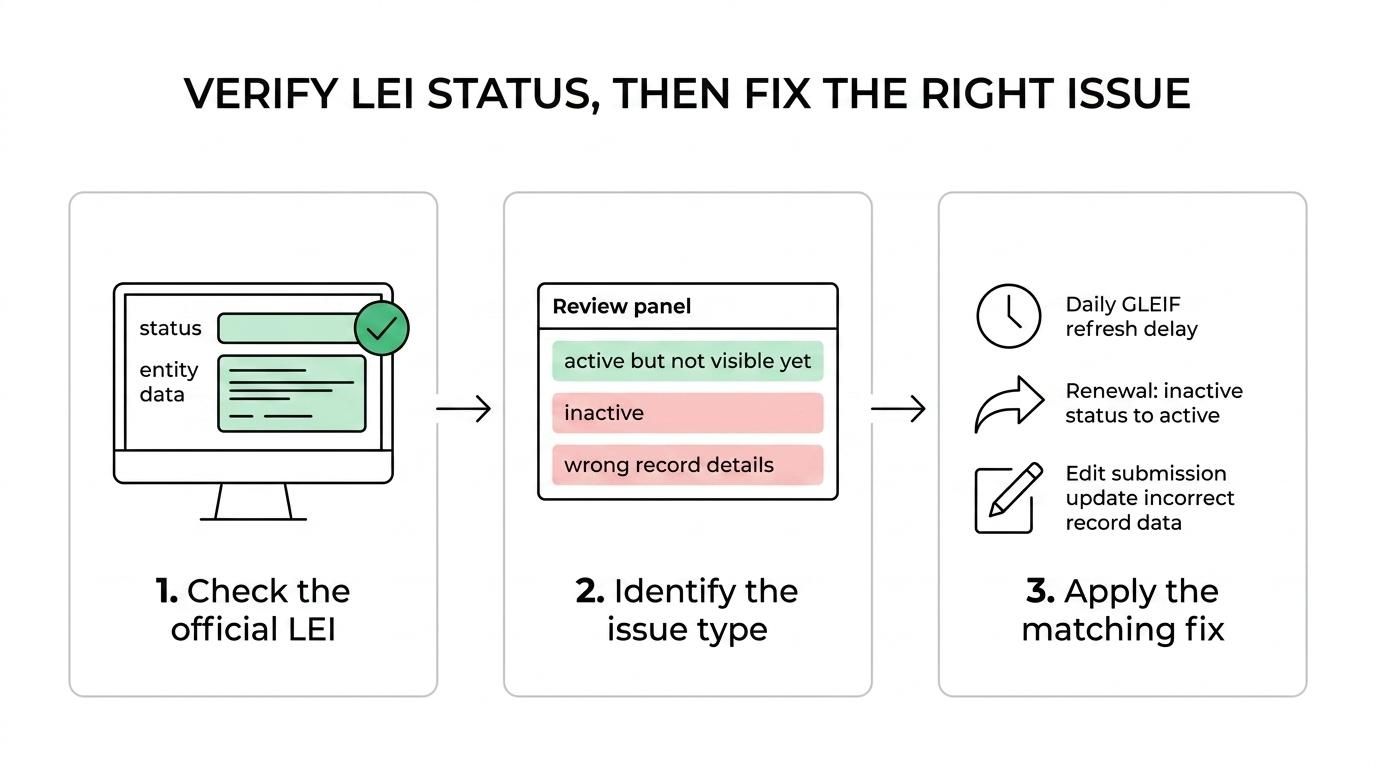
Corrections follow a similar path. The changed information is reviewed against authoritative sources, then the update is submitted to the managing issuer platform. Once processed, the revised data appears in the global LEI index. For many entities, this is the fastest way to deal with name changes, address updates, or obvious record errors.
| LEI issue | Likely cause | Support action | Typical result |
|---|---|---|---|
| New LEI not recognised | Daily GLEIF refresh delay | Check issuance status and confirm timing | LEI becomes visible after database update |
| LEI shows as invalid | Renewal overdue | Process renewal and confirm reactivation | Record returns to active status |
| Legal name is wrong | Outdated or incorrect reference data | Verify official record and submit correction | GLEIF entry updated |
| Address no longer matches registry | Entity details changed | Review supporting data and amend record | Current address shown in LEI index |
| Existing LEI held elsewhere | Different managing issuer | Arrange transfer and renewal if needed | LEI managed under one support desk |
| Unsure if an LEI already exists | Duplicate or historic search issue | Search by entity name or registration details | Correct record identified before application |
Common LEI issues resolved by Australian LEI support
Some problems are urgent, others are simply frustrating. Both deserve a clear answer.
In practice, most support requests fall into a few familiar categories. A newly issued LEI may not appear immediately in a bank system. A renewal may have been missed. An applicant may be unsure which entity should hold the LEI, or whether a fund, trustee, or company requires its own code. There are also cases where the GLEIF record contains details that are no longer current.
A good support process keeps the steps clear and realistic. It checks the official data, explains what is happening, and handles the submission work on the client’s behalf rather than pushing all of the admin back to the entity.
Typical queries include:
- Validation delay: the LEI has been issued, but a bank or platform has not picked it up yet
- Lapsed status: the LEI needs renewal before it can be used again
- Reference data correction: the legal name, address, or related entity information needs to be updated
- Existing LEI search: the entity may already have a code registered through another route
- Authority check: support may need to confirm who is authorised to request the application or correction
- Transfer request: the entity wants the LEI managed by a provider offering local support and ongoing assistance
LEI correction support for data quality and record accuracy
Accurate LEI data is not just an administrative detail. Counterparties, reporting systems, and regulators rely on the record to identify the legal entity behind a transaction. When the data is wrong, even a small typo can create avoidable delays.
That is why correction support should be practical and ongoing. If official entity data changes, the record should be updated in the GLEIF index. Where the existing data appears incorrect, a review can be triggered and the issuer can check the record. In many cases, these updates can be handled without extra fees as part of ongoing LEI management.
Strong LEI support also helps with data quality before a problem reaches the market. Instead of waiting for a rejection from a broker or reporting platform, entities can ask for a verification check early. That is useful after a corporate restructure, office move, legal name update, or change in parent relationship.
Some service arrangements include free ongoing data updates, which can be valuable for entities that want a cleaner process over time.
LEI renewal support in Australia for uninterrupted validity
Renewal is one of the most common reasons entities contact support, and with good reason. An LEI is not a one off registration. It needs to be renewed each year to remain active and usable.
For entities managing deadlines across multiple obligations, annual renewal can easily slip. Support reduces that risk by handling the renewal request, checking the latest reference data, and maintaining the record through the required cycle. Multi year plans can make this even easier, with pricing that may start from $97 for one year and lower annual costs across longer terms.
That approach suits organisations that want fewer manual tasks and more certainty around validity. It also helps when several LEIs need to be managed together, as in group structures, fund portfolios, or high volume entity administration.
Renewal support may include:
- Phone and email assistance
- Multi year maintenance options
- Bulk or portfolio arrangements
- Transfers combined with renewal
- Free updates to reference data
Australian LEI support channels, response times and practical help
Support works best when it is accessible, fast, and handled by real people who can explain the issue in plain language.
For that reason, many entities prefer a provider offering English speaking phone and email support with unlimited assistance. A response within 24 hours gives certainty, while urgent matters can often be resolved much sooner. When the application flow is simple, even entities without an ACN on hand or without a successful registry lookup at the first attempt can still move forward with guided help.
This kind of service is particularly useful during time sensitive transactions, onboarding deadlines, and end of financial year administration, when a missed LEI renewal or unresolved validation error can interrupt work that is otherwise ready to proceed.
LEI application and transfer support for Australian entities
Some support requests begin before the LEI even exists. An entity may have been told by a broker, custodian, or overseas counterparty that an LEI is now required. In other cases, the entity already has a code, but wants to transfer it to a provider with better pricing, simpler management, or stronger support.
Both situations benefit from a service desk that can review the entity’s current position and recommend the right path. A new registration, a renewal, and a transfer each follow different steps, though the goal is the same: an active LEI with accurate public data and minimal delay.
Where extra assistance is needed, the process can be handled on the client’s behalf from application through to maintenance, with the same support team available for later corrections, renewals, and validation checks.