LEI Troubleshooting: Fixing Entity Name Mismatches, Address Changes, and Registry Issues
An LEI record is meant to be a reliable public reference point for a legal entity. When the entity name is slightly off, the registered address is out of date, or the registry link does not match the official source, that reliability drops quickly.
For Australian companies, funds, charities, and other legal entities, those small errors can lead to delayed onboarding, reporting friction, and extra back and forth with banks or trading counterparties. The good news is that most LEI record problems are fixable, and the path to a clean record is usually quite direct once the source of the mismatch is clear.
Why LEI record accuracy matters for trading and compliance
The Global LEI System is built around verified reference data. That means the legal name, registered address, and related registry details should match an authoritative source wherever one is available. If the LEI record drifts away from that source, the issue is not just cosmetic.
A stale or inconsistent LEI can affect regulatory reporting, client due diligence, settlement checks, and internal controls. A bank may question the record. A counterparty may pause onboarding. A compliance team may need to explain why the LEI says one thing while the company register says another.
Even when the issue looks minor, the safest approach is to correct it promptly rather than waiting for the next renewal cycle.
How to fix entity name mismatches in an LEI record
Name mismatches are among the most common LEI data issues. Sometimes the problem is obvious, like a typo or a missing legal suffix. At other times, it is more subtle, such as a trading name being used instead of the full registered legal name.
The first step is to compare the LEI record against the official legal name shown on the relevant business register or supporting legal documentation. In Australia, that often means checking ASIC or another applicable registration authority, depending on the entity type.
A mismatch usually falls into one of a few patterns:
- abbreviated legal name
- trading name used instead of legal name
- missing “Pty Ltd”, “Ltd” or other legal form
- old pre-rename entity name
- transliteration or language variation
- simple data entry error
If the LEI shows the wrong name, the correction request normally needs to point back to the authoritative source. That source matters because LEI issuers and the wider LEI system are expected to validate updates against official records where possible.
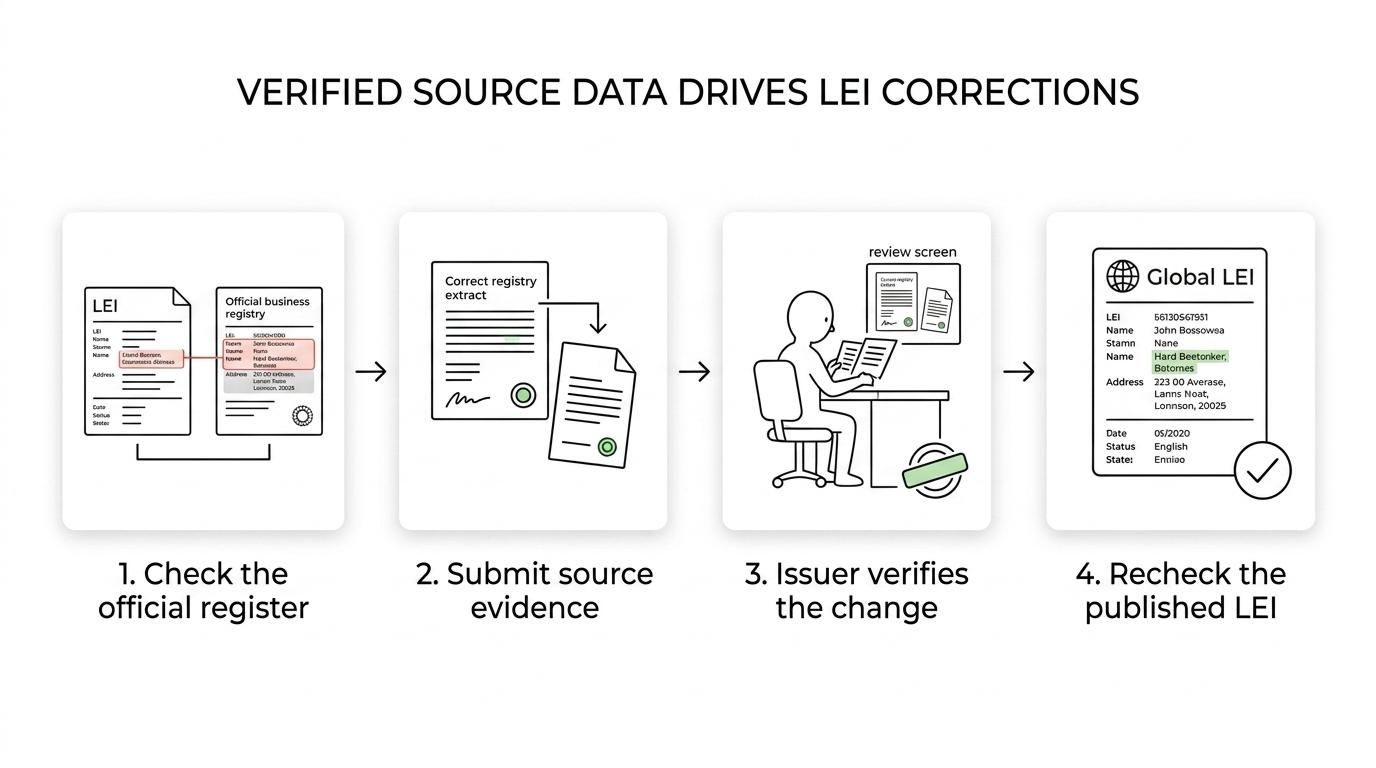
A practical name correction often looks like this:
- Check the official record: Confirm the exact registered legal name, including punctuation and legal form.
- Review recent legal events: Look for mergers, conversions, or name changes that may not yet be reflected in the LEI.
- Submit evidence: Provide the relevant registry extract or supporting document if asked.
- Update through the managing issuer or service provider: The change must be verified before publication.
- Recheck the published LEI: Make sure the Global LEI Index reflects the corrected entry after processing.
One point is worth keeping in mind. A trading name may be perfectly valid for commercial use, but it is not a substitute for the legal entity name in the LEI reference record.
Entity name mismatches after a company rename or restructure
Corporate events often sit behind name issues. An entity changes its registered name, converts legal form, merges into another structure, or updates its registry details, yet the LEI record still shows the older position.
This is where timing matters. Annual LEI renewal is the formal point when data is reconfirmed, but a legal event should not wait months if the record is actively used for reporting or trading. Prompt correction keeps the LEI aligned with the current legal reality.
How to update an LEI address after a registered office change
Address changes are usually straightforward, though they still need verification. If the legal address or registered office changes, the LEI record should be updated so the public record remains current.
Many entities assume the next annual renewal will take care of it. That can work if the timing is close and the LEI is not being used urgently. Still, where a bank, broker, or reporting obligation depends on the LEI, updating the address soon after the legal change is the better move.
The table below shows the most common address-related scenarios and the usual response.
| LEI address issue | What it usually means | Best fix |
|---|---|---|
| Old registered office still displayed | Registry changed, LEI not yet updated | Submit an address update with current official source data |
| Minor formatting difference | Abbreviations or formatting vary, but location is the same | Check whether the official source requires a full correction |
| Wrong suburb, postcode, or street line | Manual entry error or stale data | Provide corrected registered address details |
| Address changed after renewal | Legal event happened after last recertification | Request an interim update rather than waiting |
| Bank cannot see the new address yet | Publication or downstream refresh delay | Recheck after the next data refresh window |
Address updates usually depend on three things: an authorised request, reliable source material, and successful verification before the amended record is published.
If the local registry already shows the new registered address, that will usually be the strongest support for the update. If the registry is not clear or not available for the relevant field, additional documentation may be requested.
How to resolve LEI registry issues and validation problems
Not every LEI problem is a name or address mismatch. Some issues sit deeper in the record and relate to registration authority data, duplicate records, missing fields, or technical validation rules.
A registry issue can show up in a few ways. The LEI may point to incomplete or outdated registration data. Two records may look suspiciously similar. A bank may say the LEI cannot be verified yet, even though the update has been submitted. In other cases, a record may fail validation before publication because the field combination does not fit LEI data rules.
These are common examples:
- Duplicate LEI: The same legal entity appears to have more than one LEI or a second application has been started elsewhere.
- Wrong registry reference: The registration authority ID or related source details do not line up with the official record.
- Incomplete reference data: Mandatory fields are missing or unsupported placeholders have been used.
- Technical validation issue: The update fails checks before publication because the structure or field logic is not acceptable.
- Data refresh delay: The correction is processed, but counterparties do not see it immediately.
When this happens, the right response is usually procedural rather than technical. Confirm the legal entity details, gather the source documents, and work through the managing LEI issuer or a registration agent. The LEI system includes duplicate checks, pre-publication controls, and post-publication quality checks, but ambiguous cases still need human review.
If an error is already public and the standard correction route is moving too slowly, GLEIF’s challenge process can be relevant. That allows suspected inaccuracies to be flagged for investigation by the managing issuer.
What to prepare before asking to fix an LEI record
A faster correction often comes down to preparation. Before contacting support, it helps to have the basics ready.
- current legal entity name
- LEI code
- updated registered address, if relevant
- company or registry identifier
- evidence of the legal change
- authorised contact details
That small bundle of information can save days of avoidable back and forth.
What to expect from LEI correction timing and verification
Many organisations want to know one thing first: how long will it take?
The answer depends on the type of issue. Simple corrections tied to a clear official source can often move quickly. More complex matters, like duplicates or inconsistent registry data, may take longer because the record needs extra review before it can be republished.
There is also a difference between the correction being approved and the correction being visible everywhere. The Global LEI data environment updates on a cycle, and banks or counterparties may not reflect the change immediately. A short delay after issuance or amendment is normal.
This is why a practical timeline often has three stages:
- request and verification
- publication to the LEI system
- downstream visibility to banks and counterparties
If a record is urgent for a transaction or reporting deadline, it is sensible to start the correction as soon as the issue is spotted, not the day before the LEI is needed.
How Australian entities can get help fixing an LEI record
For many entities, the hardest part is not the rule itself. It is knowing who should submit the correction, what evidence is likely to be accepted, and whether the issue is a simple update or a registry mismatch that needs closer attention.
That is where an LEI service provider can be useful. LEI Service Australia assists with new LEI registrations, renewals, transfers, and ongoing record maintenance, including support by phone and email. For organisations managing compliance deadlines, that can make the update process clearer and less time-consuming.
Support tends to be especially valuable in cases like these:
- Name correction after a legal event: The entity has renamed, restructured, or converted and needs the LEI updated promptly.
- Address change before a renewal date: The registered office has moved, but the next recertification is still months away.
- Transfer and correction together: The entity wants to move its LEI management and update the record at the same time.
- No easy registry lookup path: The entity details are not straightforward to match from the outset.
- Bulk maintenance needs: A group has several LEIs to renew or clean up across multiple entities.
For Australian entities, speed matters, but so does accuracy. A fast submission is only useful if the resulting LEI matches the legal reality on the ground. Good support helps keep both pieces in view.
An LEI record does not need to stay wrong just because the mismatch looks awkward or the registry history is messy. With the right source data, a verified update path, and a quick follow-up check after publication, most record problems can be corrected before they turn into a larger compliance issue.