LEI vs ABN vs ACN: What’s the Difference and Which One Do You Need for Trading?
If you are setting up an entity for trading, opening a market account, or responding to a bank or broker onboarding request, three acronyms can appear very quickly: ABN, ACN and LEI.
They are not interchangeable.
That matters because each identifier answers a different question. An ABN identifies a business for Australian tax and commercial purposes. An ACN identifies a registered company under Australian company law. An LEI identifies a legal entity in global financial markets. When a counterparty asks for one, giving the wrong number can slow onboarding, trigger compliance follow-up, or stop a trade from proceeding.
LEI vs ABN vs ACN explained clearly
The easiest way to separate them is to think about scope.
An ABN is Australia’s broad business identifier. It is used across invoicing, GST, tax administration and day-to-day business dealings. Many entity types can have one, including sole traders, partnerships, trusts and companies.
An ACN is narrower. It applies only to companies registered with ASIC. It is part of the company’s legal identity under the Corporations Act and appears on certain company documents.
An LEI is different again. It is a global identifier for legal entities involved in financial transactions. It is mainly relevant where institutions, markets, brokers, banks or reporting rules need a standardised international entity ID.
| Identifier | Full name | Format | Main use | Who it applies to | Main scope |
|---|---|---|---|---|---|
| ABN | Australian Business Number | 11 digits | Tax, invoicing, GST, business dealings | Many business and organisation types | Australia |
| ACN | Australian Company Number | 9 digits | Company law identification | Registered companies only | Australia |
| LEI | Legal Entity Identifier | 20-character alphanumeric code | Financial trading, counterparty identification, regulatory reporting | Legal entities involved in finance or required by counterparties | Global |
That table captures the core difference: ABN is broad and domestic, ACN is company-specific and domestic, LEI is specialised and international.
ABN meaning for Australian trading and business operations
For most Australian entities, the ABN is the practical starting point.
If you are carrying on an enterprise in Australia, the ABN is usually the identifier that customers, suppliers, government agencies and finance teams expect to see. It supports invoicing and tax administration, and it is often part of the everyday mechanics of doing business.
This is why many people assume the ABN should be enough for every kind of trading. For ordinary commercial activity, that assumption is often correct. For financial markets, it often is not.
In day-to-day terms, an ABN is commonly linked with:
- invoices
- GST registration
- supplier onboarding
- Australian business records
A sole trader selling online may only need an ABN. A trust carrying on a business may need an ABN. A partnership providing services may need an ABN. It is the broad identifier for business activity, not a specialised passport into securities or derivatives markets.
ACN meaning for Australian companies
The ACN matters when the entity is a company.
ASIC issues an ACN when a company is registered. That means you do not generally apply for an ACN as a separate stand-alone item in the same way you might apply for an ABN. It comes with company registration.
For companies, the ACN sits at the corporate law layer. It identifies the company itself and must appear on certain documents unless the ABN is used in a way that satisfies the relevant ASIC rules.
This leads to a common source of confusion. Many Australian companies have both an ABN and an ACN, and the numbers are connected. Even so, they serve different legal and operational purposes.
A useful way to read the distinction is this:
- ABN: business and tax identity for dealings across Australia
- ACN: company identity under Australian corporations law
- LEI: financial market identity recognised across jurisdictions
If you are not a company, you will not have an ACN. If you are a company, you will almost always need to know both your ABN and your ACN, because different forms, documents and counterparties may ask for one or the other.
LEI meaning for financial instrument trading
The LEI becomes relevant when trading moves into a regulated or institutional setting.
It was created as a standard global identifier for legal entities participating in financial transactions. Banks, brokers, trading venues, custodians and reporting frameworks use it because domestic identifiers do not work well across borders. An ABN might make sense in Australia. It does not solve the same problem in Europe, Asia or a cross-border reporting environment.

That is why an Australian entity can be fully legitimate domestically and still be blocked from a financial transaction until it gets an LEI.
An LEI is often requested in situations like these:
- Derivatives trading: interest rate, FX or commodity hedging through institutional channels
- Securities trading: market access where the broker or venue requires global entity identification
- Counterparty onboarding: banks and financial institutions conducting entity verification
- Regulatory reporting: frameworks where the reporting regime expects LEI-based identification
This is especially relevant for companies, funds and charities that are entering international markets or working with large financial institutions. The LEI is not a replacement for ABN or ACN. It sits alongside them.
Which identifier do you need for trading in Australia?
The answer depends on what “trading” means in your case.
If trading means selling goods or services in Australia, issuing invoices, collecting revenue and meeting tax obligations, the ABN is usually the key identifier. If the entity is a company, the ACN also forms part of the legal picture.
If trading means buying or selling financial instruments, using a broker for institutional execution, hedging currency exposure, or accessing markets where counterparties must identify legal entities globally, the LEI may be required.
Domestic business trading with customers and suppliers
For normal domestic commerce, the ABN is usually the number that matters most. It helps identify the entity to the government and the market, and it supports the commercial processes most businesses rely on every day.
A company in this position would still have an ACN, but the ABN is usually more visible in standard trading relationships.
Company trading as a registered Australian company
If your entity is incorporated, the ACN is part of your legal identity whether or not you trade internationally.
That does not mean the ACN replaces the ABN. In practice, most Australian companies operate with both. The ABN supports the business and tax side. The ACN supports the company law side.
Cross-border financial trading and institutional onboarding
This is where the LEI comes into focus very quickly.
A bank, broker or overseas platform may request an LEI before the account can be activated or a trade can be placed. In some regulated contexts, the logic is simple: no LEI, no trade.
This can affect:
- treasury teams managing FX or interest rate risk
- investment entities
- managed funds
- charities with investment portfolios
- corporates dealing with institutional counterparties
LEI vs ABN vs ACN by entity type
Different entity structures tend to face different identifier requirements. That helps narrow the answer fast.
| Entity type | ABN | ACN | LEI |
|---|---|---|---|
| Sole trader | Usually yes | No | Rare, generally not applicable unless a special business-capacity case exists |
| Partnership | Usually yes | No | Sometimes, if entering relevant financial transactions and eligible |
| Trust carrying on business | Often yes | No, unless a corporate trustee is involved and that company has an ACN | Possible where a legal entity structure is eligible and counterparties require it |
| Australian company | Usually yes | Yes | Sometimes, and often necessary for financial market activity |
| Fund or charity | Often yes, depending on structure and activity | Sometimes, if incorporated company structure applies | Often relevant in investment and institutional contexts |
That comparison also shows why people get caught out. A company can easily need all three in different contexts. A sole trader, by contrast, usually only deals with the ABN question.
When ABN and ACN overlap, and when they do not
Australian companies often assume their ABN covers everything because it is used so often in practice.
That confidence can be misplaced.
The ABN and ACN may be linked, and the ABN can sometimes appear on documents where the ACN requirement is satisfied under ASIC rules. Even so, the ACN remains the company’s own company-law identifier. It is not a duplicate label with no purpose.
The same principle applies with LEI. An ABN or ACN can confirm an entity inside Australia, but neither one replaces a globally recognised financial market identifier.
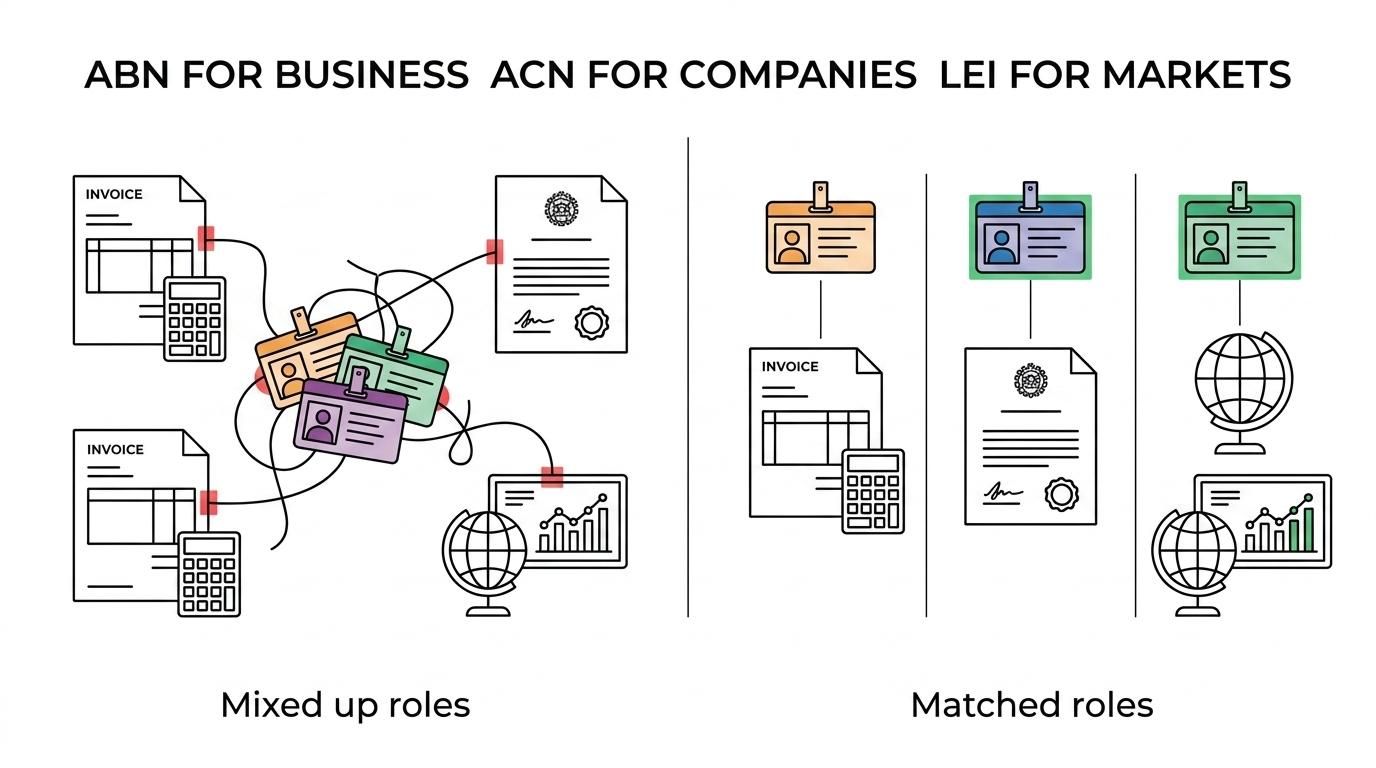
A helpful rule of thumb is:
- Running a business in Australia: think ABN
- Operating through an incorporated company: think ACN as well
- Trading financial instruments or dealing with institutional counterparties: check whether an LEI is required
How to obtain ABN, ACN and LEI
The process differs because the systems are designed for different purposes.
An ABN is generally applied for through the Australian Business Register, assuming the entity is entitled to one. An ACN is issued by ASIC when a company is registered. An LEI is issued through accredited LEI channels and must be kept current so the record remains active and trusted by counterparties.
For entities that need an LEI quickly, provider support can make a real difference. In Australia, some LEI services handle the application and data maintenance on the client’s behalf, offer same-day issuance for orders placed before a cut-off time, and assist with renewals, transfers and reference data updates. That can be useful when a trade or onboarding process is already waiting.
The practical differences look like this:
- ABN: apply if you are carrying on an enterprise and meet eligibility rules
- ACN: issued when a company is registered with ASIC
- LEI: apply when a bank, broker, platform or reporting framework requires global legal entity identification
Common mistakes when choosing the right identifier for trading
The most common error is assuming a domestic identifier is enough for a global financial transaction.
A second mistake is treating the LEI as a general replacement for ABN or ACN. It is not. It does not handle your Australian tax identity, and it does not replace company registration.
Another frequent issue is timing. Some entities only learn they need an LEI when the account is ready to open or the trade is ready to book. That can create avoidable pressure.
Good preparation usually comes down to three checks:
- What is the entity type? Sole trader, trust, company, fund or charity
- What is the activity? Ordinary commerce, company administration or financial instrument trading
- Who is asking? Customer, tax authority, ASIC, bank, broker or overseas platform
Once those three questions are answered, the right identifier is usually obvious.
If the activity is ordinary Australian business, the answer will often be ABN. If the entity is a company, ACN joins the picture. If the trade sits in a financial market setting, the LEI may be the key that unlocks access.