Multi‑Year LEI vs Annual Renewal: Which Option Is Best for Cost and Compliance?
Choosing between a one-year LEI renewal and a multi-year term looks simple at first: one costs less upfront, the other usually costs less per year. Yet the better choice is rarely just about the invoice.
For Australian entities that need an LEI to trade, report, or move from AVID or BIC-based processes to LEI-based identification, renewal is a compliance task tied to data quality. That changes the decision. A lower annualised price is valuable, but only if the LEI record stays properly re-validated and ready for use.
LEI renewal is a compliance requirement, not just a billing cycle
A Legal Entity Identifier is not a “set and forget” code. According to GLEIF, LEI reference data must be reviewed and re-validated at least once every year. That annual check is part of how the global LEI system keeps entity records current and reliable.
This matters because renewal is linked to the status of the record, not just payment timing. When an LEI is renewed, the issuing organisation checks the entity’s reference data against an authoritative source, often a business registry or other official register. That process supports trust in the data used by counterparties, regulators, and market participants.
If renewal is missed, the LEI does not suddenly disappear. GLEIF states that a lapsed LEI remains valid. Still, “lapsed” means the next renewal date has passed and the re-validation is behind schedule. In practice, that status can create unnecessary friction when an active LEI is expected.
That is why the annual versus multi-year choice should start with one question: how will the entity keep annual re-validation on track year after year?
Multi-year LEI renewal costs compared with annual renewal
The pricing difference is clear when you look at the numbers. Based on current pricing published by LEI Service Australia, the average yearly cost falls as the renewal term gets longer.
| Renewal term | Total price | Average cost per year | Saving vs renewing yearly |
|---|---|---|---|
| 1 year | A$97 | A$97 | A$0 |
| 3 years | A$267 | A$89 | A$24 |
| 5 years | A$345 | A$69 | A$140 |
The commercial case for a longer term is strong. A three-year renewal trims the effective yearly rate, while a five-year term brings the largest saving. For an entity that expects to need its LEI continuously, the difference is meaningful rather than marginal.
Cash flow still matters, of course. Paying A$97 each year may feel easier than committing A$267 or A$345 upfront. Yet cost should be measured across the full period the LEI is expected to be used, not only against this month’s budget.
A simple comparison helps:
- Lower upfront spend
- Lower average annual cost
- Fewer approval cycles
- Fewer renewal reminders
Annual renewal gives flexibility. Multi-year renewal improves cost efficiency.
Annual re-validation still applies during a multi-year LEI renewal
This is the point that causes the most confusion. A multi-year LEI renewal does not cancel the underlying annual re-validation requirement.
GLEIF’s framework requires LEI reference data to be reviewed at least once per year. So, if an entity chooses a three-year or five-year renewal term, the commercial arrangement may cover several years, but the compliance process still needs to occur annually. The key difference is administrative: the client is not coming back each year to place a new order and make another payment for that period.
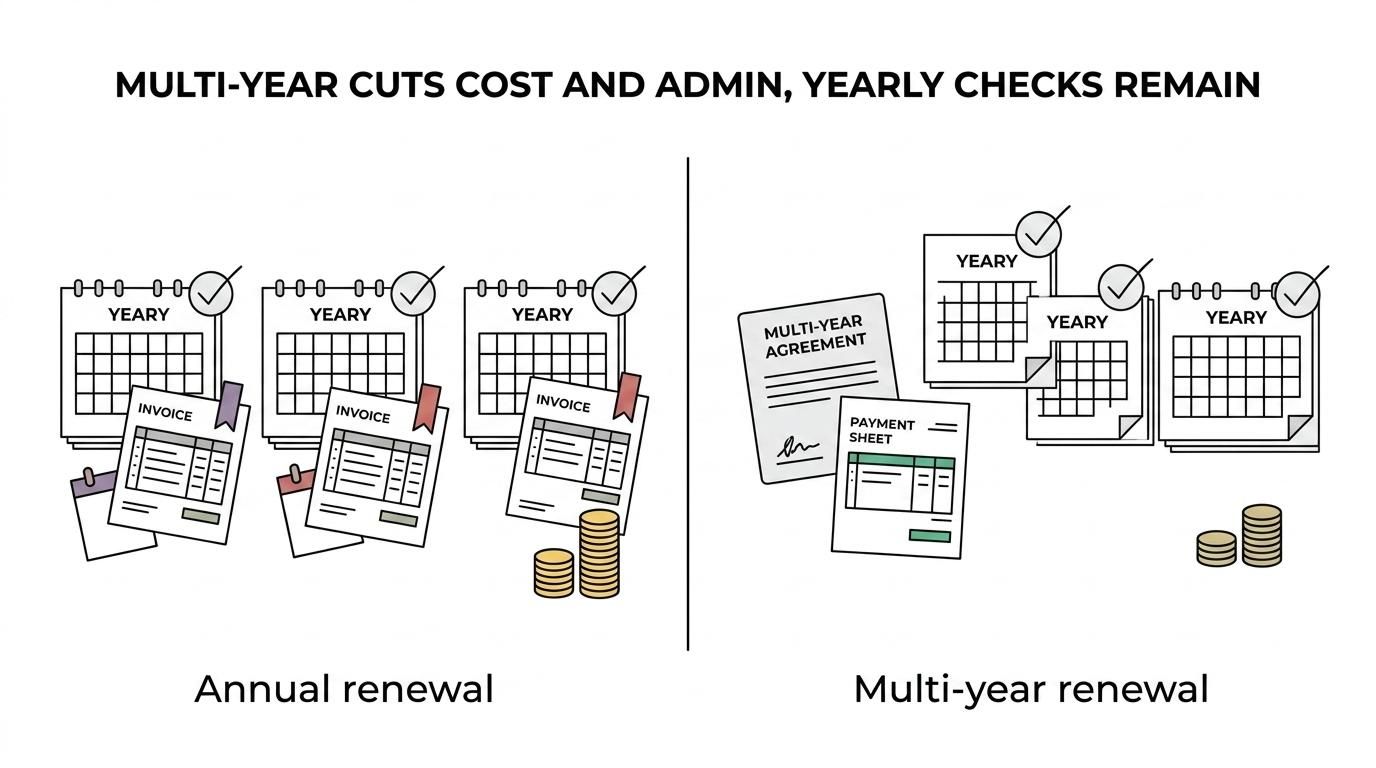
For many organisations, that distinction is extremely useful. It means the budgeting decision and the compliance process are separated. The entity can secure a lower per-year price now, while the issuer or service provider continues to manage the yearly validation cycle in the background, along with updates to reference data where needed.
That is why a good multi-year option is not simply a “prepaid discount”. It should also reduce the chance of a missed next renewal date.
When annual LEI renewal may be the better choice
Annual renewal still suits some entities very well. Flexibility has value, especially where future LEI use is uncertain.
If the organisation is not sure it will still need an LEI beyond the next 12 months, a one-year term may be the cleaner option. The same applies where there may be structural changes, a fund wind-up, a merger, or a shift in trading arrangements that could make the LEI unnecessary later.
Annual renewal often works best in cases like these:
- Shorter planning horizon
- Tighter yearly budgeting
- Possible restructuring
- Uncertain future trading activity
- Internal procurement rules tied to annual approvals
There is also a governance angle. Some organisations prefer to review every vendor relationship once a year, including identifier services. In that setting, a one-year renewal fits internal process even if it is not the cheapest route.
Still, yearly renewal has a trade-off: every new cycle creates another opportunity for delay. A missed approval, a lost email, or a change in staff responsibility can push the LEI into lapsed status.
When multi-year LEI renewal makes more sense
For stable entities, the case for multi-year renewal is often stronger. If the organisation already knows it will need an LEI for several years, the question becomes less about flexibility and more about cost control and administrative certainty.
This is especially relevant for entities with recurring reporting or trading activity, ongoing fund operations, treasury activity, or regular counterparty onboarding. In those settings, continuity matters.
A longer term is often a good fit where these conditions apply:
- Stable LEI need: the entity expects to keep trading or reporting for at least three to five years
- Cost focus: the lower average annual price matters across the full term
- Admin efficiency: finance and compliance teams want fewer purchase approvals and invoices
- Renewal discipline: the organisation wants less exposure to missed dates and manual follow-up
- Support value: the entity prefers a provider that can handle renewals and data maintenance on its behalf
There is a practical benefit here that goes beyond simple savings. Multi-year renewal reduces decision fatigue. Teams do not need to revisit the same low-value administrative task every year, and the LEI remains part of a managed compliance process rather than an item that reappears at the last minute.
For Australian companies, funds, and charities with steady operational needs, that is often the most persuasive argument.
Lapsed LEI status and why timing still matters
A lapsed LEI is not the same as a cancelled LEI. GLEIF makes that clear. The code still exists and remains valid, but its renewal is overdue and the record is behind the expected review cycle.
That distinction matters.
A lapsed status can still create avoidable issues. Counterparties, platforms, and internal compliance teams may treat an overdue renewal as a red flag, even where the identifier itself has not been withdrawn. In practical terms, a lapsed LEI can slow down activity at exactly the wrong time.
GLEIF’s reported renewal data gives useful context. In Q1 2026, the overall LEI renewal rate was 56.6%. That suggests many entities globally are still missing their annual cycle. The problem is common, but common does not mean harmless.
A multi-year term does not guarantee perfect compliance by itself. What it does is reduce one of the biggest causes of lapse: the yearly need to remember, approve, and pay again.
What to check before choosing a multi-year LEI renewal
The best choice becomes clearer when finance, legal, and compliance teams ask a few practical questions together. This is less about theory and more about how the entity actually operates.
A useful short list includes:
- How certain is our future LEI need? If the answer is “very certain”, a longer term usually deserves serious attention.
- Who owns the next renewal date? If there is no clear internal owner, multi-year support can reduce risk.
- Will annual re-validation still be handled properly? This is essential, because the yearly compliance requirement does not go away.
- How often do our entity details change? Name, address, registry details, and ownership data may need updates.
- Is the upfront saving worth it over our planning period? For many entities, the maths is persuasive once viewed across three or five years.
It is also sensible to confirm whether the provider supports ongoing data maintenance and responds quickly when details change. That matters because LEI records are built around current, corroborated information, not just a code on file.
Choosing the best LEI renewal model for cost and compliance
For many entities, the decision is straightforward once the real issue is stated clearly. Annual renewal buys flexibility. Multi-year renewal buys lower average cost and less admin. Neither option removes the need for annual re-validation.
That means the strongest multi-year option is one that combines pricing value with active management of the yearly compliance cycle. Where a provider handles renewal administration, supports updates to LEI reference data, and keeps communication clear, the longer term becomes much more attractive.
For an Australian entity with an ongoing need for an LEI, the five-year price point is especially compelling on pure cost. At A$345 in total, the effective yearly rate falls to A$69, compared with A$97 for a single-year term. That gap is large enough to matter, especially across multiple entities or repeated renewal cycles.
Where the future need is less certain, a one-year renewal may still be the right call. Yet if the LEI is likely to remain part of normal operations, a multi-year term often gives the better mix of economy, continuity, and compliance discipline.