What Documents Do You Need for an LEI Application? (And What to Do If You Don’t Have Them)
Applying for a Legal Entity Identifier can sound like a document-heavy process, especially if you are doing it for the first time or handling it under time pressure for a trade, reporting obligation, or a move away from older identifiers. The good news is that many LEI applications are much lighter on paperwork than people expect.
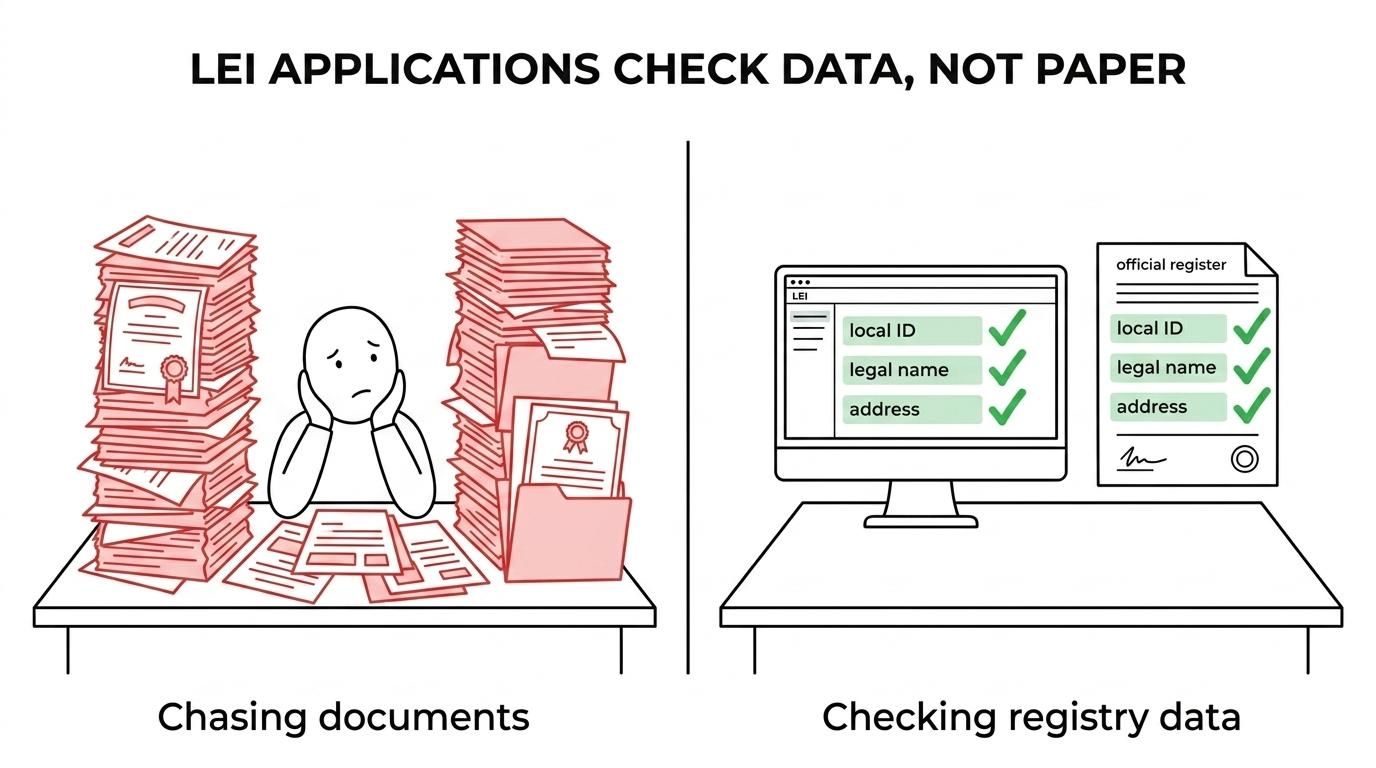
In many cases, the core requirement is not a thick file of certificates and forms. It is accurate reference data about the entity, tied to a local identity number and checked against an official register. If that registry data is available and current, the application may move forward with very little manual evidence from the applicant.
That also means there is a practical answer to the worry behind many first-time applications: what if you do not have all the documents ready? Often, you can still proceed.
LEI application information: what is usually checked
An LEI is built around verified reference data. GLEIF describes this in two layers. Level 1 data identifies the entity itself, while Level 2 data covers parent relationships where those relationships are applicable and reportable.
For many entities, the first layer does most of the work. The issuing organisation checks the registered legal name, local registration details, address, legal form, formation country, and similar registry-backed information. If those details can be retrieved from a local registration authority, the application can be quite direct.
Here is a practical view of what is commonly reviewed.
| LEI application item | What it covers | Usual source | Is a separate document always needed? |
|---|---|---|---|
| Local identity number | Company or entity registration identifier | Official register | No |
| Registered legal name | Exact legal name of the entity | Official register or constituting documents | No |
| Registered address | Legal address on record | Official register | No |
| Headquarters address | Main operating address if different | Entity records or official sources | Sometimes |
| Legal form | Company, fund, charity, trust-related structure, etc. | Official register or constituting documents | No |
| Formation country | Jurisdiction where the entity was created | Official register | No |
| Entity creation date | Date of incorporation or establishment | Official register | Sometimes |
| Direct and ultimate parent details | Accounting consolidation relationships | Group records, financial statements, official sources | Sometimes |
| Authorised contact details | Person handling the application | Applicant input | Yes, as information rather than a formal document |
The main point is simple: an LEI application often depends more on verifiable data than on document uploads.
Core LEI application inputs for Australian entities
For Australian entities, the process usually starts with the local registration number and the details attached to it. Depending on the entity type, that may be an ACN, ABN, ARBN, or another recognised registry identifier. A provider may use that number to pull or confirm data held in the relevant official register.
If the register is clear and current, you may only need to confirm that the information is correct and provide a contact person who is authorised to handle the application.
Typical inputs include:
- local registration number
- registered legal name
- registered office address
- legal form
- formation country
- contact name and email
- parent relationship details, if relevant
This is why many applicants are surprised to learn that the process can begin even when they do not have a folder full of scanned records. Accurate registry-backed details do a lot of the heavy lifting.
Constituting documents in LEI applications
When an official register does not show enough detail, constituting documents may be used instead.
That can apply to structures where the register is limited or where the legal name and status need to be supported by founding documents, rules, deeds, constitutions, or comparable records. Funds, charities, certain trusts, and entities with more specialised legal structures sometimes fall into this category.
When LEI applications need ownership information and parent documents
Level 2 LEI data deals with who owns whom, but only in the accounting consolidation sense used by the LEI system. Not every entity will have reportable parent data, and not every group relationship results in a disclosed parent record.
Where parent information is relevant, the application may ask for the direct parent and the ultimate parent. That information is commonly based on financial reporting relationships rather than a simple shareholder list.
A useful way to think about it is this:
- Direct parent: The lowest-level legal entity that consolidates the applicant into its financial statements
- Ultimate parent: The highest-level legal entity that consolidates the group into its financial statements
- No parent disclosure: Possible where no parent exists, no consolidation applies, or an accepted exception is available
In some cases, support may be requested to verify the ownership structure or explain why parent data is not reported. That does not always mean you need a large pack of evidence. It may mean confirming the group structure, providing the relevant parent names, or pointing to published financial statements.
What to do if you do not have the documents ready
This is where many LEI applications become easier than expected. If you do not have the certificate of registration, incorporation papers, or old onboarding records at hand, start with the data that is easiest to verify: the local identity number and the entity’s exact registered name.
If your organisation is listed in an official register, the provider may be able to retrieve the reference data from there. GLEIF recognises this approach, and it is one reason many applications do not require a full manual evidence pack.
If you do not have an ACN immediately available, that may not stop the process either. Some providers can continue without a registry lookup at the first step and use other registration information or manual checks to locate the entity. This is especially helpful where internal records are incomplete or the person applying is not from the legal or company secretarial team.
A practical starting checklist helps keep things moving:
- Check the entity’s exact legal name in the official register
- Find any local registration number available
- Confirm the registered address is current
- Identify whether the entity has a direct or ultimate parent
- Gather any trust deed, constitution, or formation document if the register is limited
- Contact the LEI provider early if the structure is unusual
If the official record is outdated, fix that issue as early as possible. LEI data is intended to reflect reality, and stale registry details can slow verification.
Common situations where extra LEI evidence may be requested
Most straightforward applications are resolved through register checks and applicant confirmations. Still, some situations need extra attention.
One common example is a mismatch between the name used in day-to-day business and the legal name held in the register. An LEI is issued to the legal entity, not to a trading name, desk name, or brand label. If internal teams are using the wrong name, the application can stall until the legal identity is confirmed.
Another example is a recent corporate change. A new address, a restructure, a merger, or a legal name change may not yet appear cleanly across all public and internal records. In that case, a provider may ask for a current extract or supporting document to bridge the gap.
These are the kinds of cases that often trigger follow-up questions:
- Recent name change: Registry data and internal records do not yet match
- Trust or fund structure: The official register alone does not fully identify the legal entity
- No public registry record: Manual verification is needed through constituting documents or comparable evidence
- Parent relationship exception: The applicant needs to state why Level 2 parent data is not reported
- Authorised applicant check: The provider needs confirmation that the contact is allowed to act for the entity
None of this should be read as a sign that the application is in trouble. It usually means the verifier is trying to keep the LEI record accurate, which is exactly what the system is designed to do.
How to make an LEI application faster and easier
The quickest path is to treat the LEI application as a data verification exercise, not a paperwork exercise. Start by checking the entity’s legal name, registration number, and address against the official record before you submit anything. Small spelling differences, old addresses, and missing parent information create a surprising number of delays.
It also helps to choose a provider that handles registry checks, data maintenance, and applicant support rather than leaving the applicant to work out every field alone. Some providers, including LEI Service Australia, offer same-day issuance for complete orders lodged before the daily cut-off, along with assistance by phone and email, support for renewals and transfers, and help even where registry lookup is not available at the first step.
If your organisation is applying for several entities, a bulk approach can save time as well. Group structures, repeating contact details, and shared parent data are easier to manage when handled together instead of one entity at a time.
LEI data accuracy matters more than document volume
A successful LEI application is usually built on two things: a reliable local identifier and accurate reference data. That is why the most useful preparation is often not scanning more files, but making sure the official record is current and the group structure is clear.
When that information is available, many entities can apply with far less paperwork than they expected. When it is not, the next step is usually not to stop, but to identify which missing detail can be confirmed through the register, constituting documents, or a quick check with the provider.
That shift in mindset makes the process far more manageable. Instead of asking, “Do we have every document?”, the better question is, “Can the entity’s legal identity and ownership information be verified clearly enough for the LEI record?” In a large share of cases, the answer is yes.