What Happens to an LEI After Company Deregistration?
When an Australian company is deregistered, the legal change is blunt and immediate: the company no longer exists as a legal entity. That point is clear under ASIC guidance, and it often prompts a practical follow-up question for directors, fund managers, finance teams, and advisers.
What happens to the LEI?
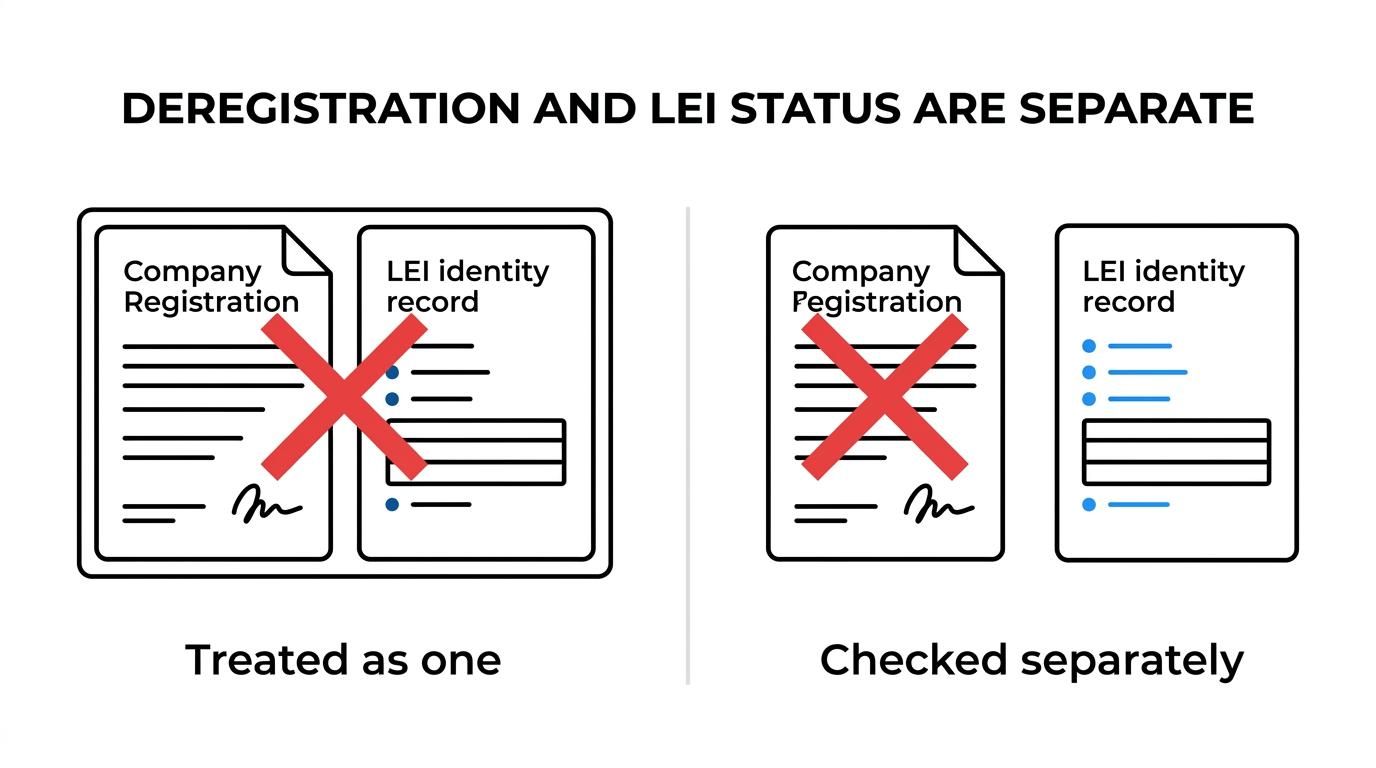
The answer is less dramatic than many expect. A deregistered company does not keep operating just because an LEI record still appears online, and an LEI does not vanish the moment ASIC deregisters the company. Those are two different systems describing two different things. ASIC records the company’s legal existence in Australia. GLEIF and the LEI data network record the identity history and status of the entity within the global LEI framework.
That distinction matters when a company has traded internationally, reported to counterparties, or used an LEI for financial transactions before deregistration.
Australian company deregistration and legal entity status
ASIC states that a deregistered company no longer exists as a legal entity. In plain terms, the company is no longer registered and cannot continue as though it were still on the register.
A company may be deregistered after liquidation, through voluntary deregistration, or through ASIC-initiated deregistration. Each path has its own process, though the end result is the same in legal terms: the company ceases to exist.
This is the starting point for any LEI discussion. An LEI is issued to a legal entity. So when the company is deregistered, the legal foundation behind that LEI has changed in a major way.
Still, the LEI framework is designed to preserve public reference data over time. That is why the LEI record does not simply disappear from view when the company is no longer registered.
Why LEI deregistration status and company deregistration are different
An LEI is not a licence to trade, and it is not a substitute for ASIC registration. It is a global identifier tied to reference data about a legal entity. That reference data can continue to exist in public records even after the underlying entity becomes inactive or ceases to be legally registered.
GLEIF’s LEI Search system makes this easy to see. It allows anyone to search the global LEI data pool free of charge. For each record, the system can show items like Entity Status, Registration Status, Next Renewal, and Change History.
This means there are really two questions at once:
| Question | Australian legal answer | LEI data answer |
|---|---|---|
| Does the company still legally exist? | ASIC says a deregistered company no longer exists as a legal entity. | The LEI record may still remain visible in the global database. |
| Is the LEI current? | ASIC does not decide LEI renewal status. | GLEIF data shows whether the LEI registration is current, lapsed, or otherwise updated. |
| Does a visible LEI mean the company is active? | No. Legal existence depends on company registration status. | No. A visible LEI record is not proof that the entity is active. |
| Does a lapsed LEI mean the company is deregistered? | No. | No. LAPSED refers to renewal verification, not legal existence. |
That separation clears up a very common misunderstanding. People often assume that a visible LEI equals an active business, or that a lapsed LEI proves the entity is defunct. Neither assumption is reliable.
How GLEIF shows a deregistered company in LEI data
When a company is no longer legally registered or operating, GLEIF’s data dictionary indicates that the Entity Status can be marked as INACTIVE. This field speaks to the legal and operational state of the entity.
Registration Status is different. GLEIF explains that LAPSED means the LEI is due for renewal and has not been verified within the planned interval. It does not mean the entity is inactive.
That distinction is easy to miss if someone looks only at the headline status on a screen and does not read the record properly.
After a paragraph review of the record, these are the fields that usually matter most:
- Entity Status: whether the legal entity is shown as ACTIVE or INACTIVE
- Registration Status: whether the LEI record is current from a renewal and verification perspective
- Next Renewal: the date when the next verification cycle falls due
- Change History: the trail of updates made to the public LEI record
A deregistered Australian company will usually be assessed through the Entity Status lens, not just the renewal lens. In other words, the legal cessation of the company is reflected in the entity-related data, while the LEI’s renewal condition remains a separate data point.
What INACTIVE means for an LEI record
GLEIF defines INACTIVE as a legal entity that is no longer legally registered and/or operating. For a deregistered company, this is the field that most closely matches the ASIC position.
That does not mean the identifier becomes invalid history or disappears from public view. It means the LEI record reflects that the entity behind it is no longer active in a legal or operating sense.
Timing can matter here. The LEI record may need to be updated by the managing issuer once the change in legal status is confirmed through available documentation or registry information. So there can be a gap between the ASIC event and the refreshed LEI display.
What LAPSED means for an LEI record
GLEIF is explicit on this point: LAPSED does not mean the entity is inactive.
It simply means the LEI has not been renewed and verified within the intended cycle. A company can be active and have a lapsed LEI. A company can also be deregistered and still have a record that is not best described by LAPSED alone.
This matters for counterparties, compliance teams, and operations staff. If someone is reviewing a deregistered entity, they should not rely on LAPSED as the signal that the company has ceased to exist.
Does an LEI disappear after company deregistration?
Usually, no.
The LEI system is built around transparency, identity continuity, and accessible reference data. Public records continue to have value even after an entity has ceased operating, entered liquidation, merged, or been deregistered. Historical transaction records, reporting files, onboarding records, and counterparty checks can all depend on that continuity.
So the better way to think about deregistration is this: the entity’s legal state changes, and the LEI record should reflect that change within the GLEIF data structure. The record is not reborn as a new identifier merely because the company has been deregistered.
That point is especially useful in legacy data environments. Institutions may have years of records tied to one LEI. If deregistration automatically created a new identity footprint, the audit trail would become much harder to follow.
GLEIF’s data dictionary also includes fields related to successor entities. That tells you something important about the design of the system. It is meant to preserve relationships and status changes over time, not erase them.
What organisations should check after an LEI company deregistration event
Once deregistration occurs, the first priority is accuracy. Internal records, counterparty records, and the public LEI record should not be left to drift apart.
A practical review often starts with the ASIC status and then moves to the LEI record in GLEIF Search. That lets teams compare the legal position with the published LEI data and spot whether updates are still pending.
Useful actions include:
- Confirm the ASIC outcome: voluntary deregistration, liquidation-related deregistration, or ASIC-initiated deregistration
- Review the LEI record: check Entity Status, Registration Status, Next Renewal, and Change History
- Notify the relevant LEI service contact: provide supporting details if the public data needs updating
- Retain evidence for counterparties: registry extracts, deregistration notices, and transaction records
- Short internal note for finance and compliance teams
- Counterparty outreach where open trades or reporting lines still exist
- Review of any standing references to the company in onboarding files
For many organisations, this is less about filing a brand-new LEI request and more about managing the existing record properly. A service provider that handles LEI updates, renewals, or transfers can help keep the published reference data in step with the legal reality.
What happens if the deregistered company is later reinstated?
ASIC says a reinstated company is registered once again and is treated as if it was never deregistered. That is a powerful legal effect, and it has obvious implications for the LEI record.
If the company comes back onto the register, the sensible next step is to review the existing LEI record before assuming anything new is required. In many cases, the key issue will be updating the existing public data so that the record matches the reinstated legal status.
ASIC states that only certain people can apply for reinstatement. That group can include:
- former directors
- former secretaries
- former members
- liquidators
- aggrieved third parties
From an LEI perspective, reinstatement is a reminder that corporate status can change more than once across the life of an entity. The LEI framework is meant to record those changes, not replace the entity’s identity each time a legal event occurs.
How to read a deregistered company’s LEI record with confidence
When someone searches an LEI after deregistration, they should read the full record rather than fixating on a single label. A clear review usually answers four separate questions:
Is the company still legally in existence under Australian law?
What is the Entity Status in the LEI data?
What is the Registration Status of the LEI?
When was the record last updated, and what does the Change History show?
That full view is much more reliable than relying on one status word in isolation.
A deregistered company in Australia has ceased to exist as a legal entity. Its LEI record, though, may remain publicly visible and may continue to carry historical and reference value. If the record later shows INACTIVE, that speaks to the legal or operating state of the entity. If it shows LAPSED, that speaks to overdue renewal verification and nothing more.
For finance teams, trustees, charities, funds, and corporate groups, that distinction makes LEI management far more straightforward. It turns a confusing status check into a simple rule: start with the legal entity position, then read the LEI record on its own terms.