Who Can Authorise an LEI Application for a Company?
An LEI application is made for the company, yet a real person still has to stand behind the request. That is where many Australian entities pause. Who exactly is allowed to authorise the application, and what happens if the person filling in the form is not a director?
The short answer is clear. For an Australian company, the strongest and cleanest authority usually comes from a director or a company secretary. A person with documented company authority may also be accepted, and a third party can often lodge the application if there is clear evidence that they are acting on the company’s instructions.
This area sits at the meeting point of LEI rules and Australian company authority rules. It is practical rather than mysterious, and once the roles are separated properly, the application process becomes much easier to manage.
LEI application authorisation in Australia
An LEI, or Legal Entity Identifier, belongs to the legal entity, not to an individual. In GLEIF’s framework, registration is based on self-registration. That does not mean the director must personally type every field into the form. It means the registering entity is responsible for providing accurate legal entity reference data to the LEI issuer.
That distinction matters. A company can apply through an employee, adviser, administrator, or specialist LEI service provider, while the authority still comes from the company itself. The practical question is not “Who clicked submit?” It is “Who had the right to authorise the company’s request?”
For Australian companies, the answer usually rests on ordinary company authority principles. Formal authority can be shown by the company’s officers, and operational authority can also come from a person acting with the company’s express or implied authority.
Who can sign an LEI application for an Australian company
The most reliable signatories are the people whose authority is already visible from the company’s governance structure. A current director is the obvious example. A company secretary is also a strong choice. In many cases, those roles let the LEI issuer quickly connect the application to someone who appears to have proper corporate authority.
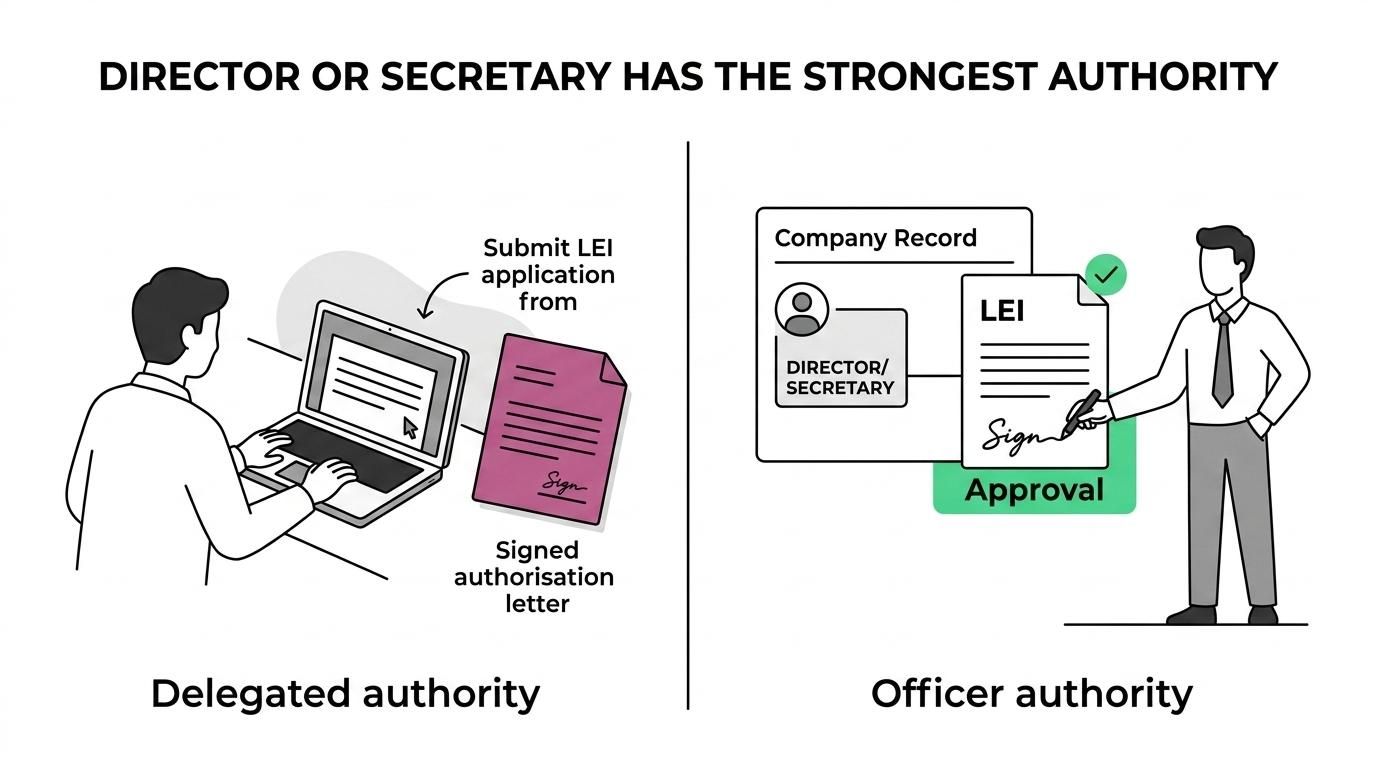
That said, the list does not stop there. A company may authorise another person to act on its behalf, including a senior employee, an external adviser, or an administrator. What changes is the evidence expected. When the person lodging the application is not an obvious officer of the company, written proof becomes far more important.
| Role | Basis for authority | Likely acceptance level | Common proof |
|---|---|---|---|
| Director | Corporate office held by the company | Very strong | Company register details, ASIC records, identity checks if requested |
| Company secretary | Corporate office held by the company | Very strong | Company register details, ASIC records, identity checks if requested |
| Sole director | Statutory authority in the permitted sole-director structure | Strong | Company records showing sole director status |
| CEO or senior executive | Express internal authority | Moderate to strong | Letter of Authorisation, board approval, internal delegation |
| Employee in finance, legal, treasury, compliance | Express or implied authority | Moderate | Written delegation, instruction from director/secretary |
| Accountant, lawyer, corporate services provider | Agent acting for the company | Moderate | Signed authority letter, power of attorney, signatory email confirmation |
| Administrator or other appointed representative | Appointment or formal authority | Moderate to strong | Appointment documents, signed authorisation |
Why directors and company secretaries are the strongest LEI signatories
Australian company law gives a useful starting point. A company may execute documents without a common seal through the signatures of two directors, or a director and a company secretary, or a sole director in the permitted sole-director case. Even when an LEI form is not treated exactly like a formal deed or contract, these execution rules still reflect the strongest evidence of corporate authority.
That is why a director or company secretary is usually the easiest path. The LEI issuer or registration agent can more readily see that the person is connected to the company and is likely to have the right to confirm the entity’s legal name, registered details, and other reference data.
Where speed matters, this can make a real difference. Missing or uncertain authority is a common reason applications pause for manual review.
A few indicators usually make the position stronger:
- Officer role visible: The signatory is a current director or company secretary in up-to-date company records.
- Details match: The company name, registration details, and signatory information are consistent across the application.
- Direct confirmation: The signatory can respond to follow-up questions from the LEI provider or issuer.
- Written evidence ready: Any authority document can be produced quickly if requested.
Can an employee or adviser lodge an LEI application for a company?
Yes, often they can.
Australian law also recognises that a company’s power to make or vary contracts, or execute documents, may be exercised by an individual acting with the company’s express or implied authority and on behalf of the company. In practical LEI terms, that means a company does not always need a director to be the person entering the application.
A treasury manager may be told to arrange the LEI. An accountant may handle renewals each year. A law firm may lodge the application during a transaction. A funds administrator may coordinate LEI data maintenance for multiple entities. All of those situations can be workable if the company’s authorisation is clear.
The risk appears when the applicant and the signing authority are blurred together. Many LEI forms now separate those two roles on purpose. The applicant may be the person doing the admin, while the signing authority is the person whose corporate authority supports the request. If those roles are not documented properly, the application can slow down.
Common examples include:
- finance staff preparing the form
- an external accountant handling annual renewals
- a legal adviser lodging the request during onboarding
- a company administrator managing a portfolio of entities
Documents accepted to prove LEI signing authority
Where the signatory is not obviously a director or company secretary, the next question is simple: what document shows that the company approved this person to act?
A Letter of Authorisation is often the cleanest answer. A power of attorney may also be accepted, especially where an external service provider or adviser is acting across multiple company matters. Some providers also accept direct confirmation from the company’s signing authority, depending on the situation and the entity type.
The point is not paperwork for its own sake. It is making the authority trail easy to verify.
- Letter of Authorisation: A signed company letter stating that the named person may apply for, renew, or manage the company’s LEI.
- Power of attorney: Useful where an external representative is formally appointed to act on the company’s behalf.
- Board or internal approval: Helpful where authority has been delegated to a senior employee.
- Signing authority email confirmation: Sometimes accepted where the form allows the authorised officer to confirm directly.
How to prevent LEI application delays caused by missing authority
A delayed LEI application often has little to do with the company’s eligibility and a lot to do with the evidence trail. If the entity details are correct but the authority is thin, the issuer may ask for clarification before issuing the code.
That is avoidable in most cases. The best approach is to decide first who the signing authority is, then decide who will actually complete the application. If those are two different people, make that visible from the start.
A smooth file usually follows a simple pattern:
- Identify the company officer or other person with actual authority.
- Confirm whether the applicant is the same person or an agent acting for them.
- Gather supporting authority documents before submission.
- Check the legal entity reference data carefully.
- Respond quickly if the LEI issuer asks for verification.
This matters even more when a company is moving from another identifier arrangement, entering regulated trading, or working to a tight settlement timetable.
Special cases in company LEI authority: sole directors, agents and trustee companies
A sole director company can usually authorise the LEI application through that sole director where the company structure fits the permitted statutory position. In practice, that is often a straightforward case because the authority sits with one clearly identifiable officer.
Corporate groups can be slightly more involved. A parent company officer is not automatically the right signatory for every subsidiary’s LEI application. Each company is its own legal entity. The authority should link back to the specific company receiving the LEI, even if group staff are managing the process centrally.
Trustee structures need care too. If a company acts as trustee of a trust or fund, the LEI application still needs to identify the legal entity that is actually being registered. That may be the trustee company itself, depending on the use case and the relevant market requirement. The signatory must have authority for that company, not just a general connection to the broader structure.
What the authorised person confirms in an LEI registration
Authorising an LEI application is not just a box-ticking exercise. The authorised person is effectively standing behind the accuracy of the company’s reference data.
That can include the legal name, registered address, registration authority details, entity status, and in some cases ownership or parent relationship data. GLEIF makes LEI records publicly searchable, so accuracy matters well beyond the application stage.
This is why companies should treat the LEI as part of their governance data set, not as a one-off form. If the company changes name, address, legal status, or corporate structure, the LEI record may need updating as well.
When the applicant is not the signing authority
This is very common, especially in larger organisations and in professional service environments.
An application may be prepared by an operations team member while the authority sits with a director. A specialist LEI provider may handle the entire filing, renewal, or transfer process while the company officer confirms approval. Some application flows even ask directly whether the person filling in the form is the signing authority and, if not, invite the applicant to provide the authorised person’s email or upload a power of attorney.
That split can actually make the process easier. It lets the company keep control of authorisation while delegating the admin work to the people who manage deadlines and data. Where support is needed, LEI Service Australia offers assisted registrations, renewals, transfers, and ongoing data maintenance, with English-speaking support by phone and email. For companies working to a trading deadline, that kind of structured support can help keep the authority trail clear while moving the application through quickly.
The strongest practical rule is simple: let the company officer provide the authority, and let the operational team or adviser handle the mechanics only when that authority is documented properly.